
Tsinghua's OMNIFLOW Forces Gemini 3 Flash to Forecast Weather Without Hallucinating Physics
A new neuro-symbolic framework wraps frozen multimodal LLMs in physics-aware reasoning loops, matching specialized weather models without any fine-tuning.
 Pro
Takeaways
- OMNIFLOW grounds frozen multimodal LLMs in physics without any fine-tuning of model weights.
- Architecture couples a diffusion-based Neural Earth Simulator with Gemini 3 Flash as the cognitive core.
- A physics critic forces rollback whenever reasoning steps violate mass or momentum conservation laws.
- Beats EarthFarseer, GraphCast baselines on ERA5 with SSIM 0.931 and RMSE 0.552.
- Doubles structural similarity versus monolithic image models like ChatGPT-Images on zero-shot forecasting.
- Code released at github.com/Alexander-wu/OMNIFLOW; latency and simulator bias remain open limitations.
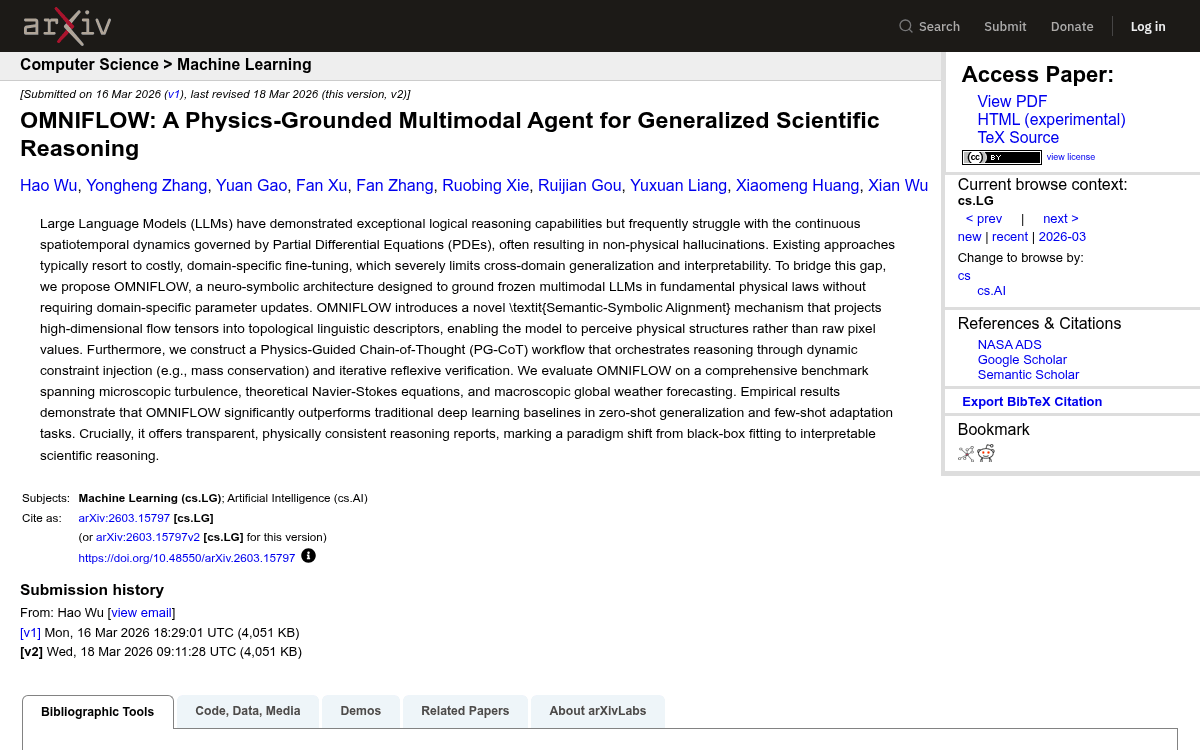
A team of researchers from Tsinghua University, Tencent, and several other institutions has released OMNIFLOW, a neuro-symbolic agent framework that tries to solve one of the more embarrassing failure modes of modern vision-language models: they can describe a hurricane beautifully, but when asked to forecast one, they hallucinate physics that would make a fluid dynamicist wince.
The paper's core claim is that you do not need to fine-tune a foundation model to make it reason about partial differential equations. Instead, you wrap a frozen LLM (in this case Gemini 3 Flash) in an architecture that handles the numerics separately and forces the language model to reason inside a cage of hard physical constraints.
The hallucination problem in scientific forecasting
Large Language Models have demonstrated exceptional symbolic reasoning, code generation, and mathematical problem-solving capabilities, but the authors argue they fall apart on continuous spatiotemporal dynamics. When applied to the physical world governed by Partial Differential Equations, particularly systems involving continuous spatiotemporal dynamics such as turbulence evolution or global weather forecasting, LLMs often exhibit significant limitations.
Two workarounds have dominated the field, and both have real problems:
- Specialized surrogate models like FNO or GraphCast are accurate but behave as pure data fitters with no interpretability and poor cross-domain generalization.
- Fine-tuning LLMs on scientific data is expensive, causes catastrophic forgetting of general capabilities, and still fails to guarantee strict adherence to physical conservation laws, such as mass or momentum conservation.
The authors' bet is that the LLM already knows enough physics from pretraining. What it lacks is a way to see fluid data properly and a mechanism that stops it from producing outputs that violate conservation laws.

How the dual-cycle architecture works
OMNIFLOW is organized as three interconnected modules built around Gemini 3 Flash as the cognitive core. The system decouples numerical simulation from linguistic reasoning, then stitches them back together with retrieval and verification loops.
- Physics Perception Loop. A Neural Earth Simulator, built as a latent diffusion model, generates ensemble forecasts by injecting Gaussian noise into latent embeddings. A Visual Symbolic Projector then converts those raw tensors into what the authors call topological linguistic descriptors, so the LLM perceives structures like vortices and shear lines rather than raw pixels.
- Agentic Reasoning Core. Gemini 3 Flash runs a ReAct loop with three actions available: retrieve knowledge, simulate scenarios, or reason. A physics critic validates every reasoning step against conservation laws. If mass conservation is violated, the model backtracks to prune non-physical branches in the search tree, ensuring grounding in physical reality.
- Knowledge Retrieval Loop. A stratified vector database holds three tiers: axiomatic physics like Navier-Stokes, operational protocols, and historical event reports. The agent queries these via standard maximum inner product search during reasoning.
The clever piece is what the authors call counterfactual active probing. When the ensemble spread exceeds a threshold, the agent formulates hypotheses like "what if the subtropical high pressure were weaker," translates them into perturbed initial conditions, and re-runs the simulator. Comparing counterfactual and factual outcomes gives a causal sensitivity score that the LLM can reason over.

The numbers on turbulence, weather, and radar
The team evaluated OMNIFLOW on three benchmarks of increasing scale: 2D Turbulence for PDE adherence, ERA5 for global weather, and SEVIR for regional radar. The comparison is against a mix of vision backbones, spatiotemporal predictors like ConvLSTM and SimVP, and specialized scientific operators including FNO and EarthFarseer.
On the 2D Turbulence task, OMNIFLOW maintains high structural fidelity (SSIM of 0.715) and a competitive RMSE, which the authors credit to the reflexive loop actively pruning trajectories that break conservation laws. On ERA5, it hits RMSE 0.552 and SSIM 0.931, beating EarthFarseer and specialized meteorological models on a training-free basis.
The more striking result is the head-to-head against monolithic image generation foundation models. When asked to zero-shot forecast in pixel space, models like ChatGPT-Images, Banana Pro, and Seedream 4.5 produce RMSE values above 90 on ERA5, while OMNIFLOW scores 59.10. The SSIM gap is roughly double.

What is actually new here
The real contribution is not another weather model. It is a recipe for making frozen multimodal LLMs behave scientifically without touching their weights. Three ideas stand out:
- Semantic-Symbolic Alignment projects continuous flow fields into physically meaningful tokens using learnable queries and a contrastive alignment objective, so the LLM stops treating fluid imagery like a natural photograph.
- Physics-Guided Chain-of-Thought injects hard constraints like mass conservation into the reasoning trace, with a critic that forces rollback on violation.
- Counterfactual probing turns the LLM from a passive observer into an active experimenter that queries its own simulator to test causal hypotheses.
The output is also different in character. Instead of a raw tensor prediction, OMNIFLOW produces a structured analysis report with an executive summary, quantitative statistics, spatial interpretation, and actionable alerts, all traceable back to retrieved protocols.
Where the approach breaks down
The authors are candid about the limits. The reflexive loops and counterfactual probes add real inference latency compared to end-to-end models, which is a problem if you want real-time deployment. Reasoning quality is also bounded by the fidelity of the underlying diffusion simulator: any bias there propagates through the chain. And extremely fine-grained sub-grid dynamics remain hard to capture with linguistic descriptors.
The code is available on GitHub, and the full paper includes the report template, hyperparameters, and ablations. For anyone building scientific reasoning agents, it is a useful blueprint for how to compose diffusion simulators, retrieval, and frozen LLMs into something that behaves more like a domain expert and less like an overconfident chatbot.