
Tsinghua's MIND-V Beats Every Robot Video Model by 172% on Long Tasks
A hierarchical world model turns long-horizon robot instructions into physically plausible videos, boosting policy success from 27.7% to 43.5%.
 Pro
Takeaways
- MIND-V is a hierarchical video world model for long-horizon robotic manipulation.
- Three-tier design: Gemini 2.5 Pro plans, a structured Behavioral Semantic Bridge translates, a CogVideoX-5B backbone renders.
- GRPO post-training uses V-JEPA2 as a physics referee via a Physical Foresight Coherence reward.
- Staged Visual Future Rollouts run propose-verify-refine at each subtask, with K=3 as the sweet spot.
- On long-horizon tasks, task success rises 76.7% and user preference 172.2% over the next-best method.
- Downstream policy training on MimicGen improves from 27.7% base to 43.5% with MIND-V rollouts as supervision.
Training robots is bottlenecked by data. Collecting hours of manipulation demonstrations is slow, expensive, and rarely covers the tail of long, multi-step tasks. Video world models promise a way out: if you can generate photorealistic robot videos on demand, you can train policies on synthetic experience. The problem is that today's video generators either drift semantically over long horizons or need heavy manual scaffolding like hand-drawn trajectories and object masks.
A new system called MIND-V, from Tsinghua University and collaborators, takes a different route. It splits video generation into a planning brain and a rendering body, aligns the renderer to physics using reinforcement learning, and searches over candidate futures at test time. On long-horizon benchmarks, MIND-V surpasses the second-best method by 9.0%, 76.7%, and 172.2% on PFC Score, Task Success Rate, and User Preference, respectively.
Why long-horizon robot video is so hard
Fine-tuning a video foundation model on robot data usually produces clips that look plausible for a few seconds and then fall apart. Baseline models exhibit critical failure modes including logical hallucinations, physical implausibility such as spontaneous object disappearance, and inaccurate semantic grounding. Trajectory-guided generators fix some of this by feeding the model explicit motion paths and object masks, but those annotations have to come from somewhere, which kills scalability.
The authors frame the problem as three separate failure modes that need to be solved together:
- Long-horizon coherence: keeping causal consistency across a chain of subtasks.
- Semantic-to-pixel grounding: turning an abstract instruction like
clean the desktopinto the right pixel-level interaction. - Physical plausibility: respecting collisions, object permanence, and contact forces.
A three-tier cognitive stack
MIND-V borrows a metaphor from human motor control: the cortex plans, the cerebellum executes, and specialized pathways translate between them. That maps to three modules.
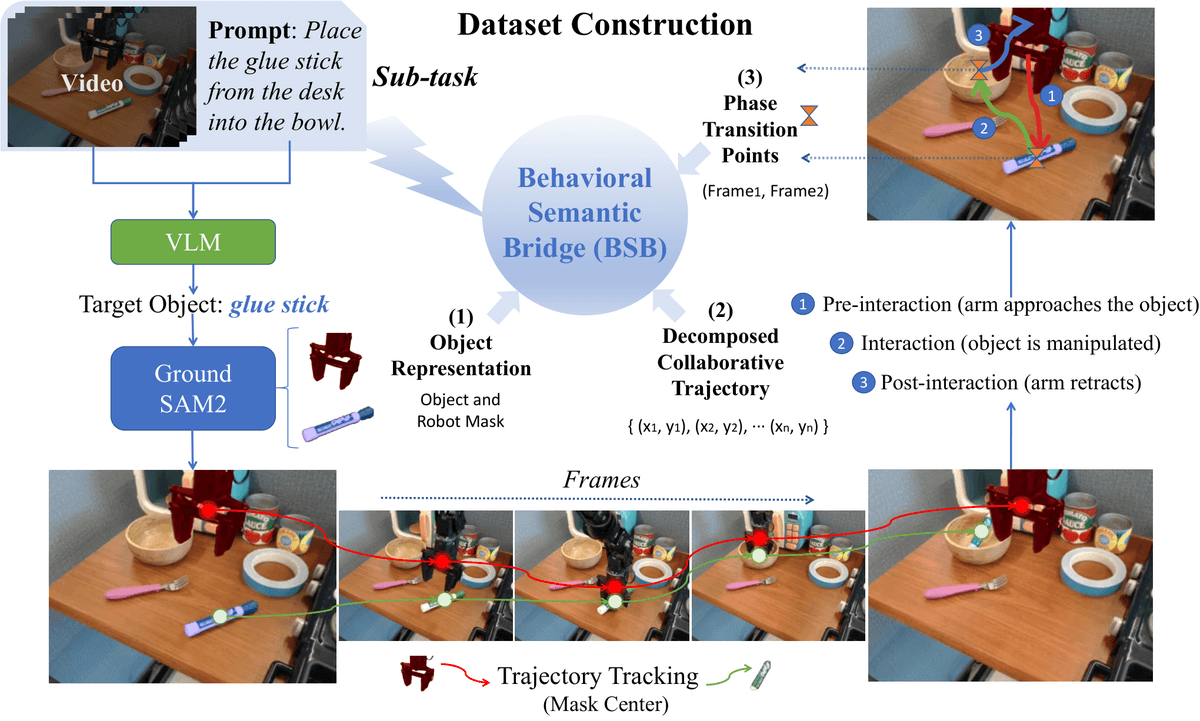
The Semantic Reasoning Hub (SRH) handles planning. Given an initial observation and a long-horizon instruction, the VLM decomposes the task into an ordered sequence of atomic subtasks, each defined by a tuple specifying the action primitive, manipulation target, and goal location. It uses Gemini 2.5 Pro for reasoning and an affordance localizer to find grip points and segmentation masks.
The Behavioral Semantic Bridge (BSB) is the intermediate representation, and it is the trick that makes this architecture work. Instead of passing raw text to the video model, the BSB packages three structured signals:
- Segmentation masks for the manipulated object and the robot arm.
- A trajectory split into three phases: pre-interaction (arm approach), interaction (object manipulation), and post-interaction (arm retraction).
- Phase transition frame indices that allocate duration to each phase.
Because the BSB describes motion abstractly rather than in pixels, it generalizes across scenes. By decoupling task logic from visual appearance, the BSB achieves domain invariance, enhancing generalization to novel environments and tasks.
The Motor Video Generator (MVG) is the renderer. It is a Diffusion Transformer initialized from CogVideoX-5B and modified to accept the BSB as conditioning. The BSB is rasterized into a spatiotemporal guidance tensor that embeds the active agent's visual features along its planned path, then fused into every other DiT block during denoising.
Using V-JEPA2 as a physics referee
Supervised fine-tuning gets you a model that follows instructions but still hallucinates physics. To fix that, MIND-V adds a GRPO reinforcement learning stage with a novel reward called Physical Foresight Coherence (PFC).
The idea: use Meta's V-JEPA2, a self-supervised video model that has learned dynamics in latent space, as a judge. For each generated clip, PFC runs a sliding window that asks V-JEPA2 to predict the next latent state from context, then compares that prediction to the actual next frames using cosine similarity. Windows with worse physics get weighted more heavily via a softmax, so optimization focuses on the worst violations.
The full reward mixes physics with an aesthetic score from a VLM, weighted w_p = 0.2 and w_a = 1.0. GRPO samples groups of 8 candidate videos per prompt, normalizes rewards within each group, and updates the policy with a clipped objective plus KL regularization to the SFT model.
Test-time search over futures
Even a physics-aligned model drifts over multi-step tasks. MIND-V adds Staged Visual Future Rollouts, a test-time strategy that treats each subtask boundary as a decision point. The SRH proposes K semantically diverse plans, the MVG renders each into a short clip, and the VLM scores them on task success, physical plausibility, and visual quality.
If the best candidate clears a threshold, the pipeline commits and moves on. Otherwise, the VLM returns structured feedback (for example, end position error) and the SRH re-plans. Ablations show K=3 is the sweet spot: task success jumps from 35.2% at K=1 to 61.3% at K=3, then plateaus, while VRAM nearly doubles going from K=3 to K=5.
Numbers on Bridge V2 and MimicGen
Experiments are conducted on the Bridge V2 dataset with a resolution of 480x640 pixels and 37 frames per subtask. Training runs on four H200 GPUs, with 30,000 SFT steps followed by 1,500 GRPO iterations. At inference time, generating a 111-frame long-horizon video spanning three subtasks requires approximately 50 GB of VRAM. Peak memory stays constant regardless of how many subtasks you chain, because the autoregressive design reuses memory across subtasks.
Against autonomous world model baselines like DreamDojo, RoboDreamer, WoW-1-Wan-14B, HunyuanVideo, and vanilla CogVideoX-5B, MIND-V leads on every long-horizon metric:
| Method | PFC Score | Task Success | User Preference |
|---|---|---|---|
| Dreamdojo | 0.424 | 0.333 | 18% |
| WoW-1-Wan-14B | 0.420 | 0.347 | 14% |
| HunyuanVideo | 0.411 | 0.098 | 1% |
| MIND-V | 0.462 | 0.613 | 49% |
The more interesting test is downstream policy learning. The team fine-tuned OpenVLA-OFT on three MimicGen tasks (Coffee, StackThree, Square), then continued training with a visual goal derived from MIND-V rollouts as extra supervision. MIND-V guidance raises the mean success rate from 27.7% (Base) to 43.5%, substantially exceeding the 33.4% achieved by IL continuous training. That 10-point gap over plain imitation learning is the real payoff, because it shows the synthetic videos carry information the policy can actually use.
Where it breaks
The propose-verify-refine loop is not free. Every subtask transition runs K rollouts in parallel, so wall-clock time and VRAM scale with K. The authors argue this beats the manual cherry-picking baseline methods rely on, but it is a real cost for anyone deploying at scale.
The bigger fragility is upstream: if the affordance localizer picks the wrong grip point, the error cascades through the entire subtask. MIND-V mitigates this with a VLM fallback that infers coordinates and feeds them as point prompts to a segmentation model, but the failure mode is inherent to any hierarchical system where the planner and renderer are decoupled.
One practical note for anyone wanting to reproduce this: the paper does not link to a public code release. Anyone wanting to build on MIND-V will need to reimplement the BSB pipeline and the PFC reward on top of an existing DiT backbone.