
Tsinghua's LottieGPT Beats Sora and Veo 3.1 at Vector Animation
A new CVPR 2026 model tokenizes Lottie JSON files and fine-tunes Qwen2.5-VL to generate editable vector animations from text or images.
 Pro
Takeaways
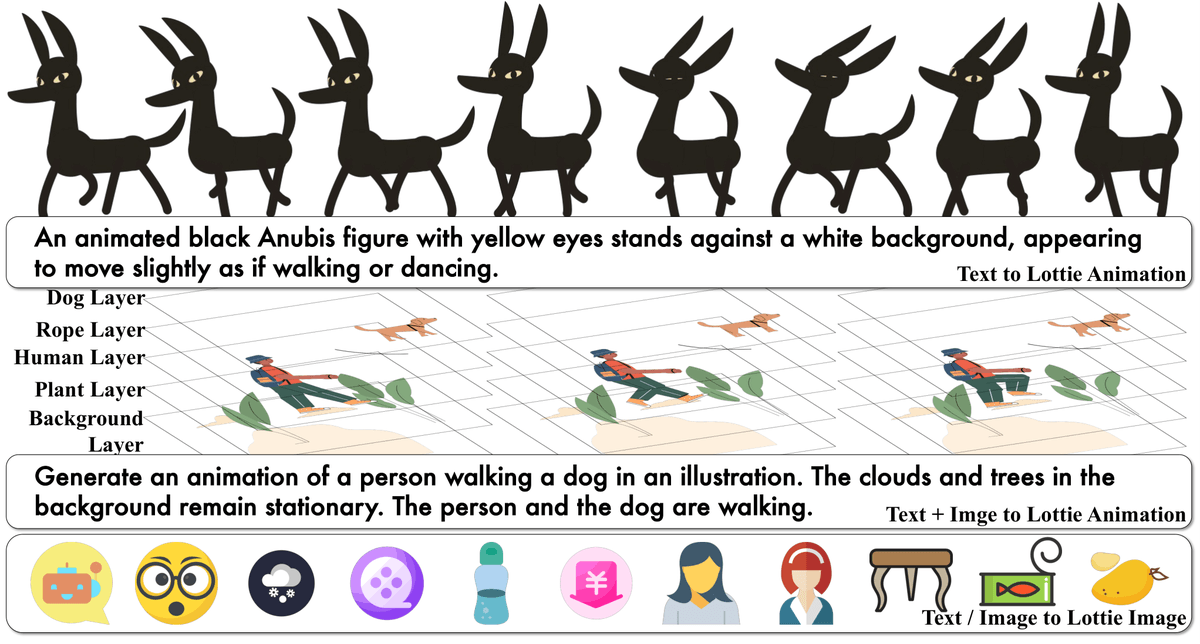
- LottieGPT is the first autoregressive model that generates editable Lottie vector animations from text or images.
- A custom tokenizer compresses 300-frame animations by around 98 percent while remaining losslessly decodable to JSON.
- Training uses LottieAnimation-660K plus 15M static Lottie images, the largest vector animation corpus to date.
- The model fine-tunes Qwen2.5-VL with a two-stage curriculum: static graphics first, then temporal motion.
- Reported to beat Sora 2, Veo 3.1, GPT-5, and Gemini 2.5 Pro on the new LottieBench evaluation.
- Paper, figures, and demos are hosted on GitHub; accepted at CVPR 2026.
Video generation has raced ahead, but one corner of internet multimedia remains untouched by current models: vector animation. The looping icons on landing pages, the checkmarks that bounce in mobile apps, the illustrated onboarding sequences: nearly all of them are Lottie files, and no diffusion model can produce one. A new paper from Tsinghua, BAAI, and collaborators takes a run at that gap. LottieGPT is the first system that treats vector animation as a native generation target, encoding the JSON structure of Lottie files into tokens and letting an autoregressive multimodal model write them one token at a time.
Why raster models fall short here
Existing generative models operate exclusively in raster space, so they cannot synthesize vector animations, even though those animations offer resolution-independence, compactness, semantic structure, and editable parametric motion. Ask Sora or Veo for a bouncing checkmark and you get pixels: fixed resolution, no layers, no way for a designer to tweak the easing curve. Lottie files, by contrast, are JSON documents that describe shapes, transforms, and keyframes symbolically. They render crisply at any size, weigh a few kilobytes, and remain editable inside tools like After Effects.
The team behind LottieGPT noticed something suggestive in recent work: large multimodal models have shown strong capabilities in generating structured data such as slides, 3D meshes, LEGO sequences, and indoor layouts. If a transformer can emit a valid slide deck or CAD sequence, it should be able to emit a valid Lottie file too. The catch is that raw Lottie JSON is verbose, deeply nested, and full of redundant per-frame data, a bad fit for a fixed-context autoregressive model.