
Tsinghua's IN-FOAMs Pocket-Sized Soft Muscles Lift 1kg With 54% Contraction
A new soft actuator combines compressed air with vacuum in a paper-thin package, hitting 54% contraction while folding flat when off.
 Pro
Takeaways
- IN-FOAMs combine positive and negative pressure in one flat, foldable pneumatic muscle from Tsinghua University
- Fabricated in four heat-press steps from TPU-coated nylon and PET film, no molds required
- Linear version hits 43 percent contraction, multilayer zigzag design reaches 54 percent
- Programmable skeleton patterns produce contracting, bending, twisting, rotating, and 2D motions
- Lifts a 1 kg load in 0.2 seconds with peak power density near 0.5 kW/kg
- Demonstrated in an inchworm crawling robot and a low-profile haptic wrist sleeve
Soft robotics researchers have long faced a frustrating tradeoff. Pneumatic artificial muscles driven by positive pressure can be built from thin films that fold flat when idle, but they barely contract. Vacuum-driven muscles pull much harder and shrink much further, yet they need bulky 3D skeletons that occupy space even at rest. A team at Tsinghua University has designed an actuator that refuses to pick a side.
Their Inflatable Fluid-Driven Origami-Inspired Artificial Muscles, or IN-FOAMs, use both compressed air and vacuum in the same device. Each one consists of an inflatable skeleton enclosed within an outer skin, driven by a combination of positive and negative pressures. Manufacturing relies on low-cost heat-sealable sheet materials joined through heat-pressing and heat-sealing, so the actuators can be ultra-thin when off, making them flexible, lightweight, and portable. Roll one up, stick it in a pocket, and inflate it later.
Why the hybrid trick matters
Existing pouch-style actuators like McKibben muscles or Pouch Motors are compact but limited to roughly 17 to 28 percent contraction. Vacuum-driven designs like the original FOAMs from the Wood and Rus labs can exceed 90 percent, but they require a rigid pre-formed skeleton to collapse into. IN-FOAMs bridge that gap by making the skeleton itself inflatable. It starts as a flat stack of laminated sheets, puffs up when pressurized, and a second vacuum stage then pulls the skin down into the voids between the inflated columns for extra contraction.

The two-stage physics is where the real cleverness lives. Positive pressure gives the flat laminate a load-bearing structure, and negative pressure then squeezes that structure further, combining the low-profile form factor of thin-film pneumatic muscles with the high contraction ratio of vacuum-driven ones.
How it is built
Fabrication is refreshingly low-tech. The team uses TPU-coated nylon fabric for the skeleton, transparent TPU film for the skin, and PET film sheets as anti-adhesion masks that define the fluidic channels. The four steps are:
- Engrave patterns into the sheets
- Stack the materials and heat-press at 200 degrees C under 350 kPa for 50 seconds
- Cut and heat-seal the two skeleton layers
- Add pneumatic connectors and heat-seal the outer skin
When the skeleton inflates, tension runs perpendicular to each channel segment, so the segment pattern dictates the motion. Change the geometry and you change the behavior.
A programmable motion library

Different skeleton layouts produce different motions from the same fabrication recipe:
- Linear contraction from parallel pouches, reaching 43 percent shrinkage on a 24.6 g sample
- Bending up to 47 degrees by using an inflated beam to constrain one side
- Twisting up to 79 degrees via anti-symmetric oblique pouches on the top and bottom layers
- Rotation using a flasher-origami-like skeleton
- 2D contraction from L-shaped skeleton units, shrinking both length and width simultaneously
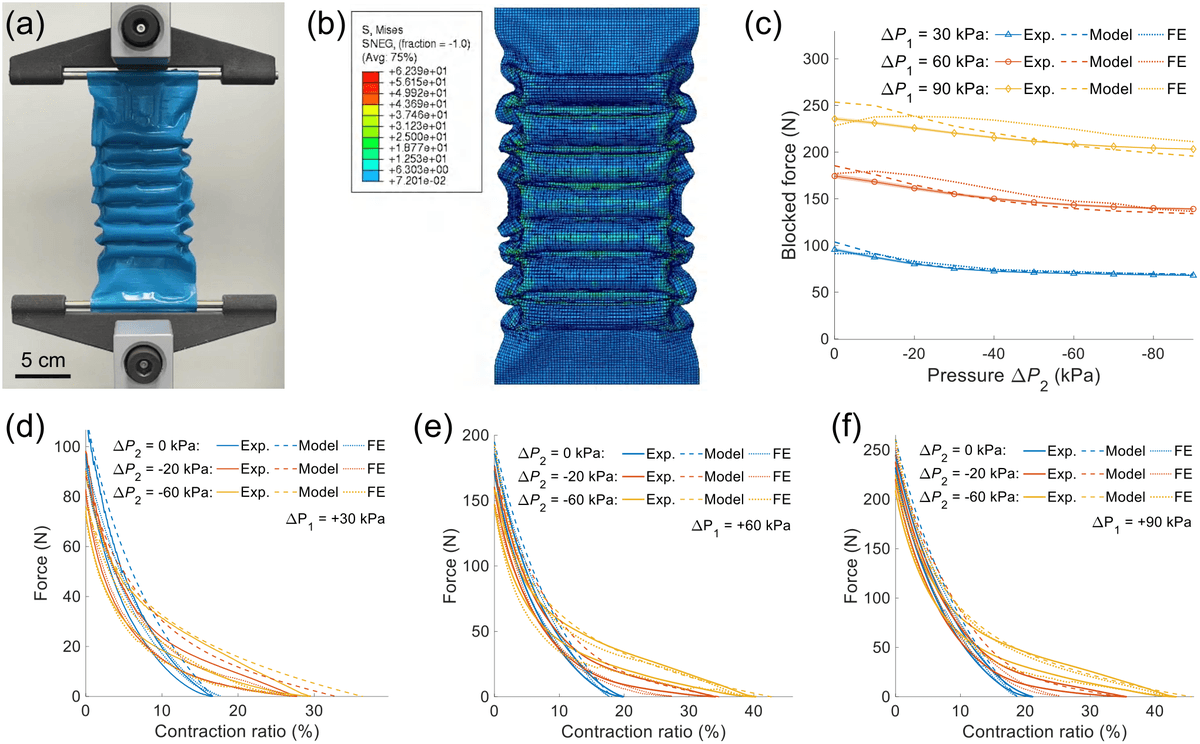
Stacking multiple skeleton layers boosts contraction further. A four-layer zigzag design reaches 54 percent, with 29 percent from positive pressure and another 25 percent from vacuum. Naive multilayer parallel-pouch designs collapse sideways under vacuum, which the authors compare to the unstable sliding of two compressed balloons, so the zigzag topology is what keeps stacking stable.
Performance numbers worth knowing
The team ran the actuator through static, dynamic, and cyclic tests. A 7.46 g linear IN-FOAM lifted a 1 kg load 3.3 cm in 0.2 seconds, delivering a peak power density of roughly 0.499 kW/kg when positive and negative pressures fired together, close to the sum of the individual contributions from each source. Repeatability held up well across the first 1,000 cycles with a 1 kg load, though contraction dropped about 11 percent by cycle 5,000 as the internal fluidic channel boundaries slowly tore.
Bandwidth is modest at 0.38 Hz for positive pressure and 0.78 Hz for negative, limited partly by the pressure supply. Energy conversion efficiency varies with operating mode, peaking at 64 percent when air is transferred from the skin chamber directly into the skeleton chamber rather than sourced externally.
Two demos and the honest caveats
The paper closes with a multi-mode IN-FOAM that packs five motions into a single actuator using a six-channel skeleton, controlled by choosing which channels to inflate. The team drops it into a 144 g inchworm crawler that walks forward, turns left, and turns right using barbed feet for directional traction. A second demo is a soft haptic sleeve that straps around a wrist and delivers kinesthetic cues, useful territory for rehabilitation and VR feedback where thin form factors matter.
The limitations are real. Multilayer skeletons never hit their theoretical contraction ceiling because the skin compresses the stacked layers and the columns tend to buckle. Wrinkling in the sheet material resists motion and introduces unintended deformations. The paper does not release code or a reference design repository, though the fabrication process is documented in enough detail that a well-equipped lab could replicate it. For anyone building wearables, portable soft grippers, or space-constrained robots where a flat resting state is worth more than raw contraction ratio, this design is worth studying.