
Tsinghua's HiSync Lets Robots Identify Their Owner at 34 Meters With 94% Accuracy
A new optical-inertial fusion system tells robots which person in a crowd is issuing commands, even at 34 meters where hands blur into a few pixels.
 Pro
Takeaways
- HiSync identifies which person in a crowd is commanding a robot by matching camera optical flow to wearable IMU signals in the frequency domain.
- Achieves 92.32% accuracy in three-person scenes at up to 34 meters, beating the prior state of the art by 48.44 percentage points.
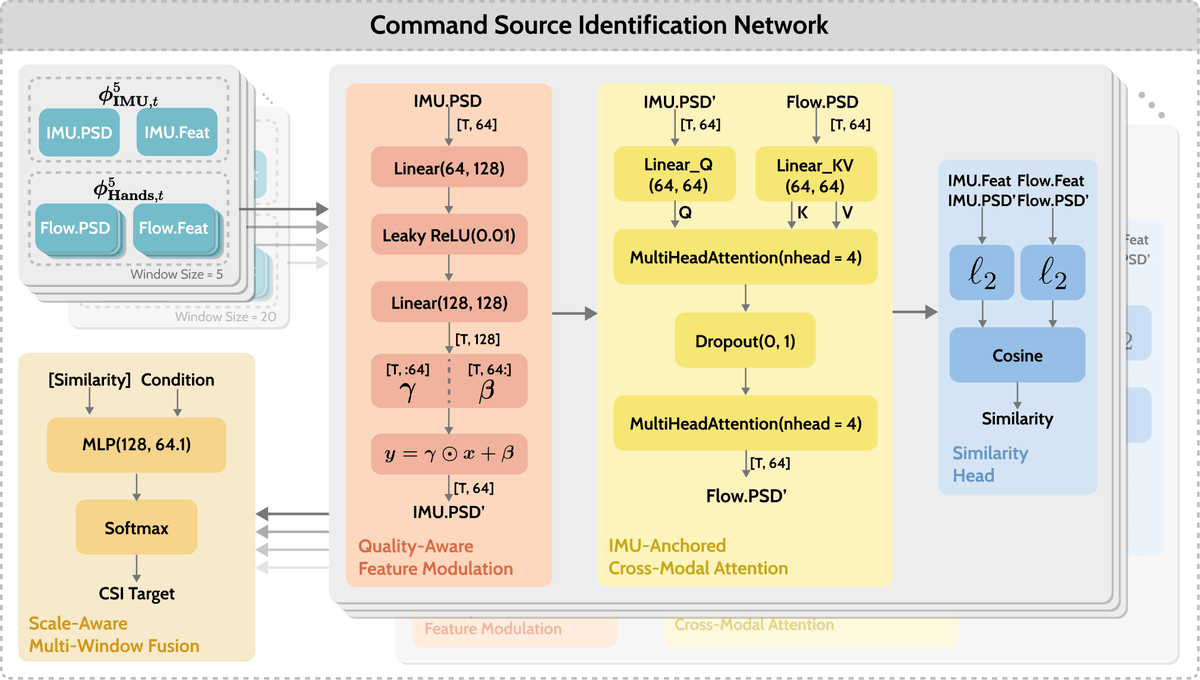
- Uses a CSINet with quality-aware modulation, IMU-anchored attention, and multi-window fusion tuned to distance.
- Dataset of 9,465 sequences from 38 participants at 3-34m released on GitHub.
- Deployed on a Unitree Go2 quadruped, holds 90.9% accuracy at 30m even against a human mimic trying to steal commands.
- Robust to 500ms synchronization drift and 60ms jitter where time-domain baselines collapse from 79% to ~50% accuracy.
Imagine standing 30 meters from a robot dog in a crowded plaza, waving to summon it while two other people nearby wave at their own robots. How does your robot know it's you calling and not one of the strangers? A team from Tsinghua University has built HiSync, a framework that solves this surprisingly unsolved problem by matching the motion signature of your hand in the robot's camera to the motion signature captured by a wearable inertial sensor, all in the frequency domain.
The problem nobody had named
Most human-robot interaction research assumes you're standing within a few meters of the robot, where the operator is visually salient and easy to disambiguate. But once you push the interaction range past 10 meters into public spaces, a foundational capability breaks: the robot no longer knows who in the scene actually issued the command. The authors call this Command Source Identification, or CSI, and argue it hasn't been formally defined as a task in prior HRI literature.
The technical challenges stack up fast. At long ranges, hands and subtle wrist motions collapse to only a few pixels on typical robot-mounted cameras; appearance cues such as texture, skin tone, and fingers are degraded, and hand estimators become unreliable. On top of that, both optical flow and IMU signals get plagued by noise, and the two streams are rarely perfectly synchronized when data travels over Bluetooth or WiFi.
Motion as the binding cue
HiSync's core insight is that even when a person is a smudge on the sensor, their motion pattern is still there. The system aligns two streams: dense optical flow from a robot-mounted RGB camera that captures how each visible person's hand region is moving, and 3D linear acceleration from a wearable IMU worn by the actual operator. If the visual motion of candidate A spectrally matches the IMU trace, A is your commander. Everyone else gets rejected regardless of how similar their gestures look.
Rather than matching raw waveforms in the time domain (which is brittle to synchronization drift), the pipeline transforms both streams into the frequency domain. Working in frequency space provides a common, modality-comparable basis for both velocity and acceleration, reduces sensitivity to temporal offsets, and suppresses uncorrelated noise through windowing and band-wise aggregation. Mathematically, acceleration is just velocity's derivative, so their spectra differ only by a known frequency-dependent scaling. And a global time shift between the two sensors just introduces a linear phase term that can be subtracted out.
Inside CSINet
The neural component, CSINet, is built around three modules that handle the messy realities of long-range sensing:
- Quality-Aware Feature Modulation uses a FiLM operator to reweight IMU spectral channels based on per-frame quality cues, effectively down-weighting frames where the signal is dominated by noise or micro-motion.
- IMU-Anchored Cross-Modal Attention treats the IMU sequence as the temporal anchor and uses multi-head attention (4 heads, 2 layers) to soft-align each candidate's flow spectrum to it, sidestepping the need for tight synchronization.
- Scale-Aware Multi-Window Fusion computes similarity across DFT window lengths from 5 to 20 frames and fuses them with weights conditioned on distance (approximated by the person's bounding-box width). Larger windows help at longer ranges, shorter windows work better up close.
A similarity head then L2-normalizes the embeddings and computes cosine similarity between the IMU and each candidate. Training uses InfoNCE contrastive loss with cross-sequence negative augmentation, where each batch gets 5 external negatives from randomly sampled people in other sequences to sharpen discrimination.
A new dataset and hard numbers
Because no public dataset existed for this problem, the team collected one. The dataset comprises 9465 gesture sequences, totaling 452055 frames of RGB data and corresponding data across all viewpoints and sensors. 38 participants performed a user-defined gesture set distilled from a formative study, at distances from 3 to 34 meters, from three camera perspectives (downward drone-style, eye-level, upward quadruped-style), while wearing IMUs at three different hand positions to emulate a smart ring, smartwatch, and hand-held phone. The dataset and code are available on GitHub.
Against baselines including VIPL (a prior visual-inertial method), a vision-only long-range gesture recognizer, and URGR (ultra-range recognition):
- HiSync sustains reliable command-source identification (CSI) across long ranges, outperforming both purely visual baselines and state-of-the-art optical-inertial methods
- With about 3 people visible per frame on average and a sequence length of 3 seconds, it achieves 99.77% CSI accuracy at 10m or less
- Even at the extreme range (up to 34 m), HiSync still attains 94.31% accuracy, whereas baselines approach random (VIPL, three-category classification: 43.88%; vision-only gesture recognizer, eight-category: 44.48%)
The spectral design also pays off under synchronization noise. When the team injected 500ms global offsets, clock drift, and 60ms jitter into the test data, HiSync dropped from 97.01% to 95.14%. Time-domain baselines with pre-alignment via cross-correlation or dynamic time warping crashed from around 79% to the low 50s.

Real-world deployment
The team deployed HiSync on a Unitree Go2 quadruped with a RealSense D435 camera and ran field tests with 12 new participants across indoor and outdoor scenes not in the training set. IMU data traveled over the public internet, adding roughly 387 ms of latency on average with about 50 ms jitter. In an adversarial condition where a second participant deliberately mimicked the operator to try to steal commands, HiSync held 90.9% accuracy at 30m with an average response time of 3.88 seconds.
Users also preferred it to alternatives. Compared with a joystick remote and voice control, participants rated HiSync significantly higher on willingness to use, ease of learning, and every NASA-TLX workload dimension. Voice control was quietly dropped past 5 meters because participants refused to shout in public.
Where it falls short
HiSync is not magic. Its maximum range of 34 meters is a hard ceiling because optical flow simply stops producing usable motion estimates when a person occupies a handful of pixels. The current pipeline is also sensitive to robot ego-motion and works best when the platform pauses briefly during identification. The test scenes averaged about 3 people per frame, well below the density of an actual airport or mall, so ecological validity in crowded venues is still an open question. And crucially, the current setup assumes only one user's IMU is transmitting to a given robot; scenarios where multiple IMU-equipped users share a communal robot haven't been experimentally validated.
There's also a rare but interesting failure mode the authors call a spectral collision: when two people gesture in near-perfect sync, sharing dominant frequencies, harmonic structure, and amplitude envelopes, their cross-modal similarity scores can be nearly identical.
Why this matters beyond one paper
HiSync reframes long-range summoning as a cross-modal matching problem rather than an identity or appearance problem. That has downstream implications for robotaxi hailing, drone piloting in outdoor spaces, and service robots in transit hubs, all of which need a way to bind a fleeting command to a specific person without pre-enrolling their face or requiring them to hold up a fiducial marker.

The released dataset also gives other researchers a reproducible benchmark for a problem that previously didn't have one, and the authors point to natural extensions like fusing robot odometry to compensate ego-motion, handling small-amplitude micro-gestures, and validating multi-IMU scenarios where several people command the same robot.