
Tsinghua's FingerTip 20K Exposes How Badly AI Fails at Predicting Your Phone Habits
A Tsinghua team collected 21,437 real Android sessions from 95 users to test whether mobile agents can predict intent and match personal habits.
 Pro
Takeaways
- FingerTip 20K introduces 21,437 real Android episodes from 95 users across 506 apps with user context.
- Two new tracks test proactive intent prediction and personalized action-trajectory execution, not just task success.
- Best model hit 12.8% intent-prediction success versus 30.3% for humans, exposing a large gap.
- UI-TARS-1.5-7B led execution success at 38.5%, but no model matched individual users' action styles.
- LoRA-fine-tuned Qwen-2.5-VL-7B outperformed larger generalists on personalization metrics after training on FingerTip.
- Code and data are available on GitHub and Kaggle, with ADB-driven physical-phone evaluation.
Most mobile GUI agents today wait patiently for you to type out exactly what you want. Ask them to set an alarm and they will happily comply, but they have no idea that at 8:30am you always open the same coffee-ordering app, or that you scroll through recommendations before searching rather than tapping the search bar first. A new benchmark out of Tsinghua University tries to close that gap.
FingerTip 20K is a dataset and evaluation suite designed to test two abilities that current mobile agents largely ignore: guessing what a user wants before they ask, and executing tasks in a way that matches an individual's habits. The best model scored 12.8% on intent prediction while humans reached 30.3%, which gives a rough sense of how far behind the frontier sits on this problem.
Why existing datasets fall short
Benchmarks like AndroidControl, AitW, and AndroidWorld have driven a lot of progress, but they share a common shape. Task instructions are either pre-defined by authors or generated by LLMs, demonstrations are collected by having annotators operate simulators on computers rather than real phones, and each data instance is isolated with no temporal correlation or user context.
That framing makes it impossible to study personalization. If every episode is a fresh annotator clicking through a simulator, you cannot learn that this user prefers Bilibili over YouTube for the same query, or that they always filter by price before scrolling. The FingerTip authors argue this is why agents are confined to a passive paradigm where they only perform tasks upon receiving a clear instruction.
How the data was collected
The team built a custom Android app and recruited 95 users through crowdsourcing. Whenever users had a real intent to use their phones in daily life, they opened the FingerTip app, recorded their intent in one sentence, selected the location category they were in, then switched to the relevant app and demonstrated the specific action sequence to complete the intent. The app automatically uploaded the intent (with time and location), screenshot sequences, corresponding accessibility tree XML files, and UI action sequences to a cloud server.
Each user collected data for one month, with a maximum of 12 pieces of data uploaded per day. The result: 21,437 episodes covering 506 apps, with an average of 11.1 steps per episode, all with matched user profiles containing age, sex, occupation, address, and phone brand.

The two new tracks
FingerTip introduces evaluations that go beyond the standard "given an instruction, click the right thing" formulation:
- Proactive task suggestion. The agent generates an intent prediction from user profile, current time, scenario, up to 20 historical intents, and optionally the first few screenshots of the user's current actions. No instruction is provided.
- Personalized task execution. Given the user's true intent, a similar past action sequence for in-context learning, the agent's own prior actions, and the current screenshot plus accessibility tree, the agent must produce the next action and its overall trajectory should reflect that user's preferences, not just complete the task.

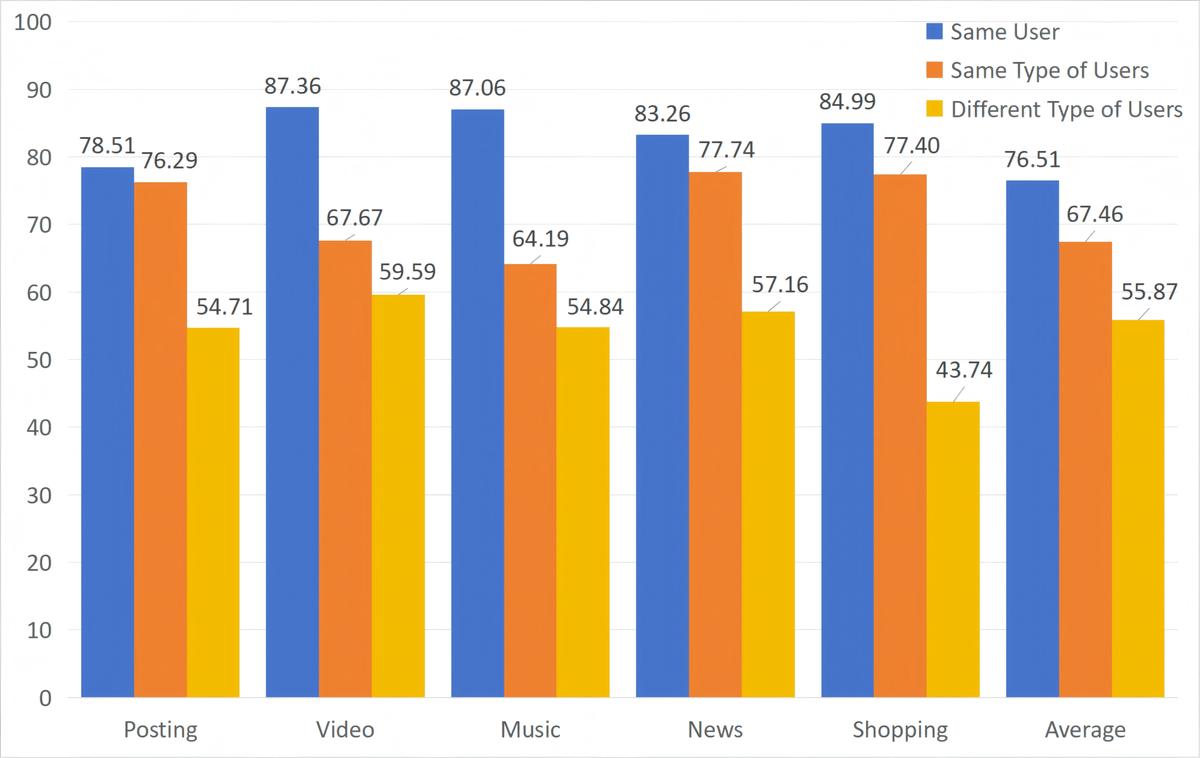
Personalization is measured with a Levenshtein similarity ratio the authors call Sim_2: how close the agent's action sequence is to the current user's typical path, divided by how close it is to users of a different demographic type. A value above 1 means the agent leans toward the current user's style.
How today's models perform
The team benchmarked generalist models (GPT-4.1, Qwen-VL-Max, DeepSeek-VL2, Qwen-2.5-VL-7B/72B, Qwen-QVQ-Max) and GUI-specialists (Aguvis-7B, CogAgent-9B, UI-TARS-1.5-7B, plus prompt-engineered AutoDroid and AppAgent). A few things stand out:
- On personalized execution, generalist model success rates were very low, mainly because they lack precise GUI grounding and output incorrect UI coordinates even when they correctly analyze the next action.
- UI-TARS-1.5-7B reached the highest success rate at 38.5%, but the Sim_2 values across all models sat around 1, indicating that agents complete tasks in a generic way without catering to specific user preferences.
- Removing time from the input caused the largest performance drop in proactive suggestion, suggesting time is the most crucial factor in user intent patterns.
Fine-tuning closes some of the gap
The authors LoRA-fine-tuned Qwen-2.5-VL-7B on the FingerTip training set. Despite using a smaller model and less training data, the fine-tuned models achieved significant performance improvements in all main metrics, with increases in training data having a particularly significant effect. The 7B tuned model beat Qwen-QVQ-Max on proactive suggestion and, while it still trailed UI-TARS on raw execution success rate, it produced meaningfully higher Sim_2 scores. The fine-tuned models had significantly higher Sim_2, indicating that the action paths they select may not be optimal but are closer to the user's action preferences.
A user study reinforced this: the fine-tuned model achieved the highest user rating at 3.35 out of 5, showing that fine-tuning on the data improved the model's personalization ability.
Getting the data
The code lives on GitHub with data hosted on Kaggle, and includes training and test splits, user profiles, and reference scripts for both tracks. The repository ships two entry points, proactive_suggestion.py and personalized_execution.py, where you plug in an LLM API and either evaluate on CSV files or drive a physical phone through ADB. Because most Chinese apps refuse to run on emulators, the personalized track expects a real device connected over USB.
The limitations are worth flagging. All 95 contributors live in mainland China and mainly interact with Chinese third-party apps, so recorded linguistic habits, UI layouts and action patterns may differ markedly from other regions. The authors plan to open-source the collection app itself so other groups can extend the dataset to different languages and app ecosystems.