
Tsinghua's Fast-WAM Runs Robots 4x Faster by Skipping Future Imagination
Fast-WAM shows robots can skip the expensive step of imagining future video frames at inference, cutting latency 4x while matching accuracy.
 Pro
Takeaways
- Fast-WAM removes future-video generation at inference, cutting robot control latency from ~800ms to 190ms.
- Video co-training during training matters more than test-time imagination for final task success.
- Achieves 97.6% on LIBERO and 91.8% on RoboTwin 2.0 without any embodied pretraining.
- Built on Wan2.2-5B video diffusion backbone plus a 1B action expert DiT.
- Ablation drops 8+ points when video co-training is removed, versus near-zero drop from removing test-time imagination.
- Code available at github.com/yuantianyuan01/FastWAM; runs on a single RTX 5090D.
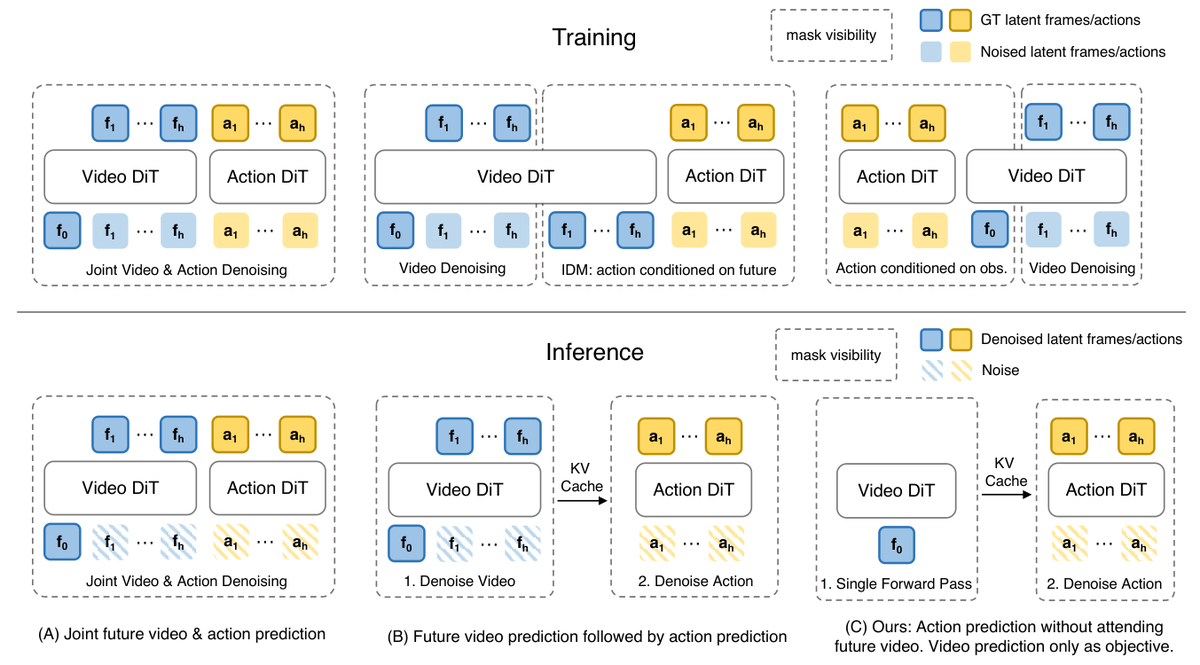
A team from Tsinghua's IIIS and Galaxea AI has released Fast-WAM, a robot control model that challenges a core assumption behind a popular class of policies. World Action Models (WAMs) typically work by first imagining what will happen next as a short video, then deriving an action from that prediction. Fast-WAM keeps the video training but discards the imagination step at runtime, and the robot performs just as well.
The finding is blunt: the main value of video prediction in WAMs may lie in learning better world representations during training rather than generating future observations at test time. If that holds up, it removes one of the biggest latency bottlenecks in embodied AI.
Why imagining the future is expensive
To understand the contribution, it helps to know how WAMs differ from Vision-Language-Action (VLA) models. World Action Models have emerged as a promising alternative for embodied control because they explicitly model how visual observations may evolve under action. In practice, most WAMs use a diffusion transformer to denoise a short predicted video conditioned on the current frame and a language instruction, then read off the action.
That denoising loop is the problem. Most existing WAMs follow an imagine-then-execute paradigm, incurring substantial test-time latency from iterative video denoising, which makes them awkward for closed-loop manipulation where you need sub-second reaction times. The authors' central question is whether runtime imagination is doing real work, or whether it is just a training signal that leaked into inference.