
Tsinghua's EasyInsert Plugs USB Cables With 90% Accuracy Without CAD Models
EasyInsert teaches robots to plug in cables and connectors with 90%+ success using just one hour of human-guided training data
 Pro
Takeaways
- EasyInsert is a robotic insertion framework achieving 90%+ zero-shot success on 13/15 novel objects including HDMI, Ethernet, and Type-C cables.
- The key insight is framing insertion as delta-pose regression (predict the spatial gap, not joint commands), making training labels automatically computable from geometry.
- Only 1 hour of human teleoperation is needed to bootstrap a largely automated data collection pipeline that generates 80% of training data autonomously.
- A three-phase coarse-to-fine controller handles alignment, vertical descent, and final contact with random perturbations to overcome friction.
- EasyInsert outperforms CAD-dependent baselines like AutoMate and FoundationPose+motion planner, which collapse to 0% on novel out-of-distribution objects.
- Rapid fine-tuning in under 15 minutes (30 seconds human effort + automated data collection) brings even the hardest objects to 100% success. Read the paper
Teaching a robot to plug in a USB cable sounds trivial. In practice, it is one of the hardest problems in robotics: the task demands sub-millimeter precision, works across wildly different connector shapes, and must succeed even when the workspace is cluttered and the plug starts far from the socket. Most existing systems either require expensive CAD models of every object, or are trained in clean simulation environments that fall apart in the real world. A new paper from Tsinghua University and the Shanghai Qi Zhi Institute proposes EasyInsert, a framework that sidesteps all of these constraints and achieves over 90% zero-shot success on 13 out of 15 never-before-seen objects, trained with just one hour of human effort.
Why insertion is still an open problem
Robotic insertion, also called peg-in-hole assembly, has been studied for decades. The challenge is not just precision but generalization: a system trained on one connector type typically fails completely on another. The two dominant paradigms both have serious cracks.
- Sim-to-real RL: Train a policy in simulation using CAD models, then transfer to the real robot. Works well in-distribution, but requires a custom simulation environment per object, careful reward engineering, and suffers from the sim-to-real gap when textures and physics differ.
- Real-world imitation learning: Collect human teleoperation data directly on the robot. Avoids the sim gap, but is expensive and slow, so datasets stay small and environments stay clean and structured.
Both paradigms share a deeper flaw: they require the plug and socket to start close together (typically within 1-2 cm), and they collapse entirely on out-of-distribution objects. EasyInsert is designed to break all three of these constraints simultaneously.
The core insight: predict the gap, not the action
Most learning-based insertion methods train a policy to output low-level robot joint commands directly from camera images. This is hard because the policy must memorize entire trajectories, and any compounding error along the way causes failure. EasyInsert takes a different approach inspired by how humans actually insert things: we look at the plug and socket, estimate the spatial gap between them, move to close that gap, and repeat.
Formally, EasyInsert frames insertion as delta-pose regression. At every timestep, the model takes images from two wrist-mounted cameras and predicts a 4-DoF relative offset between the plug and socket: delta-x, delta-y, delta-z, and yaw rotation. A classical closed-loop controller then converts that predicted offset into robot motion. The neural network never has to predict raw joint angles or worry about trajectory continuity.

This reframing has a crucial side effect: the training labels are automatically computable from geometry. At any robot pose, the ground-truth delta to the socket is just a coordinate subtraction. This means the robot does not need to follow expert trajectories to generate valid training data. It can wander randomly around the socket, and every frame it captures is a valid labeled example.
A data pipeline that runs itself
Because the labels are geometric, EasyInsert can automate 80% of its own data collection. The pipeline is split into two spatially decoupled phases:
- Automated free-space collection (80% of data): A motion planner randomly samples robot poses within a large bounding box around the socket (up to 8 cm in XY and 40 degrees in yaw). The robot moves to each pose, captures images, and records the delta-pose label automatically at 10-15 Hz. A human only occasionally tosses distractor objects into the scene to add visual variety.
- Manual close-contact collection (20% of data): Within the final 1 cm of the socket, random exploration risks collisions. An operator uses kinesthetic teaching (physically guiding the robot arm by hand) to safely wiggle the plug near the socket. Crucially, this does not require performing a perfect insertion. Erratic, noisy movements are actually ideal because they densely cover the state distribution near the socket.
Across five training object categories, the team collected 5 hours of total data, of which only 1 hour required any human involvement. The ablation studies confirm that neither component alone is sufficient: automated data alone gets the plug within 1 cm with near-100% reliability but fails at the final millimeter, while manual-only data has a 0% success rate at the standard starting distance of 3-6 cm because those poses are completely out-of-distribution.
Three-phase execution that mirrors human behavior
During inference, EasyInsert does not just move directly to the predicted target pose. Instead, a multi-phase controller translates the delta-pose prediction into a safe, contact-aware motion sequence.

- Phase 1 - Coarse alignment: If the XY error exceeds 2 cm or yaw exceeds 20 degrees, the controller moves the plug to the predicted XY/yaw target while keeping it elevated 6 cm above the socket to avoid collisions.
- Phase 2 - Fine vertical adjustment: Once horizontal alignment is within tolerance, the controller lowers the plug in 5 mm steps toward the socket.
- Phase 3 - Close contact with perturbation: In the final millimeters, the controller adds small random noise (up to 3 mm) while continuing to press down. This jitter overcomes surface friction and absorbs residual micro-misalignments.
The model backbone is a Diffusion Policy with a shared ResNet-18 image encoder pretrained on ImageNet. The diffusion head predicts the delta-pose rather than joint actions. DDIM sampling is used for fast real-time inference. Aggressive color augmentation during training (random jitter, grayscale conversion) forces the model to learn geometry-based representations rather than relying on object color or background appearance.
Results: beating CAD-dependent baselines without any CAD
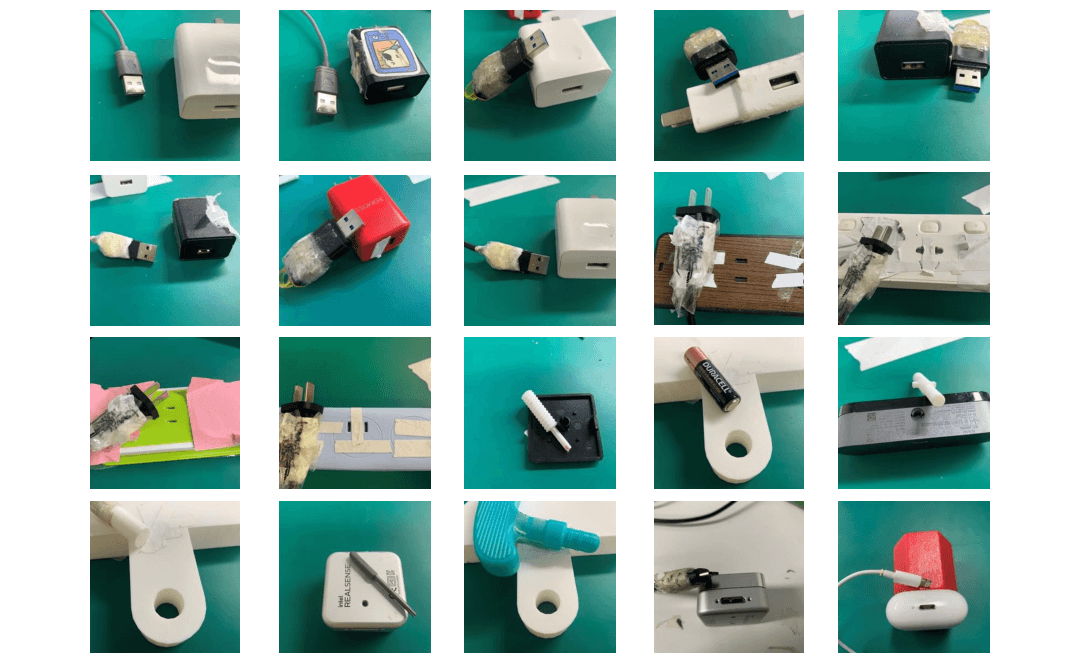
The team evaluated EasyInsert on a 7-DoF Franka Panda arm against two baselines: AutoMate (a state-of-the-art RL policy trained in simulation with ground-truth CAD models) and FP-Insert (FoundationPose pose estimation combined with a motion planner, also requiring CAD models). The evaluation used 15 novel objects never seen during training, with starting poses randomized at 3-6 cm XY offset and 15-40 degree yaw deviation, surrounded by random distractor objects.
On the five AutoMate benchmark objects, EasyInsert scored 10/10, 10/10, 10/10, 9/10, and 9/10 while operating out-of-distribution and without any CAD access. AutoMate's specialist policies, trained specifically on these objects with CAD models, scored lower on two of the five. FP-Insert failed on all five with near-zero success. On 10 additional novel objects with no CAD files available at all, baselines collapsed to 0% while EasyInsert maintained strong performance across the board, including 9/10 on HDMI cables, 9/10 on Ethernet cables, and 8/10 on Type-C connectors.
For the two hardest objects (Type-C and trapezoidal connectors, which have extremely tight tolerances), a rapid fine-tuning step brings both to 10/10. The process requires only 30 seconds of human effort to register the target pose, followed by 4 minutes of automated data collection and 10 minutes of fine-tuning on a single RTX 3090. The full adaptation pipeline completes in under 15 minutes.
Where it still struggles
EasyInsert is not a universal solution. A few important limitations to keep in mind:
- Tight tolerances need fine-tuning: The zero-shot policy drops to 80% on Type-C and trapezoidal connectors. The automated fine-tuning fixes this, but it does require one manual reset per new object.
- Extreme spatial offsets: At 10 cm XY offset (well beyond the training range of 8 cm), success drops to 3/5. The system still guides the plug toward the socket, but reliability degrades.
- 4-DoF only: The framework assumes pitch and roll are pre-constrained by the gripper fixture. Objects requiring full 6-DoF insertion are not handled.
- Data scaling matters: Training on only 12% of the collected data causes generalization to collapse entirely. The method needs sufficient coverage of the pose distribution to work.
What this unlocks
The practical implication is significant. Factory assembly lines today require either expensive custom programming per connector type or human workers for any non-trivial insertion task. EasyInsert offers a path to a generalist insertion robot that can be bootstrapped with one hour of human teleoperation and then adapted to new connectors in under 15 minutes with a single manual reset. The framework is CAD-free, simulation-free, and handles real-world clutter without special preparation.
No code or pretrained models have been released alongside the paper at this time, but the methodology is described in sufficient detail to reproduce. The full paper includes the complete coarse-to-fine execution algorithm and training setup. For teams working on contact-rich manipulation, cable routing, or industrial assembly automation, EasyInsert represents a meaningful step toward a robot that can handle the messy, unpredictable geometry of real connector ecosystems.