
Tsinghua's Dolphin Beats Top Voice Separation Models at 6x Faster Speed
A new audio-visual speech separator matches state-of-the-art quality with half the parameters, 2.4x fewer MACs, and 6x faster GPU inference.
 Pro
Takeaways
- Dolphin is a new audio-visual speech separation model from Tsinghua that beats prior SOTA on LRS2, LRS3, and VoxCeleb2.
- Cuts parameters by more than 50%, MACs by 2.4x, and GPU inference latency by 6x versus IIANet.
- DP-LipCoder maps lip video into discrete audio-aligned semantic tokens using VQ and AV-HuBERT distillation.
- Single-iteration separator uses Global-Local Attention blocks with heat diffusion attention for local feature modeling.
- Direct feature regression instead of masking gains 0.5 dB SI-SNRi over conventional mask-based decoders.
- Code will release under Apache-2.0; demo page is live with audio samples.
Audio-visual speech separation, the task of isolating one person's voice from a noisy mixture using their lip movements as a guide, has been stuck in a familiar tradeoff. The best models produce clean audio but demand so much compute that they cannot realistically sit at the front of a downstream speech pipeline. A team from Tsinghua University is proposing Dolphin, a model that claims to break that tradeoff by rethinking both the visual encoder and the audio separator.
The headline numbers are aggressive. Compared with the SOTA method IIANet, Dolphin performed better on all separation metrics, while also having significant advantages in resource efficiency: more than 50% reduction in parameters, over 2.4x reduction in computational cost, and more than 6x improvement in GPU inference speed. That is the kind of gap that turns a research demo into something you can actually put in front of an ASR system or a real-time meeting tool.
Why lip-reading backbones have been the bottleneck
In audio-visual speech separation (AVSS), a video encoder extracts features from the target speaker's lips, and those features guide the audio network toward the right voice. The catch is that the visual side has been carrying most of the parameter budget. Most methods employ large-scale visual backbone networks that are pre-trained on the lip reading task, using a larger number of parameters to extract semantically aligned features from lip movements.
Attempts to shrink these encoders have historically failed in one of two ways. Directly compressing existing large-scale visual encoders often leads to a significant loss in semantic representation capability and a drastic drop in separation performance, while designing lightweight encoders from scratch tends to yield only shallow, pixel-level features and fails to extract effective semantic information. Dolphin's authors take a third route.
Turning lips into a discrete vocabulary
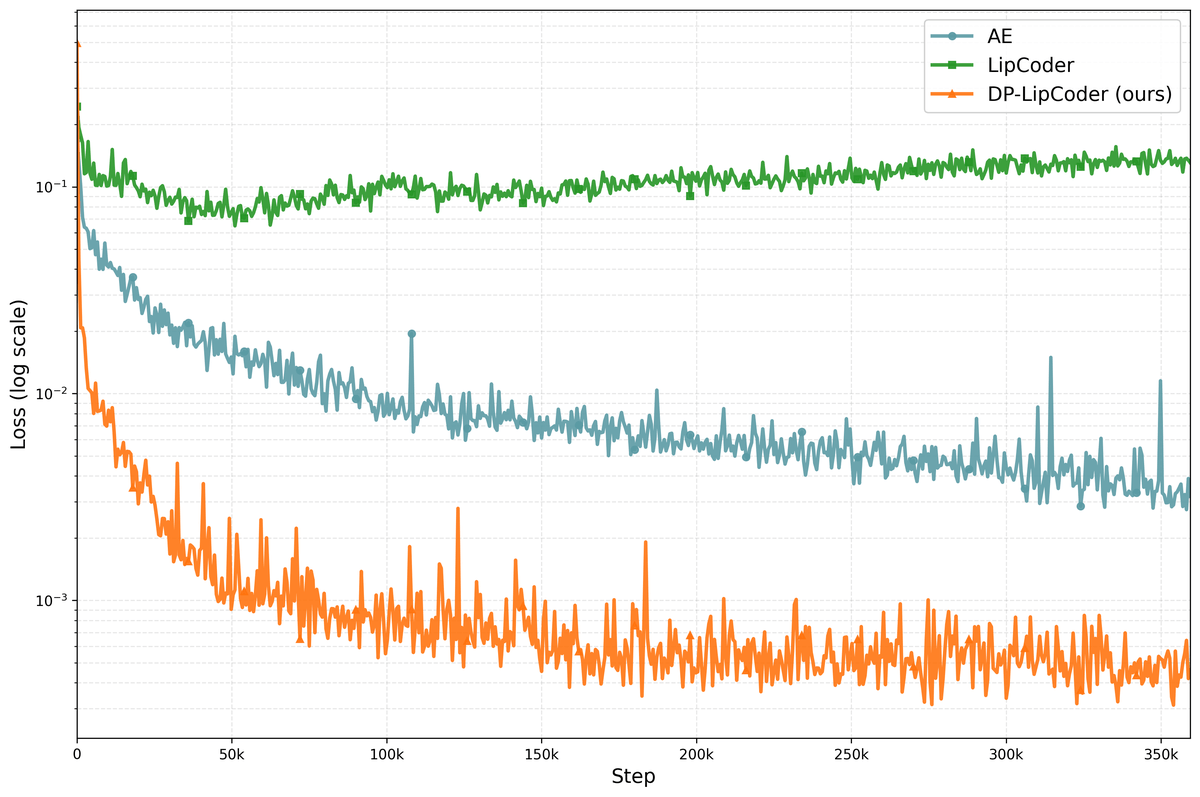
The visual encoder, called DP-LipCoder, is a dual-path autoencoder with vector quantization. One path handles reconstruction, preserving speaker-identity cues like facial expression. The other path produces discrete tokens aligned with audio semantics. By incorporating vector quantization and leveraging knowledge distillation from a pretrained audio-visual representation model AV-HuBERT, they map continuous video streams into discrete semantic tokens that are highly aligned with audio.

The efficiency payoff is substantial. Taking 3D ResNet-18 as a reference, DP-LipCoder attains a comparable SI-SNRi within 0.2 dB while reducing parameters by 93% and MACs by 70%. The quantization step itself matters too: an ablation shows the VQ module contributes approximately 0.5 dB to the SI-SNRi by enhancing semantic alignment. Discrete tokens act as semantic anchors, forcing the encoder to commit to phoneme-related lip shapes rather than pixel-level noise.
Killing the iteration loop
On the audio side, prior lightweight systems like RTFSNet and AVLiT tried to save parameters by running a small separator many times in a loop. That trick trades parameter count for wall-clock latency. Dolphin drops iteration entirely and builds a single-pass encoder-decoder around what the authors call the Global-Local Attention (GLA) block.
Each GLA block has two halves:
- Global attention (GA): A coarse self-attention that downsamples the sequence before running multi-head attention, then upsamples back. This drops the quadratic attention cost by a factor of 1/2^(2Q) where Q is the encoder depth.
- Local attention (LA): A heat diffusion attention (HDA) layer that transforms features into the frequency domain via DCT, applies a learnable exponential decay per channel derived from the heat equation, then transforms back.
The heat diffusion piece is the clever bit. Instead of learning a large convolutional kernel to smooth features, the model learns a small set of channel-wise decay coefficients that shape a physically-motivated filter. The basic shape of the filter is constrained by physical priors, and the model only needs to learn a small number of scaling and gating parameters for each channel, substantially reducing the risk of overfitting. An ablation replacing HDA with a 1D large-kernel convolution loses 0.4 dB SI-SNRi and adds parameters.
The benchmark results
Dolphin was evaluated on three standard AVSS benchmarks: LRS2, LRS3, and VoxCeleb2. It beats every prior method on every metric across all three. On LRS2, it reaches 16.8 SI-SNRi versus 16.0 for IIANet and 15.1 for AV-Mossformer2. The efficiency comparison is where the story gets sharp:
| Model | Params (M, with encoder) | MACs (G) | GPU latency (ms) |
|---|---|---|---|
| AV-Mossformer2 | 68.52 | 124.46 | 62.30 |
| IIANet | 15.01 | 26.51 | 142.30 |
| RTFS-Net | 12.03 | 41.51 | 56.59 |
| Dolphin | 7.00 | 10.89 | 33.24 |
The gap widens in tough conditions. In experiments with music noise plus two interfering speakers, Dolphin achieves 4.11 SI-SNRi versus 0.54 for IIANet and 3.90 for AV-Mossformer2. Multi-speaker LRS2-4Mix scenarios show a similar pattern, with Dolphin outperforming IIANet by 1.9 dB SI-SNRi.
What it is not good at
The authors are direct about the limits. Dolphin relies on relatively clean and synchronized lip videos, and robustness against large head pose variations, occlusions, and extreme lighting conditions remains an open problem. Extreme edge deployment (think microcontrollers) still needs quantization or pruning work. And the discrete lip vocabulary, while efficient, may discard fine-grained articulatory cues.
There is also a subtle catch for people hoping to swap DP-LipCoder into their existing pipeline. When the authors replaced the visual encoders in IIANet, CTCNet, and AV-Mossformer2 with DP-LipCoder, all three models lost a small amount of separation quality (0.1 to 0.6 dB SI-SNRi). The efficiency gain is real, but Dolphin's separator was co-designed with its encoder.
Availability
A demo page with audio samples is live at the project site. The authors will release the code of Dolphin under the Apache-2.0 license on GitHub once this work is accepted for publication, including conda environment specification, complete configuration files, pretrained weights for the video backbone, and the source code. Datasets need to be obtained separately from their respective publishers, but preprocessing scripts will be provided. The vector quantization implementation the authors use is already available on PyPI.