
Tsinghua Proves Label-Free RLVR Always Collapses and Offers a 5.6x Cheaper Fix
A new paper proves that label-free RL for LLMs always collapses — and proposes a cheap diagnostic to predict when, and what to do instead
 Pro
Takeaways
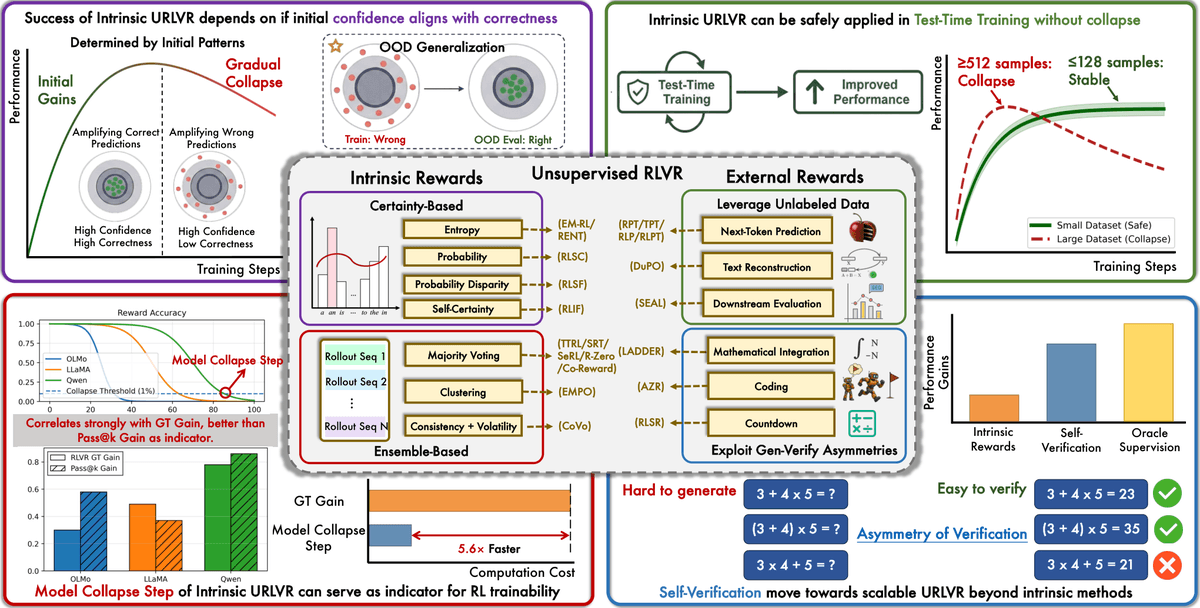
- Core finding: All label-free intrinsic RL methods for LLMs share one mechanism — "sharpening" the model's initial distribution — and inevitably collapse.
- Rise-then-fall is universal: Every intrinsic reward method (majority voting, entropy, probability) follows a rise-then-fall accuracy pattern; only the timing differs, not the outcome.
- New metric: "Model Collapse Step" predicts RL trainability 5.6x cheaper than running full RL, with no ground-truth labels needed.
- Safe zone: Intrinsic rewards work safely for test-time training on small datasets (≤128 problems) without triggering collapse.
- External rewards are the future: Methods grounded in code execution, proof checkers, or unlabeled corpora escape the confidence-correctness ceiling that limits intrinsic methods.
- Code available: Experiments use open-source TTRL and veRL; Model Collapse Step is immediately applicable to existing RL pipelines.
The most exciting trend in LLM post-training right now is RLVR , Reinforcement Learning with Verifiable Rewards , the technique behind DeepSeek-R1, Gemini 2.5, and the Qwen3 series. The idea is elegant: instead of expensive human feedback, you reward the model when it gets a verifiable answer right, like a correct math solution or passing code tests. It works remarkably well. The problem is it requires labeled data , ground-truth answers , and those are getting harder and harder to produce as models approach or exceed human expert level in specialized domains.
That bottleneck has sparked a wave of research into Unsupervised RLVR (URLVR): can you run the same RL loop, but without any ground-truth labels at all? A new paper from Tsinghua University and Shanghai AI Lab titled "How Far Can Unsupervised RLVR Scale LLM Training?" delivers the most systematic answer yet , and it is both sobering and practically useful.
The label-free RL zoo
The paper starts by taxonomizing the field. URLVR methods split into two camps based on where the reward signal comes from: intrinsic rewards, derived from the model's own outputs, and external rewards, grounded in mechanisms independent of the model's internal state.
Intrinsic methods are the ones that have attracted the most attention. They come in two flavors:
- Certainty-based rewards: The model is rewarded for being confident. Variants include Self-Certainty (KL divergence from a uniform distribution), Token-Level Entropy, Trajectory-Level Entropy, raw sequence Probability, and Probability Disparity. All are different mathematical ways of saying "reward high-confidence outputs."
- Ensemble-based rewards: Generate multiple responses to the same question, take a majority vote, and treat that vote as a pseudo-label. TTRL (NeurIPS 2025) is the flagship example here, and it showed striking early results , TTRL consistently improves performance across a variety of tasks and models, notably boosting the pass@1 performance of Qwen-2.5-Math-7B by approximately 211% on AIME 2024 with only unlabeled test data.
External methods take a different approach: they ground rewards in things outside the model , unlabeled text corpora (rewarding correct next-token prediction), or generation-verification asymmetries (it is hard to write a correct proof, but trivial to check one in Lean).
One mechanism to rule them all
The paper's core theoretical contribution is showing that despite the surface diversity of intrinsic methods, they all do the same thing under the hood. Despite diverse design choices, all intrinsic methods converge toward sharpening the model's initial distribution , amplifying existing preferences rather than discovering new knowledge.
The authors prove this formally for majority voting (Theorem 1) and extend it to all other intrinsic rewards via a unified cross-entropy framework. The intuition is a "rich-get-richer" dynamic: whichever answer the model already slightly prefers gets its probability amplified at each training step, geometrically converging to a deterministic policy concentrated on that initial preference.
This is fine when the model's initial confidence happens to align with correctness. But when it does not, the same mechanism systematically reinforces errors. The model becomes more and more certain of the wrong answer.

Rise, then fall , every time
Intrinsic methods converge toward sharpening the model's initial distribution, and through systematic experiments, intrinsic rewards consistently follow a rise-then-fall pattern across methods, with collapse timing determined by model prior rather than engineering choices.
The experiments are thorough. The team trained Qwen3-1.7B-Base on DAPO-17k using five different intrinsic reward methods, sweeping across training temperature, mini-batch size, KL regularization, and rollout count. The finding is unambiguous: some hyperparameter choices matter significantly (e.g., mini-batch size and rollout number), but nearly all settings eventually degrade, differing only in when rather than whether collapse occurs.
The failure modes differ by method, though:
- Gradual degradation: Self-Certainty and Majority Voting degrade most slowly, maintaining higher label accuracy without collapsing within one epoch.
- Length collapse: Probability-based rewards favor brevity because multiplying token probabilities naturally rewards shorter sequences. The model gets confident but stops reasoning.
- Repetition collapse: Entropy-based methods minimize entropy by repeating high-probability tokens, padding responses with repetitive text rather than correct content.
Even combining all stabilizing insights and running extended training, collapse still occurs around 1,000 steps (roughly 4 epochs), suggesting the rise-then-fall pattern reflects a fundamental limitation rather than an engineering problem.
Where intrinsic rewards still work
The news is not all bad. The paper identifies a regime where intrinsic rewards are genuinely safe and useful: small datasets and test-time training.
Despite these scaling limits, intrinsic rewards remain valuable in test-time training on small datasets. Specifically, training with 32 or 128 samples maintains stable performance without collapse, while datasets of 512 or more consistently exhibit reward hacking. The hypothesis is that small datasets induce localized overfitting rather than systematic policy shift , the model sharpens its confidence on specific samples without altering its global reasoning policy.
There is also a surprising finding about incorrect majority votes: even when training amplifies errors on a specific problem, sharpening can still generalize to out-of-distribution problems. As long as confidence aligns with correctness on unseen problems, sharpening still works. This explains why many recent URLVR papers focus on test-time rather than train-time settings.
A cheap diagnostic: Model Collapse Step
One of the paper's most practically useful contributions is a new metric called Model Collapse Step (MCS). The idea: run intrinsic URLVR training with aggressive hyperparameters and measure the step at which reward accuracy drops below 1%. Models with stronger priors (better initial confidence-correctness alignment) survive longer before collapsing.
Model Collapse Step correlates strongly with ground-truth RL gain. Models that survive longer consistently yield better results in standard supervised RL training. This metric matches and even surpasses pass@k's predictive power and cannot be gamed by random guessing on multiple-choice questions.
The computational savings are significant. Model Collapse Step requires substantially less computation than full RL training, using 5.6x fewer tokens than full RL training while preserving the relative ranking of models. Moreover, it requires no ground-truth labels, making it applicable even when verification is unavailable.
In practice, this means you can screen multiple base model candidates for RL trainability with a short diagnostic run, then commit expensive compute only to the most promising one.
The path forward: external rewards
The paper's final section looks at external reward methods as the more promising long-term direction. External reward methods escape the confidence-correctness ceiling through two complementary mechanisms: unlabeled-data methods derive rewards that grow with corpus size rather than model capability, and generation-verification asymmetry methods ground rewards in external computation from compilers, proof assistants, game engines, or scientific simulators.
As a concrete demonstration, the authors test self-verification on the Countdown arithmetic task (form an expression that equals a target number , hard to generate, trivial to check). Self-Verification works much better than Trajectory-Level Entropy, with both Qwen3-1.7B-Base and Qwen3-4B-Base reaching higher validation accuracy. The Ground Truth Reward keeps rising without the collapse patterns inherent to intrinsic methods.
The broader taxonomy of external approaches includes:
- Unlabeled corpus methods: RPT rewards correct next-token predictions on raw text, turning trillions of tokens into reward signals. Extensions like TPT add step-by-step reasoning before prediction.
- Generation-verification asymmetry: Absolute Zero uses code execution for self-play reasoning with zero human data. LADDER uses numerical evaluation to verify indefinite integrals. AlphaProof uses Lean for formal theorem proving.
The key insight is that a compiler does not become a weaker verifier as the model improves, and a Lean proof checker does not hallucinate. Where intrinsic rewards are bounded by what the model already knows, external rewards can provide a fresh signal drawn from data and computation.
What this means in practice
The paper's findings translate into concrete guidance:
- Do not expect intrinsic URLVR to scale indefinitely. Collapse is not a bug you can tune away , it is a mathematical inevitability of the sharpening mechanism.
- Use intrinsic rewards for test-time training on small, domain-specific datasets (under ~128 problems). This is where they are genuinely safe and effective.
- Use Model Collapse Step to pick your base model before committing to expensive RL training. It is 5.6x cheaper than running full RL and requires no labels.
- For scalable unsupervised RL, invest in external reward infrastructure , verifiable environments, code execution sandboxes, proof assistants, or domain-specific simulators.
The code for TTRL, the flagship intrinsic URLVR method from the same research group, is publicly available. The paper itself does not release a new model or standalone codebase, but the experimental framework is built on the open-source veRL training library using GRPO. The theoretical results and the Model Collapse Step metric are immediately applicable to anyone running RL post-training experiments today.