
Tsinghua Finds VRGA Fixes Why Smarter Reasoning Makes Vision Models Blind
A training-free attention reweighting method fixes a strange failure mode where chain-of-thought reasoning makes vision language models less accurate at seeing.
 Pro
Takeaways
- Chain-of-thought prompts cause vision language models to disperse attention away from answer-relevant image regions.
- Failure analysis on TextVQA shows scenes are described correctly but final answers still wrong.
- Visual processing heads identifiable by high image attention plus low spatial entropy, Pearson r above 0.9.
- VRGA selects those heads via an Entropy-Focus Ratio and reweights attention on question-relevant tokens.
- Improves comprehensive score 1-6 points on HaloQuest, HallusionBench, MMStar; training-free at inference.
- Code released on GitHub, works with Qwen2-VL, Qwen2.5-VL, Qwen3-VL out of the box.
Chain-of-thought prompting made large language models dramatically better at math and code. Bolt the same trick onto a vision language model and something weird happens: accuracy on visual question answering can actually get worse. A new paper from Tsinghua Shenzhen and Huawei diagnoses why, and proposes a fix that requires no retraining.
The paper, Deeper Thought, Weaker Aim, argues that when multimodal LLMs are told to think step by step, their attention over the image becomes spatially scattered. The model still describes the scene correctly, but it stops looking at the parts of the image that actually contain the answer. The authors call this attention dispersion, and their fix, VRGA (Visual Region-Guided Attention), is a training-free intervention that runs at inference time.
The paradox: more thinking, worse seeing
Prior work had already noticed that extended chain-of-thought reasoning can reduce accuracy on perceptually grounded VQA, and blamed it on perception itself degrading during reasoning. The authors ran an analysis on TextVQA and found something different: most failure cases actually contain correct perceptual descriptions of the image, yet still produce wrong final answers. The model sees fine. It just aims at the wrong thing.

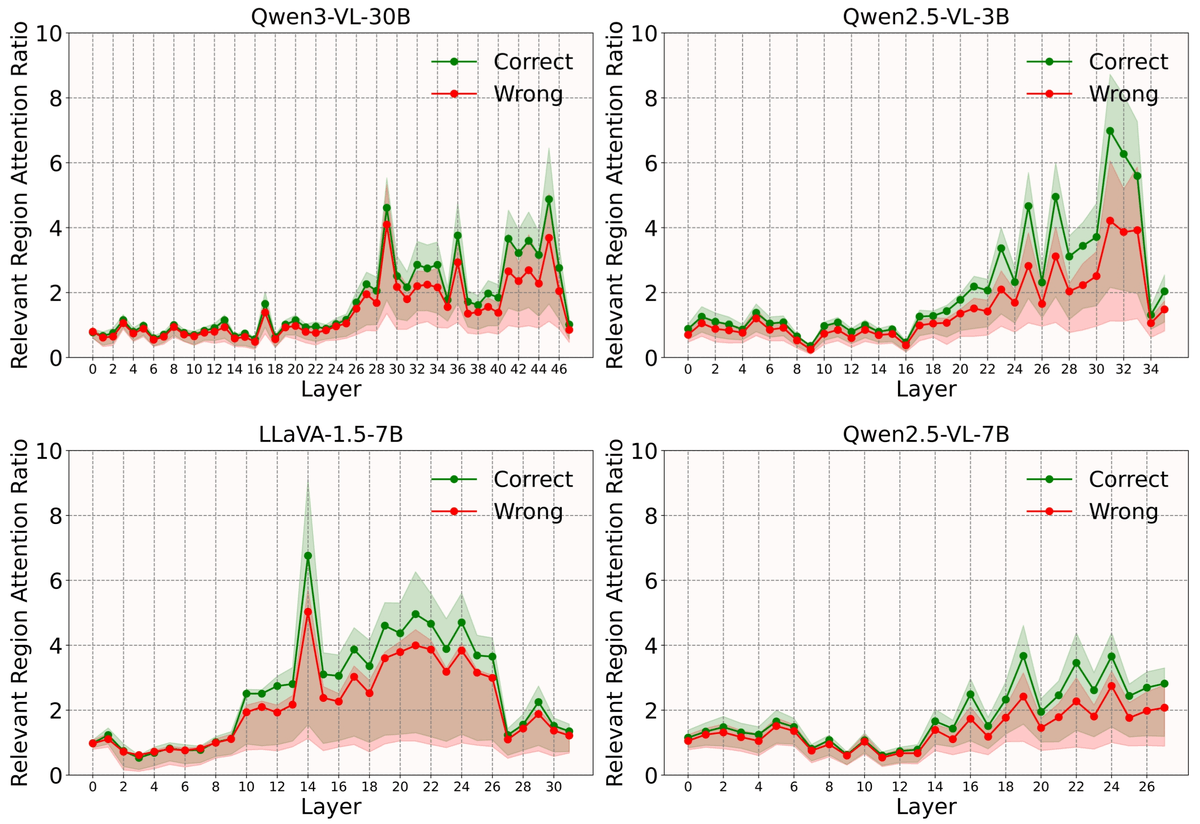
To quantify this, the authors define a Relevant Region Attention Ratio (RRAR), which compares how much attention lands on the ground-truth answer region versus the image as a whole. Across seven MLLMs and 1,450 TextVQA samples, correct answers consistently show higher RRAR than wrong ones, and the ordering is stark:
- Reason (CoT) prompts: lowest RRAR, lowest accuracy
- Direct answering: higher RRAR, higher accuracy
- Region-guided prompts (telling the model where to look): highest RRAR, highest accuracy
Step-by-step reasoning systematically pulls attention away from the pixels that matter.
Not all attention heads look at images the same way
The mechanistic insight is at the head level rather than the layer level. The authors compute two metrics per head: R_img, the share of attention going to visual tokens, and H_img, the entropy of that attention within the image. A head that dumps attention broadly across every patch has high R_img but also high entropy. A head that actually processes visual content tends to have high R_img and low entropy, meaning it concentrates on specific regions.
Across five models including LLaVA-1.5-7B, Qwen2.5-VL-3B/7B, Ovis2.5-2B, and Gemma-3-4B, the relationship between R_img and H_img is nearly linear, with Pearson correlations above 0.92 and intercepts near zero. This is the paper's most useful contribution outside of the method itself: a way to identify visual processing heads at inference time using only attention statistics, no bounding boxes or labels required.

How VRGA works
The framework has two stages. First it localizes question-relevant regions without any ground truth, then it reweights attention during response generation.
- Adaptive head selection. Compute an Entropy-Focus Ratio, defined as
EFR = H_img / R_img, for every head. Keep the heads with highR_imgand low EFR. These are the vision-focused heads that both attend to the image and concentrate on specific areas. - Background subtraction. Many heads sink into the same non-informative tokens (things like the top-left corner). The authors identify a set of background heads with low image attention and dispersed patterns, then subtract their averaged attention from the vision-focused attention map. This removes attention-sink noise.
- Region localization. Visual tokens exceeding a threshold in the cleaned attention map become the question-relevant token set.
- Attention reweighting. During generation, multiply attention weights on those tokens by
(1 + gamma)in the vision-focused heads only, then renormalize. Other heads are left alone so linguistic reasoning is not disturbed.
To confirm the selected heads actually matter, the authors mask them and measure the accuracy drop on TextVQA. Zeroing the VRGA-selected heads collapses Qwen2.5-VL-3B from 87.6% to 24.3%, while random masking or masking low-visual heads barely moves the needle. The heads it picks are load-bearing.
Results across three benchmarks
VRGA was evaluated on HaloQuest, HallusionBench, and MMStar using Qwen2-VL-7B, Qwen2.5-VL-3B/7B, and Qwen3-VL-30B. The improvements on the comprehensive score (which combines accuracy with an irrelevance penalty) are consistent but modest, in the 1-6 point range:
- Qwen2.5-VL-7B on HaloQuest: accuracy jumps from 66.67% to 73.96%, comprehensive score 0.502 to 0.549
- Qwen2.5-VL-3B on HaloQuest: comprehensive score 0.445 to 0.488, driven mostly by irrelevance dropping from 0.601 to 0.405
- Qwen3-VL-30B on MMStar: 66.1% to 67.1%
Compared baselines like CCoT and ICoT often reduced accuracy on these hallucination-heavy benchmarks, sometimes catastrophically. VRGA held or improved accuracy while cutting irrelevant reasoning.
Where it helps and where it does not
The method is best suited for perceptually grounded VQA where a small image region contains the answer: reading text in a scene, counting objects, spotting attributes. It is a decoder-side inference intervention, so it composes with any transformer-based MLLM without touching weights or the visual encoder.
Two caveats worth noting. Absolute accuracy gains on standard multiple-choice benchmarks like MMStar are small, because those tasks depend less on precise spatial grounding. And the method inherits whatever biases the underlying attention has: if the head-selection heuristic misclassifies attention sinks as visual heads on certain images, the reweighting could reinforce noise rather than signal. The background subtraction step is specifically designed to mitigate this, but the tuning of the reweighting strength gamma, threshold tau, and background weight lambda is still per-model.
The code is available on GitHub. Given that VRGA needs only attention hooks and a handful of scalars, it is a cheap thing to try on top of any Qwen2.5-VL or Qwen3-VL deployment where hallucination in extended reasoning has been a headache.