
Tsinghua Catches Failing AI Reasoning Models Before They Waste 93% of Tokens
Researchers from Tsinghua and Ant Group found reasoning models leak signals of failure early, letting you stop them before wasting 60-90% of tokens.
 Pro
Takeaways
- Tsinghua and Ant Group show reasoning models leak failure signals early, before or during reasoning, via this paper.
- Confident vs uncertain expression density in reasoning traces predicts final correctness with high accuracy as early as 2% into the trace.
- A linear classifier on the last input token's hidden state separates solvable from unsolvable questions with 96.7-98.9% accuracy.
- Two monitors, Monitor_express (black-box) and Monitor_hidden (white-box), cut token usage by 62.7-93.6% with negligible accuracy loss.
- Tested on AIME, HMMT, AMC across GPT-oss-20B, DeepSeek-R1-Distill variants, and QwQ-32B; simple system-prompt abstention baselines fail.
- Signals partially correlate with question difficulty and generalize to LiveCodeBench; code is open-sourced.
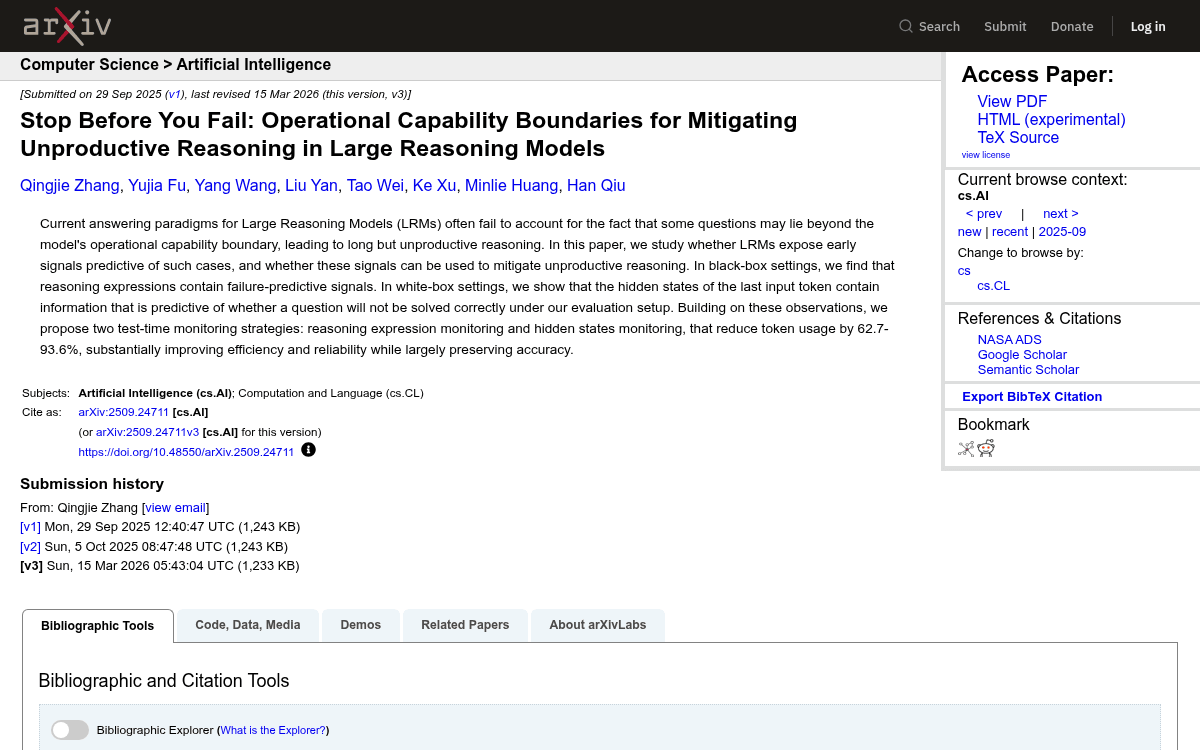
Large reasoning models have a bad habit: when they hit a question they cannot solve, they do not stop. They keep thinking, loop through the same broken deduction, accumulate errors, and burn through the entire context window before spitting out a wrong answer or nothing at all. A new paper from Tsinghua University and Ant Group argues this waste is avoidable, because the models themselves telegraph failure long before it happens.
The paper, Stop Before You Fail, studies what the authors call the operational capability boundary: under a fixed evaluation setup, the empirical separation between questions the model eventually solves and those it does not. Their claim is that this boundary shows up in two observable signals, and monitoring either one lets you cut off unproductive reasoning early while barely touching accuracy.
The tell in the reasoning trace
The first signal is behavioral. In black-box settings, the authors find that reasoning expressions contain failure-predictive signals. Concretely, they extract two vocabularies per model: confident tokens like "exactly," "no mistake," "I'm confident," and uncertain tokens like "wait," "hmm," "not sure," "might be wrong." They then track how densely each type appears across the reasoning trace.
The pattern is sharp. When a model eventually solves a problem, its confident-expression curve rises and accelerates, taking on a concave shape. When it will fail, the uncertain curve dominates and the trajectory turns convex. The authors formalize this with two indicators, ConfDiff (the sign of the gap between uncertain and confident density) and ConfCurv (the second derivative of that gap). ConfDiff turns out to be the more reliable signal, and it fires early, in some models within the first 2% of the reasoning trace.

The tell before reasoning even starts
The second signal is more surprising. In white-box settings, the hidden states of the last input token contain information that is predictive of whether a question will not be solved correctly under the evaluation setup. In other words, before the model generates a single reasoning token, the representation of the prompt already encodes whether it is going to fail.
The authors extract the last-token hidden state during prefill and train a plain linear classifier, either Linear Discriminant Analysis or Logistic Regression, to separate solvable from unsolvable questions. On GPT-oss-20B, R1-Distill-Qwen3-8B, R1-Distill-Qwen-32B, and QwQ-32B, the linear separation accuracy sits between 96.7% and 98.9%. Even more interesting: among questions the model does answer correctly, those sitting closer to the decision boundary need 1.5 to 2 times more tokens than those farther away. The hidden state does not just encode "will this fail," it encodes "how hard is this going to be."

Two monitors, one goal
These observations turn into two test-time strategies:
- Monitor_express (black-box): Track confident and uncertain expression densities as reasoning unfolds. If ConfDiff crosses a threshold, terminate the trace and reprompt the model with a suffix telling it the question is beyond its capability boundary and to output a concise 5-step approach instead.
- Monitor_hidden (white-box): Run a linear classifier on the last-token hidden state before reasoning begins. If it predicts failure, prefill an output prefix that has the model acknowledge the limit and outline a short approach rather than attempt a full solution.
Tested on AIME'24, AIME'25, HMMT, and AMC'23, the results across four reasoning models are striking:
| Model | Token reduction (4k ctx) | Overflow drop | Accuracy change |
|---|---|---|---|
| GPT-oss-20B | 62.7% (express) | 97.0% to 15.2% | unchanged |
| R1-Distill-Qwen3-8B | 69.7% (hidden) | 100% to 0% | -3.1 points |
| R1-Distill-Qwen-32B | 86.2% (hidden) | 97.4% to 5.3% | -0.9 points |
| QwQ-32B | 93.6% (hidden) | 100% to 0% | unchanged |
A useful sanity check: the baseline they compare against, BoostAbstention, simply adds a system prompt telling the model to admit when it cannot solve something. It has essentially zero effect. Across both black-box and white-box analyses, LRMs expose such signals early: reasoning expressions differ systematically between eventually solved and unsolved questions, while the hidden states of the last input token are predictive of eventual correctness even before reasoning begins. Prompting alone is not enough; you need to read the model's internals or its live reasoning behavior.
Caveats worth knowing
The authors are careful about what they are and are not claiming. The signals should be interpreted as predictive correlates of eventual failure rather than definitive evidence of a formally defined intrinsic capability boundary. In particular, these signals may partially reflect question difficulty. The evaluation is also mostly math-focused. A coding experiment on LiveCodeBench shows the reasoning-expression signal still works well (97-100% separation), but the hidden-state signal weakens (77-92%), likely because coding difficulty is not as visible in the prompt itself.
There is also a per-model quirk. GPT-oss-20B is stubborn about output prefixes, sometimes generating an approach then reversing course to try full reasoning anyway, so Monitor_express works better on it. The three DeepSeek and QwQ models are the opposite, more compliant with prefill guidance, so Monitor_hidden wins on token savings. Practitioners will want to test both.
Why this matters
The paper sits in the growing efficient-reasoning literature, but most prior work targets overthinking on easy problems, cases where the model would eventually get the right answer if it stopped sooner. This one targets the opposite failure mode: questions the model will not solve no matter how long it thinks. That is where the biggest token bills come from, because those traces routinely run to the full context limit.
For anyone shipping reasoning models in production, the practical upshot is a lightweight monitor, either a regex-based expression counter or a single logistic regression on hidden states, that can flag unsolvable prompts within the first few percent of the reasoning trace and swap a doomed 4,000-token generation for a concise 200-token outline. The authors have open-sourced their code, and given how small the classifiers are, integration is largely a matter of hooking into prefill outputs or tokenized reasoning streams.