
Tsinghua and Alibaba's LASA Slashes Multilingual AI Jailbreaks from 24.7% to 2.8%
A new method locates the mid-network layer where meaning trumps language, then anchors safety training there to close cross-lingual jailbreak gaps.
 Pro
Takeaways
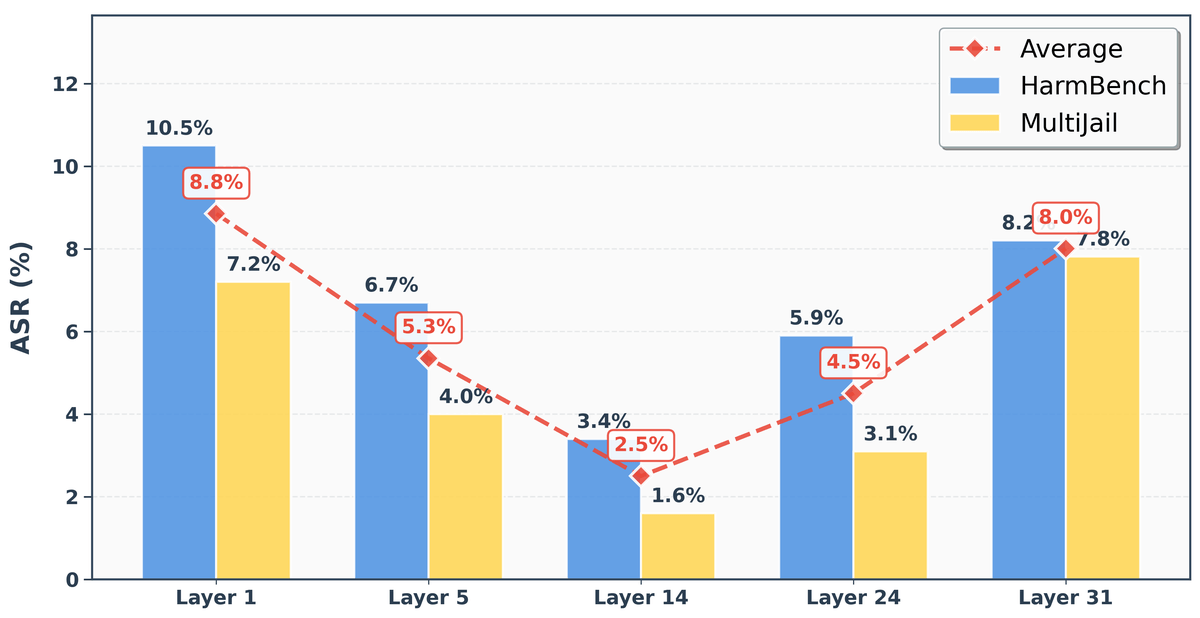
- LASA identifies a mid-network 'semantic bottleneck' layer where LLM representations cluster by meaning rather than language.
- A tiny MLP safety classifier (under 0.2% of model params) trained on that layer generalizes to unseen low-resource languages.
- Average attack success rate drops from 24.7% to 2.8% on LLaMA-3.1-8B-Instruct across 10 languages.
- Swahili attack success falls from around 50% under baselines to 13% with LASA on Qwen2.5-7B.
- General capability on HarmBench, MMLU, MT-Bench, and MGSM is preserved or slightly improved, with no alignment tax.
- Limitation: implicit harmful intent requiring multi-step reasoning (e.g. obscure emoji prompts) still evades the semantic classifier.
Large language models tend to be well-behaved in English and Chinese, but ask them the same harmful question in Swahili or Bengali and the guardrails often fall apart. A team from Tsinghua's Conversational AI group and Alibaba just published a paper arguing this gap has less to do with missing training data in low-resource languages and more to do with where in the network safety is being enforced. Their fix, called LASA (Language-Agnostic Semantic Alignment), moves safety alignment away from surface text and into an intermediate layer where the model has already stripped away language identity and is thinking in pure meaning.
Average attack success rate drops from 24.7% to 2.8% on LLaMA-3.1-8B-Instruct, and stays around 3 to 4% across Qwen2.5 and Qwen3 Instruct models from 7B to 32B. On Swahili specifically, where most baselines still fail about half the time, LASA cuts attack success to roughly 13%.
The multilingual safety gap nobody has solved
The standard playbook for multilingual safety is to collect or synthesize refusal data in each target language and fine-tune with SFT or preference optimization like DPO or KTO. It works, sort of. When existing alignment is applied only to high-resource languages, models achieve near-zero attack success on training languages yet still leave about 50% attack success on Swahili. Translating safety data into every low-resource language is expensive, brittle, and doesn't scale to the long tail.
The authors argue the real issue is a mismatch. Base models learn to map many languages into a shared meaning space, so semantic understanding generalizes. Safety training, however, happens in text space, inheriting whatever language distribution the alignment data was written in. The model