
Trustworthy Engineered Autonomy Lab Builds Vision-Only Safety Predictor With Formal Guarantees
A University of Florida team built a framework that predicts whether a camera-controlled robot will stay safe, with statistical guarantees and no access to internal state.
 Pro
Takeaways
- New framework predicts safety of camera-only autonomous robots with conformal calibration guarantees.
- Composite pipelines (encoder + latent forecaster + evaluator) beat monolithic classifiers on long horizons.
- VQ-Transformer forecaster reaches 89.35 F1 at 120-step horizon vs 79.51 for monolithic CNN.
- MEMO-based unsupervised domain adaptation cuts OOD false positive rate from 52.78% to 7.07%.
- Conformal calibration achieves 96%+ coverage on racing car, cart pole, and donkey car benchmarks.
- Code released at Trustworthy Engineered Autonomy Lab GitHub.
Predicting whether an autonomous car will still be on the track ten seconds from now is easy when you have GPS, wheel odometry, and a physics model. It gets much harder when your controller is a neural network staring at raw camera pixels, which is the direction Tesla and other end-to-end driving stacks have pushed the industry. A new paper from the Trustworthy Engineered Autonomy Lab tackles exactly this gap, introducing a modular safety-prediction pipeline that works entirely from image sequences and comes with formal calibration guarantees.
Why vision-only autonomy breaks classical verification
Traditional safety verification for robots leans on two things the paper explicitly refuses to assume: a low-dimensional state (position, velocity, heading) and a known dynamics model. Model-based offline verification scales poorly to vision systems, as it demands detailed modeling of the perception subsystem, and even black-box statistical risk assessments usually assume access to structured state variables and rich outcome labels.
The alternative, plugging softmax outputs from a deep classifier into a safety score, has its own well-known problem. Modern deep models often produce overconfident or miscalibrated outputs, undermining reliability, which means a network that says "95% safe" may only be right 70% of the time. In safety-critical control that gap is the difference between an intervention and a crash.
The setup: predict safety chances from a rolling image window
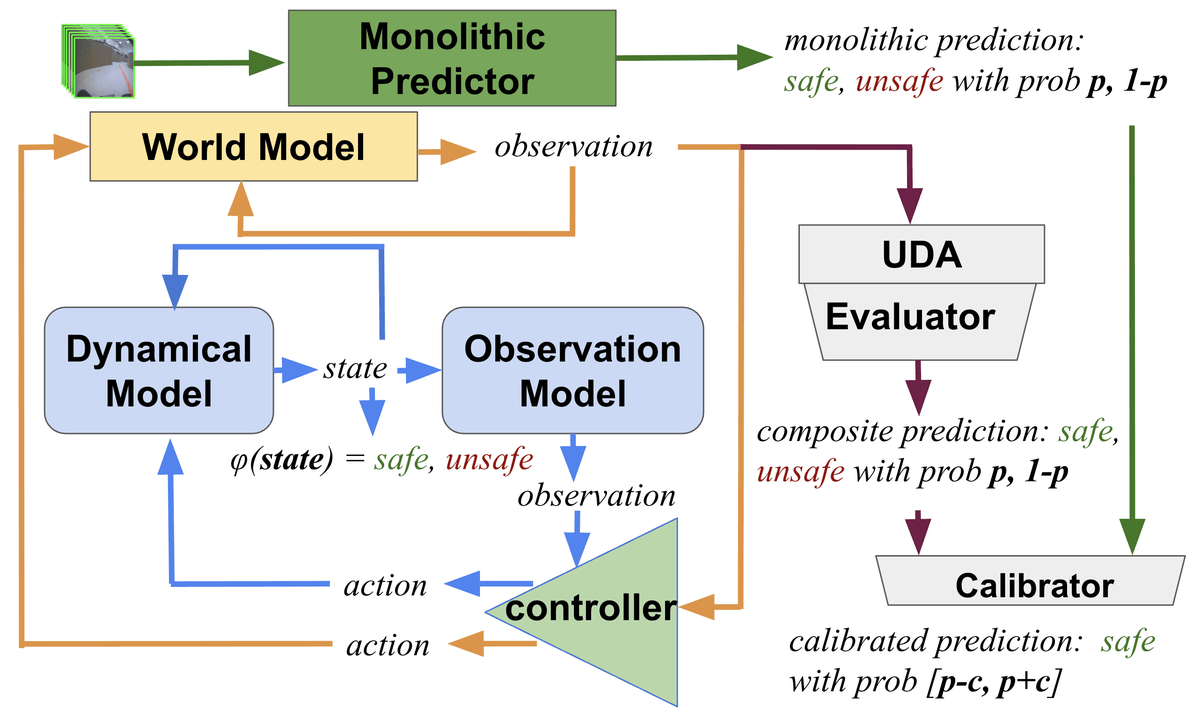
The problem the authors formalize is deliberately narrow and practical. Given the last m RGB frames from a robot's camera, estimate the probability that the system will still satisfy a safety property k steps into the future, and produce an interval that contains the true probability with confidence at least 1 - α. No access to f (dynamics), no access to o (observation model), just pixels and past actions.
They compare two architectural philosophies, which they call monolithic and composite predictors. A monolithic model maps image sequences directly to a safe/unsafe probability in one forward pass. A composite pipeline explicitly separates the job into three stages:
- An encoder (VAE or VQ-VAE) that compresses each frame into a compact latent vector.
- A latent forecaster (LSTM, BiLSTM, or Transformer) that rolls the latent state
ksteps ahead. - An evaluator that reads the forecasted latents and outputs a safety label.

This composite view is essentially a world model repurposed for safety. Instead of using the imagined trajectory to train a policy, the imagined latent trajectory is fed into a downstream classifier that judges whether the future looks safe.
Two extra ingredients that make it actually work
Rolling a latent state forward for 100+ steps is a compounding-error nightmare. The forecasted latents drift out of the distribution the evaluator was trained on, so a classifier that looked accurate on real images starts hallucinating on synthetic ones. The paper attacks this with two complementary tools.
The first is unsupervised domain adaptation via MEMO (marginal entropy minimization). At test time, each forecasted image is augmented seven different ways (autocontrast, rotation, shear, posterization, and others), the evaluator predicts each version, and its parameters are nudged by one gradient step to minimize the entropy of the averaged prediction. No labels required. This is the trick that keeps the evaluator honest when the decoder's outputs look subtly wrong.
The second is conformal calibration. Instead of trusting raw softmax scores, they treat calibration bin-wise: for each confidence bucket, they compute the empirical error between predicted and true safety rates on resampled validation sets, rank those errors, and take the (1-α)-quantile as a statistical upper bound. The result is a predicted safety chance wrapped in an interval that provably contains the true probability with the requested confidence.

Numbers on three benchmarks
They test on OpenAI Gym's racing car and cart pole, plus a physical Donkey Car platform. The pattern across all three is consistent:
- On long horizons the composite VQ-Transformer wins. On the racing car at k=120, it hits an F1 of 89.35 versus 79.51 for the monolithic CNN baseline, and monolithic models degrade faster as the horizon grows.
- UDA drastically cuts false positives under distribution shift. On the racing car OOD subset, the image evaluator's FPR of 52.78% drops to 7.07% with the UDA image evaluator, and the mix subset FPR falls from 23.53% to 4.37%, essentially without hurting in-distribution performance.
- Conformal bounds actually hold. Coverage measured on test data was 96.24% ± 4.75% for the racing car, 96.09% ± 5.71% for the cart pole, and 98.52% ± 3.76% for the donkey car, all matching the target 95% confidence.
What is genuinely new here
Two things stand out beyond the benchmark improvements. First, the framework offers calibration guarantees without a state model. Earlier work on conformal safety prediction, including conformal prediction for STL runtime verification, needed either low-dimensional states or explicit temporal-logic specifications. Doing this straight from pixels was largely unexplored.
Second, the ablation makes a clear architectural argument that will be useful to anyone building safety monitors: predicting a probability is easier to calibrate than predicting a binary label on long horizons, and modular decomposition (encode, forecast, evaluate) beats a monolithic classifier when the horizon stretches to 100+ frames. The results support the hypothesis that the inferior performance of monolithic predictors arises from the inherent difficulty of learning coherent, long-term latent dynamics.
Where it falls short
The framework is not magic. Safety has to be inferable from raw sensors, which rules out things like an aircraft whose failure mode depends on internal component stress. Labeling remains expensive. The donkey car case study required over 10,000 hand-labeled images. And the safety specifications are restricted to simple binary predicates over state, so temporal properties like "never brake harder than X for more than Y seconds" are future work, with the authors pointing at linear temporal logic extensions.
Code is released at the hsai-predictor GitHub repo, which includes the training pipelines for both the OpenAI Gym benchmarks and the physical donkey car setup, making this a reasonable starting point for anyone trying to bolt a calibrated safety monitor onto an existing vision-based controller.