
Triple X Slashes Speech Recognition Errors in Half Across 11 Languages
An encoder-adapter-LLM speech recognition system cuts word error rate in half versus baseline across 11 languages, using Whisper, Qwen3, and 30,000 hours of audio.
 Pro
Takeaways
- Triple X takes second place at MLC-SLM Challenge Task 1 with 9.67% WER.
- Architecture combines Whisper-large-v3 encoder, a Linear-ReLU-Linear adapter, and Qwen3-8B-Base as the LLM.
- Three-stage training: fine-tune encoder, then adapter-only, then LoRA on the LLM.
- Trained on 1,500 hours of challenge data plus 30,000 hours from GigaSpeech2, Reazonspeech, and MLS.
- Qwen3-8B-Base outperforms the instruction-tuned Qwen3-8B across all beam sizes tested.
- Cuts baseline WER of 20.17% roughly in half across 11 languages; no code released.
A team from the Chinese Academy of Sciences and LIGHTSPEED just published the technical report behind Triple X, the speech recognition system that took second place in Task 1 of the INTERSPEECH 2025 MLC-SLM Challenge. The system cuts word error rate from the official baseline of 20.17% down to 9.67% on the evaluation set, and it does so by wiring a Whisper encoder into a Qwen3 language model through a lightweight adapter and a three-stage training recipe.
Why multilingual conversation breaks classic ASR
The MLC-SLM Challenge is a satellite event built around real-world dialogue in 11 languages. It uses a 1,500-hour corpus and evaluates end-to-end systems with metrics like WER, DER, and tcpWER, emphasizing modular LLM-based integration and adapter-based fine-tuning to address real-world issues such as code-switching and speaker overlap. Classic encoder-decoder ASR pipelines (Whisper, Paraformer, FireRedASR) do well on clean monolingual speech, but they struggle when a single conversation mixes languages, accents, and informal speech patterns.
The idea behind speech-LLM systems is to reuse the linguistic priors already baked into text LLMs like Qwen, LLaMA, or DeepSeek. Instead of asking an acoustic decoder to learn grammar, vocabulary, and disfluency handling from scratch in every language, you let a pretrained text LLM do that part, and only teach it how to read audio features.
The three-part architecture
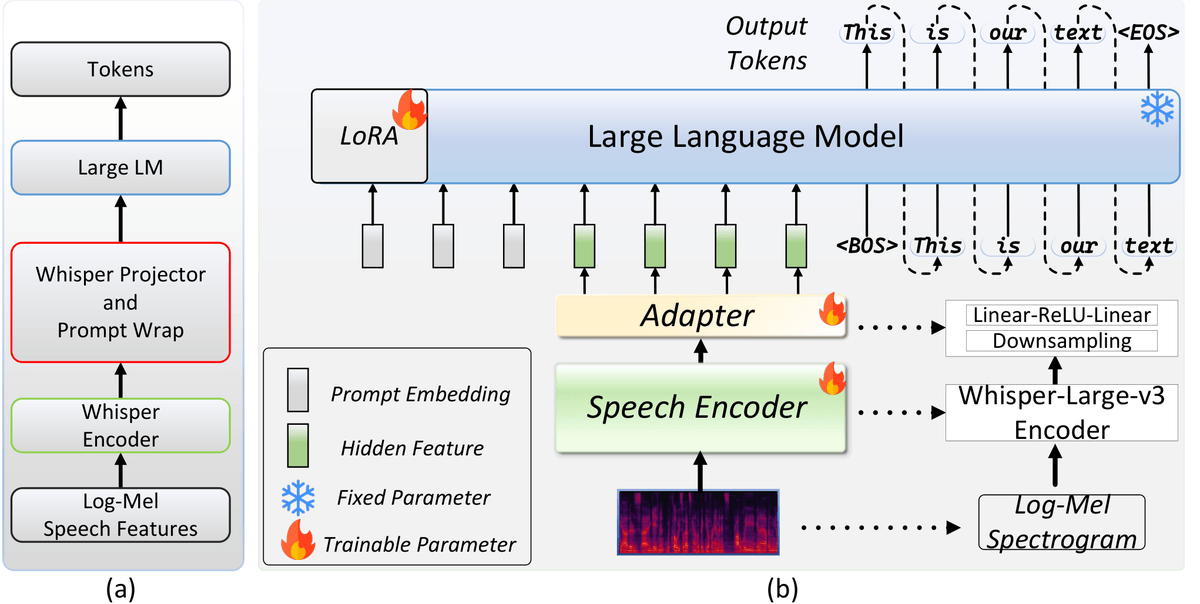
Triple X is deliberately simple. It has three modules that get their name from the paper title:
- Encoder: the Whisper-large-v3 encoder, which turns 128-dimensional log-Mel spectrograms into acoustic-semantic features.
- Adapter: a frame-splicing downsampler followed by a Linear-ReLU-Linear projection. Its job is to shorten the audio sequence (which is much longer than the equivalent text) and remap it into the LLM's embedding space.
- LLM: initialized from Qwen3-8B-Base, which receives the projected audio embeddings plus a user prompt and autoregressively generates the transcription.
The authors note that they tried multiple downsampling strategies for the adapter and found no meaningful difference, so they went with the simplest option: frame splicing. That is a useful negative result if you are building something similar.
The three-stage training recipe
The heavy lifting is in how the modules are trained. Everything is not fine-tuned jointly from scratch:
- Stage 1: Fine-tune the full Whisper-large-v3 model on the target data, then keep only its encoder weights to warm-start Triple X. This gets the acoustic features closer to the challenge domain before the LLM is ever touched.
- Stage 2: Freeze the encoder and train only the adapter. This is the alignment step, where audio embeddings get projected into whatever manifold Qwen3 expects for text tokens.
- Stage 3: Apply LoRA (Low-Rank Adaptation, which injects small trainable matrices into the LLM's attention layers while keeping the original weights frozen) to nudge the LLM toward speech transcription without destroying its pretrained knowledge.
SpecAugment and speed perturbation handle data augmentation, and cross-entropy loss is computed only at the transcription positions, not the prompt.
The data mix matters more than the architecture
The team started with the 1,500 hours provided by the organizers, covering English, French, German, Italian, Portuguese, Spanish, Japanese, Korean, Russian, Thai, and Vietnamese. Even on that alone, their model beat 80% of the participants. To push further, they added roughly 30,000 hours from GigaSpeech2, KsponSpeech, Reazonspeech, and Multilingual LibriSpeech.

English dominates that supplementary pool at nearly 41%, with Japanese at 17%, and the rest spread across Vietnamese, Thai, German, French, Korean, Spanish, Russian, Italian, and Portuguese. The imbalance matters: it is likely a big reason English WER stays low while the smaller-share languages benefit less.
Results and what actually moved the needle
Two ablations are worth flagging. First, backbone choice: the instruction-tuned Qwen3-8B lost consistently to Qwen3-8B-Base across every beam size tested, with the base model landing at 10.41% WER at beam 8 versus 10.70% for the instruct version. Instruction tuning appears to hurt when you are grafting an audio front-end onto an LLM. Second, beam size: gains plateau around beam 8 and start to regress at 10, so there is no reason to pay for wider search.
Final numbers on the official evaluation set:
| System | WER (%) |
|---|---|
| MLC-SLM Baseline | 20.17 |
| Triple X | 9.67 |
How it compares to other challenge entries
Triple X was not the only speech-LLM entry. The SHNU-mASR system took a different route: a parallel encoder architecture combining Whisper-large-v3 and mHuBERT-147, with their output embeddings concatenated and fed into the LLM to leverage complementary acoustic and linguistic knowledge. That system landed at 11.76% CER/WER on the blind evaluation set, an 8.41 absolute point improvement over baseline. Triple X's single-encoder-plus-heavy-data approach beat it, which suggests that at this scale, more audio hours matter more than encoder diversity.
What it is good for, and what to watch out for
If you are building multilingual transcription for real conversations (meetings, support calls, interviews across languages) this recipe is a strong template. The encoder-adapter-LLM pattern is easy to reproduce, and the three-stage schedule with LoRA on the LLM is far cheaper than full fine-tuning.
The paper does not release code or checkpoints, so you would need to reproduce it yourself. Other caveats worth noting:
- Performance across the 11 languages is reported only as an aggregate WER, so per-language accuracy on lower-resource languages like Thai or Vietnamese is unclear.
- The system uses oracle segmentation with speaker labels during training. Real deployments would need to pair it with a diarization front-end.
- Beam-size-8 decoding through an 8B-parameter LLM is not cheap, so latency-sensitive applications will need distillation or a smaller backbone.
- Code-switching within a single utterance is not explicitly benchmarked, only conversational multilingual data.
The authors say the next step is unifying recognition and response generation in the same model, effectively turning Triple X into a spoken dialogue system rather than just a transcriber. That is the direction the whole MLC-SLM benchmark is pushing the field toward.