
Toronto Researchers' LEVELUP Makes AI Learn Smarter by Ordering Training Problems
A new curriculum learning method spots the exact problems that separate weaker models from stronger ones, then trains up one rung at a time.
 Pro
Takeaways
- Level Up defines difficulty relative to a series of models of increasing competence, not fixed proxies.
- Transitional problems are those solved by every model above a competence threshold and failed by every model below.
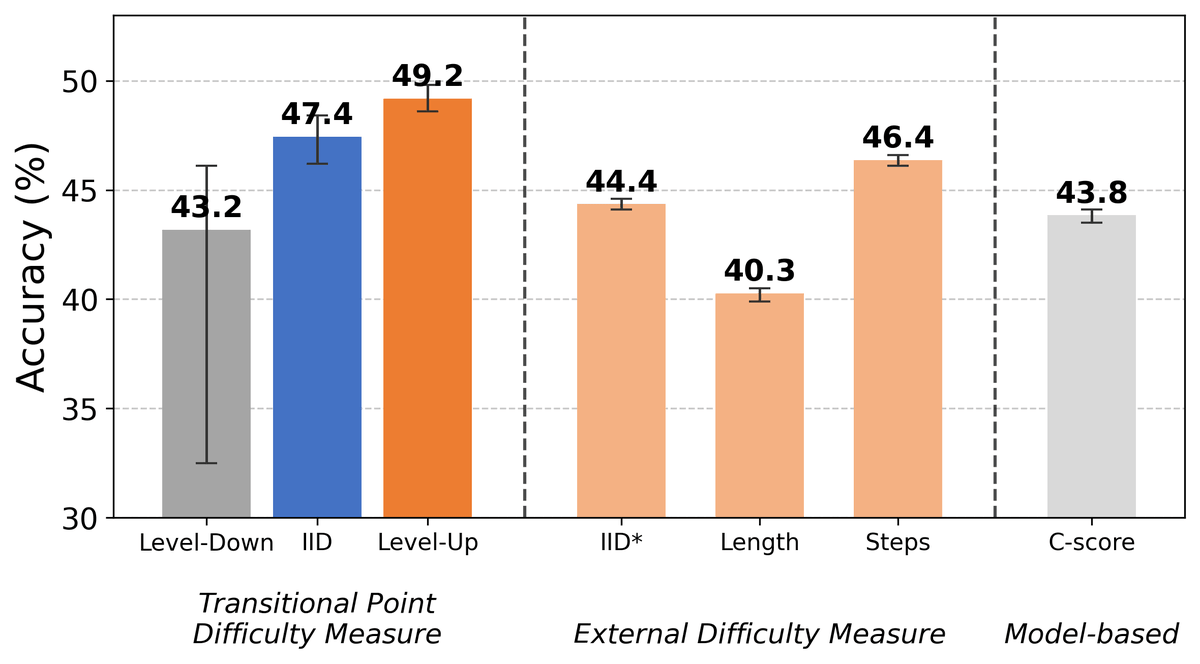
- LEVELUP curriculum trains from lowest to highest transitional level and beats i.i.d., C-score, and human heuristics.
- Validated on GSM8k with Qwen2.5 family and on chess with the Maia-2 skill-aware foundation model.
- Cross-dataset transfer via embedding similarity extends transitional labels from GSM8k to the larger Orca-math corpus.
- Transitional problems correlate with human difficulty features despite no explicit optimization for interpretability.
Curriculum learning has been the awkward cousin of modern ML training for years. The idea, cribbed from how humans learn, is simple: order training examples from easy to hard and the model will learn faster. In practice, the technique has largely fizzled, with negative results piling up in language pretraining and overparameterized networks. A new paper from researchers at the University of Toronto and Columbia proposes a different angle: stop guessing what is hard and instead let a collection of existing models tell you.
The core idea is what the authors call transitional problems. Given a series of models ordered by increasing ability, a transitional problem at level k is one that every model at or above level k solves correctly, and every model below level k gets wrong. Training on these problems in ascending order of level, a strategy the authors call LEVELUP, most efficiently pushes a model into the next tier of competence.

Why the old curricula kept failing
Two flavors of difficulty scoring have dominated the field, and both have real problems. Static approaches use human-centric proxies like sentence length, image quality, or the number of reasoning steps annotated by humans. These are cheap to compute but say nothing about what a specific model actually finds hard. Dynamic approaches watch gradient norms or loss curves during training to score examples on the fly, but the recomputation cost is punishing at scale.
The Level Up method sits between them. It is static, so difficulty is computed once, but it is calibrated to the learner because difficulty is defined against a series of models with monotonically increasing performance. The authors point out that very few curriculum methods leverage the diverse collection of existing models already available for most tasks, even though checkpoints, model families, and in-context adapted variants are lying around in almost every training pipeline.
Three ways to build a model series
To find transitional problems you need a series of models of increasing strength. The paper explores three practical constructions:
- Model family: the Qwen2.5 series at 0.5B, 1.5B, 7B, 14B, and 32B parameters, effectively giving progressive distillation from correctness signals alone.
- Training checkpoints: snapshots of a single model taken every few steps during fine-tuning, subsampled so each level shows roughly a 5% accuracy jump.
- Few-shot adaptation: the same base model with k = 0, 1, 2, 4, 8, 16 in-context examples, which for Qwen2.5-1.5B moves validation accuracy from 35% to 73% on GSM8k.
Once you have the series, a problem is checked against every model. Only those where the pass/fail pattern flips cleanly at a single threshold survive as transitional. Weak models that get a hard problem right by chance or shortcut learning are filtered out by this monotonicity requirement.
The numbers on math and chess
The experiments cover two domains with very different structures. On math, Qwen2.5-0.5B is trained on transitional problems drawn from its larger family members on GSM8k. LEVELUP beats i.i.d. training, C-score ordering, and curricula based on problem length or annotated reasoning steps. When the reverse ordering LEVELDOWN is applied, performance actually drops below random, which is a strong signal that transitional problems really are ordered by learning difficulty.

On chess, the authors use Maia-2, a foundation model whose skill-aware attention lets a single network mimic play at Elo ratings from 1100 to 2000. That single model effectively becomes an entire series through context alone. Training the 1000-rated variant on LEVELUP transitional puzzles beats random ordering, hard-to-easy ordering, and every external heuristic including the number of legal moves, solution length, and human puzzle rating. The ordering LEVELUP > Random > LEVELDOWN holds across three training budgets.
The cross-dataset transfer result is arguably the most practically interesting. The authors identify transitional problems on GSM8k, then use a Qwen3 embedding model to match them by cosine similarity to problems in the much larger Orca-math dataset. Training on these matched neo-transitional problems still outperforms baselines, meaning you can compute difficulty on a small dataset and reuse it on a larger training corpus.
The subtler finding
Beyond the curriculum wins, the authors highlight an interpretability result. Transitional problems, discovered purely from model correctness patterns, correlate with human difficulty features like question length, answer length, and puzzle Elo rating. That correlation is largely absent in the naive baseline of just looking at every problem a given model can solve. In other words, the monotonicity constraint filters out lucky guesses and yields a subset where difficulty is genuinely well-ordered, and that ordering happens to line up with human intuition even though nothing in the method optimizes for it.
An unexpected atomic result on chess: for a model at level i, the single most useful set of training problems is transitional problems at level i+1, not further ahead or behind. This is the ML analogue of Vygotsky's Zone of Proximal Development, and it gives a concrete rule for scheduling improvement one rung at a time.
Where it falls short
The paper is careful about limitations. Only constant pacing is evaluated, with no data mixing between levels. The gradient-norm effect that motivates the method on chess with a CNN backbone does not appear in the LLM math experiments, suggesting the mechanism behind LEVELUP may differ across architectures. Identifying transitional problems still requires running inference across every model in the series against every candidate problem, which is not free, though the cross-dataset transfer trick significantly reduces that cost. And the authors have not released code as of the current preprint.
For anyone doing post-training on reasoning models, especially with distillation from a family of larger teachers, this is a lightweight recipe worth trying: score correctness across your existing models, keep only problems with a clean transition, and train from the easiest transitional level upward. The paper suggests the resulting curriculum beats i.i.d. and the more elaborate baselines on both compute and final accuracy.