
Topological DeepONets Extend Universal Approximation Beyond Classical Banach Spaces
A new theorem extends DeepONet universal approximation from Banach function spaces to arbitrary locally convex spaces, using dual-space linear functionals instead of pointwise sensors.
 Pro
Takeaways
- New paper extends the Chen-Chen operator approximation theorem to arbitrary Hausdorff locally convex input spaces.
- Branch networks use continuous linear functionals from the dual space instead of pointwise sensor measurements.
- Main theorem: continuous operators on compact sets can be uniformly approximated by topological DeepONets.
- Classical DeepONet and dot-product formulation recovered as special cases when inputs are continuous functions.
- Framework covers Schwartz space, distributions, sequence spaces, L_p spaces, and matrix inputs with explicit constructions.
- Purely theoretical result with no code, no rates, and no experimental validation of training behavior.
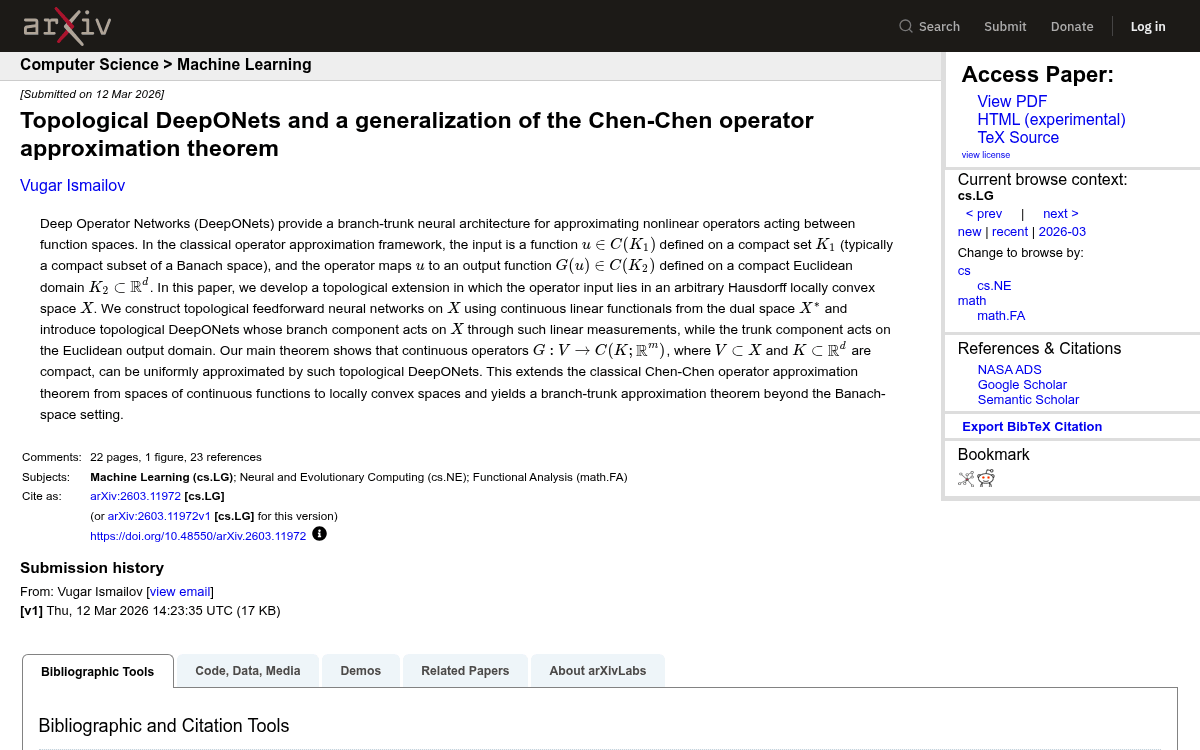
Operator learning has spent the last few years quietly reshaping how researchers approach parametric PDEs, control systems, and multiphysics surrogates. The workhorse of that shift, the Deep Operator Network, rests on a 1995 result by Chen and Chen that guarantees a shallow branch-trunk network can approximate any continuous nonlinear operator between spaces of continuous functions. A new paper on arXiv, Topological DeepONets and a generalization of the Chen-Chen operator approximation theorem, pushes that foundation into much more abstract territory: operators whose inputs live in arbitrary locally convex topological vector spaces, including non-normable spaces like the Schwartz space and the space of distributions.
Why the classical setup runs out of room
The DeepONet architecture uses two subnetworks: the branch net encodes the input function u at fixed sensor points, while the trunk net encodes the information related to the spatio-temporal coordinates at which the solution operator is evaluated. The branch's ability to sample the input u at points like u(x_1), ..., u(x_m) is what makes the classical universal approximation theorem work. Chen and Chen assumed X is a Banach space, K1 a compact set in X, K2 a compact set in R^d, V a compact set in C(K1), and G a nonlinear continuous operator mapping V into C(K2).
That framing is fine when inputs are continuous functions on a compact domain. It breaks down for inputs that are not functions in any pointwise sense: tempered distributions, elements of the test-function space, infinite sequences in c_0, or matrices with arbitrary norms. Many spaces that appear naturally in PDE analysis are not even normable. The Schwartz space of rapidly decreasing smooth functions is a Fréchet space but not normable; the space of test functions is not even metrizable. Point evaluation, the entire premise of a branch net's sensor readings, may not be defined or continuous on these spaces.
Replacing sensors with linear measurements
The paper's central move is to swap point-evaluation sensors for continuous linear functionals drawn from the dual space X*. In classical DeepONets the branch network typically receives values like u(x_1), ..., u(x_r). In the new setting, the input u is an element of a locally convex space and need not be a function, so the branch encoder instead accesses u through finitely many continuous linear functionals that play the role of generalized sensors.
Concretely, a topological neural network on X is defined as a mapping of the form:
H(x) = A * sigma(T(x))
T(x) = (f_1(x) - theta_1, ..., f_r(x) - theta_r)
with f_i in X*, theta_i in R, A in R^(m x r)
When X = R^d, every continuous linear functional has the form f(x) = w · x, so this reduces to the standard affine-then-activation layer. The generalization is that the same construction works whenever the input space has enough dual functionals to separate points, which the Hahn-Banach theorem guarantees for any Hausdorff locally convex space.
The main theorem
The topological DeepONet keeps the branch-trunk split: the branch produces a matrix B(u) in R^(m x p) whose columns are topological networks on X, the trunk produces a vector T(y) in R^p from a Euclidean point y, and the output is the matrix-vector product B(u)T(y). The main result states that for any compact V in a locally convex space X, any compact K in R^d, and any continuous operator G: V -> C(K; R^m), one can uniformly approximate G to arbitrary precision by such a topological DeepONet, provided the activation is a Tauber-Wiener function.
A Tauber-Wiener function is one whose translates and dilations sigma(wt - theta) span a dense subspace of C([a,b]) for every compact interval. Standard activations like sigmoid, tanh, and most non-polynomial continuous choices qualify. The proof uses the Stone-Weierstrass theorem on an algebra of exponentials of dual functionals, then approximates the exponential by activation ridge combinations, and finally glues local ridge approximations of the trunk together with a continuous partition of unity on the compact image G(V).
What falls out as a corollary
Both the original Chen-Chen theorem and the dot-product DeepONet theorem from Lu et al. are recovered as special cases when X = C(K_1) and the linear functionals happen to be point evaluations. The paper also works out explicit forms for several input spaces:
- Finite-dimensional matrix spaces, where functionals are traces
trace(W^T A). - Sequence spaces
l_pandc_0, where measurements are weighted sums against dual sequences. L_pspaces, where measurements are integrals againstL_qkernels.- The Schwartz space, where measurements are pairings with tempered distributions.
- The test-function space
D(U), where measurements are pairings with distributions.
Where this actually helps
This is a purely theoretical paper. There is no code, no benchmark, no trained model. What it delivers is a licensing argument for architectures that already exist and for architectures researchers might want to build. Several operator-learning problems sit uncomfortably in the classical Banach framework:
- Learning solution operators for PDEs whose natural input space is a Sobolev or Schwartz space rather than
C(K_1). - Distribution-valued inputs, such as source terms represented as measures or Dirac combs in inverse problems.
- Operator surrogates where inputs are integral measurements (sensor integrals, projections, spectral coefficients) rather than pointwise samples.
- Multi-input DeepONets and matrix-valued inputs, where the paper's trace-based functionals give a clean approximation story.
The framework legitimizes branch networks that consume integral kernels, Fourier coefficients, or distributional pairings, and it says these variants inherit universal approximation guarantees. That maps onto real design choices already showing up in recent DeepONet variants, including multiple-input operator networks that extend to multiple input Banach product spaces.
What the theorem does not do
The result is a qualitative existence theorem, not a quantitative one. It gives no bounds on network width, depth, sample complexity, or approximation rates. It also assumes compactness of the input set V and continuity of G, both of which the probabilistic L^2 analysis of Lanthaler and coauthors relaxes at the cost of using a weaker distance than the uniform norm. And because there are no experiments, the practical question of whether topological DeepONets trained on distributional or Schwartz-space inputs actually converge well in practice remains open.
Still, the theoretical gap it closes matters. Chen-Chen has been the single most cited justification for the entire DeepONet program, and until now it was tied to continuous functions on compact metric spaces. Moving the guarantee to arbitrary Hausdorff locally convex spaces widens the design space for operator-learning architectures without giving up the uniform approximation flavor that made the original theorem attractive in the first place.