
TopoBench Reveals GPT-5 Mini Hits Just 24% on Spatial Grid Puzzles
A new benchmark shows frontier reasoning models solve fewer than 25% of hard topological grid puzzles, exposing a spatial parsing bottleneck rather than a reasoning one.
 Pro
Takeaways
- TopoBench evaluates LLMs on six topological grid puzzles; frontier models solve under 25% of hard instances.
- GPT-5-mini-high leads at 24% hard accuracy; DeepSeek V3.2 tops open weights at 10%.
- Galaxies and Loopy stay near zero for every model beyond the easy tier.
- Causal interventions show premature commitment and constraint forgetting drive failure; repeated reasoning is a benign search artifact.
- Structured JSON tools beat spatial ASCII rendering; adding render_board actually degrades accuracy by 4 points.
- Code, verifiers, and 900-puzzle dataset available at github.com/mayug/topobench-benchmark.
Frontier reasoning models can crush math olympiad problems and multi-step logic chains, but hand them a paper-and-pencil puzzle involving loops, regions, or reflections and they fall apart. A new benchmark called TopoBench pins down exactly where the failure happens, and the culprit is not what most people would guess.
The team behind the work built a controlled test bed of six topological puzzle families, ran nine reasoning models through it, then dissected 750 chain-of-thought traces to figure out which errors actually cause failure versus which just correlate with it. Even the strongest model tested (GPT-5-mini-high) achieves just 0.24 accuracy on the hard tier, while the best open-weight model (DeepSeek V3.2) reaches just 0.10. The bottleneck, they conclude, is not reasoning. It is extracting spatial constraints from an ASCII grid.
The blind spot in current reasoning benchmarks
Most reasoning benchmarks reward local, step-wise deduction: solve a math problem, chain a few facts, evaluate a logical formula. Retaining a global spatial understanding through sequences of local updates arises in circuit layout, route planning, and molecular structure analysis, where a single violated constraint can invalidate an entire solution. Topological grid puzzles are a clean proxy for that class of problems because a single wrong edge or misplaced region invalidates the whole board.
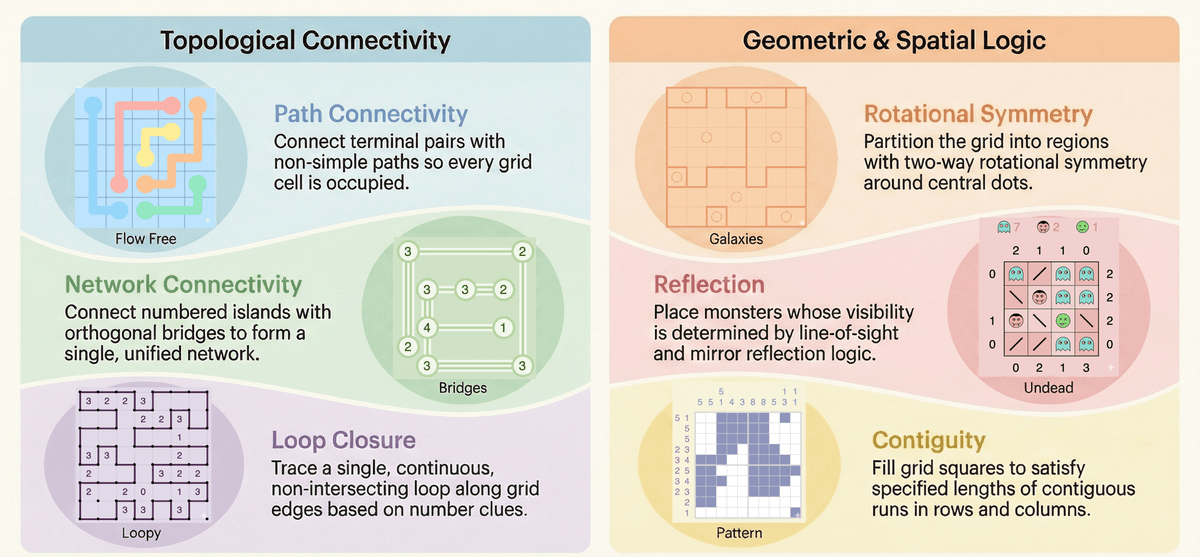
The authors picked six puzzle families from the Simon Tatham suite, each targeting a different global invariant:
- Flow Free - route non-intersecting colored paths (path connectivity)
- Bridges / Hashiwokakero - connect numbered islands with the right bridge counts (network connectivity)
- Loopy / Slitherlink - draw a single closed loop matching edge-count clues (loop closure)
- Galaxies / Tentai Show - partition the grid into rotationally symmetric regions
- Undead - place ghosts, vampires, and zombies so line-of-sight through mirrors matches clues
- Pattern / Nonogram - fill a binary grid to match row/column run-length clues
The benchmark contains 50 puzzles per family and difficulty (easy, medium, hard) for a total of 900 instances, with rule-based verifiers that give binary correct/incorrect judgments.
How badly the models fail
The models were run under one-shot prompting with a 100k token budget, no external code execution, and reasoning mode cranked to the highest available level. Three models (GPT-5 Mini, Gemini 3 Flash, and DeepSeek V3.2) form a clear frontier tier across the benchmark, with substantially higher easy-tier performance than the rest. Performance degrades sharply from easy to medium/hard across nearly all models and families, and puzzle families are not equally difficult.
Galaxies (rotational symmetry) and Loopy (loop closure) remain near zero for every model beyond the easy tier, whereas Bridges (network connectivity) and Pattern (contiguity) retain measurable accuracy into medium and hard. Constraints that require a single global invariant over the whole grid appear categorically harder than ones that decompose into semi-local checks.
Architectural diversity did not help either. Mercury, a diffusion-based language model, and the MoE models LLaMA-4-Maverick and Qwen3-235B all fall well below the frontier tier, suggesting that neither discrete-diffusion decoding nor sparse expert routing gives an obvious advantage on topology-heavy reasoning in the current generation of models.
A two-stage diagnosis: what breaks, and what actually matters
This is where the paper gets interesting. Rather than stop at accuracy numbers, the authors built a diagnostic pipeline with two stages: observational annotation of failure modes, then causal interventions to test which ones actually cause failure.
Using GPT-5-mini as a judge, they labeled 750 chain-of-thought traces with an eleven-category error taxonomy. The four categories they hypothesized might be causal:
- Repeated Reasoning (RR) - the model cycles through near-identical move sequences without variation
- State-Tracking Failure (STF) - the claimed board state drifts from the cumulative effect of the model's own actions
- Constraint Forgetting (CF) - an explicit move directly violates puzzle rules (overcounting, crossing, overwriting fixed cells)
- Premature Commitment (PC) - the model commits to a provably wrong configuration and sticks with it for three or more steps
The observational counts were misleading on their own. Explicit surrender is the most frequent label overall, appearing in 76% of failed traces. Repeated reasoning showed up in 33% of failed traces, while constraint forgetting appeared in only 2 to 7%.
To separate frequency from causation, the researchers injected each error type into partial gold solution prefixes (covering roughly 15% of the correct path) and measured how much downstream accuracy dropped. The results flipped the ranking:
- Premature commitment dropped Bridges accuracy by 20.8 percentage points and Undead by 11.3
- Constraint forgetting dropped both by around 10-11 points, despite being one of the rarest observed errors
- State-tracking failure had a borderline effect on Bridges but hit Undead harder (-11.7)
- Repeated reasoning had no measurable causal effect. Length-matched controls confirmed it is a symptom of search, not a cause of failure
The takeaway: CF is among the rarest errors in the observational analysis yet produces one of the largest causal effects when injected. The reason is subtle. STF introduces a syntactic inconsistency between the grid and the action log, and the model can partially recover by cross-referencing the uncorrupted text. CF, by contrast, produces an internally consistent state that violates puzzle rules, a semantic error detectable only through active constraint verification. The model largely lacks this capability, which explains why even rare constraint violations are so damaging.
The real bottleneck: parsing, not reasoning
The most useful contribution here may be the mitigation experiments, which point clearly at where engineering effort should go. The team tried three interventions: cell-aligned input formats, tool-augmented constraint access, and prompt-level planning guidance.
Input format matters more than expected. Standard BPE tokenizers chop ASCII grids into ragged tokens that straddle cell boundaries, breaking the row-column alignment the model needs to reconstruct 2D structure. Switching to a comma-separated integer format that produces uniform, cell-aligned tokens gave Gemini 3 Flash a 37.3 point boost on Bridges and 32 points on Galaxies. But the effect is not uniform: on Undead and Pattern, integer encodings often degrade performance, in some cases substantially (e.g., -26 pp on Undead for DeepSeek). Adding a rendered image alongside ASCII was mostly a wash or harmful.
The tool-augmented experiment is the cleanest test. The model kept the ASCII input but could call five external tools that maintained the authoritative board state. Two categories of tool were exposed:
- Spatial:
render_boardreturns the current state as ASCII - Structured:
state_summary,neighbors, andcomponentsreturn pre-computed JSON with remaining degrees, legal moves, and connected components
The results are striking. With only structured tools (make_move and state_summary, no spatial grid), accuracy rises to 46%, a 6pp gain over the no-tool baseline, while board-validity errors are eliminated entirely. The full suite of structured tools reached 50% on hard Bridges. But adding the spatial grid back into the mix actually hurt: adding it to the two-tool configuration drops accuracy by 4 pp (46% to 42%), and the model kept calling render_board around eight times per puzzle even when told not to.
Prompt-level fixes were the biggest disappointment. Across 11 prompting conditions - backtracking instructions, worked examples, self-correction directives, mistake-recovery demonstrations - none significantly beat baseline on hard puzzles. Longer prompts consistently made hard-tier performance worse, suggesting that reasoning models with extended thinking largely ignore prompt-level strategy guidance.
Why this matters beyond puzzles
The convergent finding across format changes, tool ablations, and prompt experiments is that the model can solve hard Bridges at 40% even without tools, demonstrating that the underlying reasoning capability exists. What it cannot do reliably is compile spatial layouts into the algebraic form it needs for constraint propagation, which is a step that better input formats ease and structured tools eliminate.
For anyone building agentic systems that operate over spatial or structural data (circuit layouts, molecular graphs, floor plans, network topologies), this is a concrete design signal. Offloading state extraction to an external representation - a symbol table, a graph object, a JSON constraint summary - is likely to pay off more than better prompting or bigger models. The paper also shows that adding a picture alongside text tends to hurt rather than help, at least with current multimodal encoders on grid-structured problems.
There is another benchmark-design lesson buried in the correlation analysis. TopoBench scores correlate only weakly with ARC-AGI, AIME, and general reasoning suites, while other puzzle benchmarks like KORGym and Enigmata correlate strongly with them. Topological reasoning under sustained state-tracking load appears to be a partially independent capability axis that existing evaluations do not capture.
Getting the code
The full benchmark, verifiers, error taxonomy, and intervention scripts are open source at the topobench-benchmark repository. The dataset covers 900 puzzle instances across six families and three difficulty tiers, with per-family verifiers for automated scoring. Given that even top-tier models bottom out at 24% on hard, there is a lot of headroom - and the diagnostic pipeline is arguably more useful than the leaderboard, since it gives a template for separating causal failure modes from correlational ones in any reasoning benchmark.