
Tongji University's LaDA Beats 7.5B Robot Models Using Only 0.6B Parameters
A new framework decomposes robot actions into language-grounded primitives, hitting 93.6% on LIBERO while generalizing to unseen tasks that break competing systems.
 Pro
Takeaways
- LaDA decomposes 7-DoF robot actions into three language-grounded primitives: translation, rotation, and gripper control.
- Achieves 93.6% average on LIBERO with only 0.6B parameters, beating 8.5B FlowVLA.
- Uses soft-label contrastive learning to align semantically similar motions across different tasks in a shared space.
- On unseen "push" instructions, LaDA reaches 12.3% success while CLIP-RT collapses to 0%.
- Weak on high-precision insertion: 48% on Threading, 25% on ThreePieceAssembly_D1 in MimicGen.
- Real-world validation on Franka Panda with 100 demonstrations; paper available on arXiv, no code released.
Robotic manipulation has a stubborn seam running through it. On one side, vision-language models can reason about instructions like "pour the water" or "place the bottle" with impressive fluency. On the other side, the actual motor commands that move a gripper live in a continuous 7-DoF space with no obvious semantic structure. Bridging those two worlds is where most vision-language-action (VLA) systems either overfit or collapse when faced with a task they were not explicitly trained on.
A team from Tongji University is proposing a different bridge. Their LaDA framework (Language-Grounded Decoupled Action Representation) treats language itself as the semantic glue between what the robot sees and how it moves, and it does so by chopping each low-level action into three interpretable pieces described in plain English.
Why end-to-end VLAs keep hitting a wall
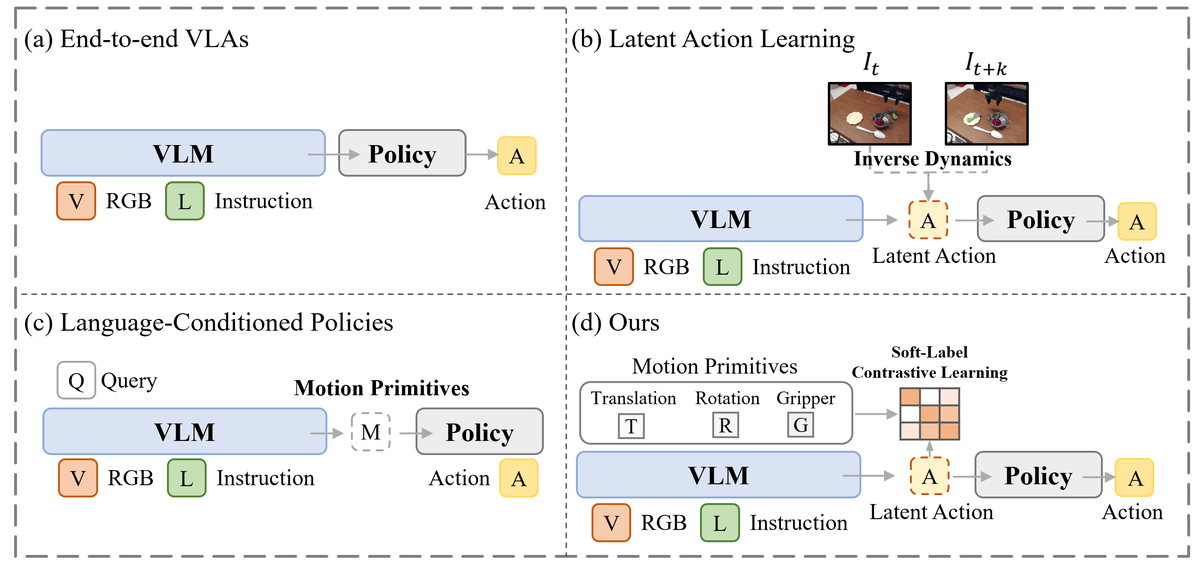
The paper frames the current landscape as three flawed paradigms. End-to-end VLA models such as RT-1, Octo and OpenVLA learn direct mappings from multimodal inputs to low-level control through unified transformer-based policies, but they entangle perception and control, limiting interpretability and the reuse of shared motion structures. Latent action approaches like LAPA and UniSkill encode actions into compact latent spaces, but those embeddings are typically defined by visual deltas without explicit semantics, which hinders cross-task transferability. And language-conditioned policies tend to use coarse commands like "move forward" or "close gripper" that miss the actual translation magnitudes and rotation angles that matter.
The observation driving LaDA is straightforward: tasks like "pour water" and "place bottle" share the same underlying reaching, grasping, and rotating primitives, yet current models learn them from scratch every time.

Three primitives, one shared language space
LaDA's core move is a projection that splits each 7-DoF end-effector action into three orthogonal, language-grounded motion primitives. The translation primitive is expressed with templates like "Move [dist] meters along [dir]", the rotation primitive as "Rotate [mag] degrees around [axis]", and the gripper primitive as discrete "Open" or "Close" commands. Each primitive is discretized into symbolic, language-aligned bins, transforming continuous control trajectories into interpretable semantic categories.
That decomposition alone is not enough, though. The real machinery is a soft-label contrastive objective that treats action similarity as continuous rather than binary. Instead of asking "is action A a positive or negative match for action B?", LaDA builds a similarity matrix where two actions get graded weights based on how many primitive attributes (translation direction, rotation axis, gripper state) they share.
The training loop runs two parallel contrastive paths on top of frozen CLIP encoders:
- Action-Action alignment: pulls latent actions with similar primitive attributes closer together, so "rotate 90 degrees around z-axis" clusters near other rotations regardless of task context.
- Action-Primitive alignment: anchors each latent action to the tokenized text description of its primitive, keeping the embedding space semantically interpretable rather than drifting into arbitrary geometry.
Both use a soft-label InfoNCE loss weighted by the affinity matrix. A third piece, an adaptive weighting scheme inspired by curriculum learning, uses a moving average of each loss to auto-balance the contrastive objective against the imitation loss. This prevents the fine-grained semantic signal from being drowned out by the coarser primitive-classification signal (or vice versa) during training.
Pretraining scale and inference behavior
LaDA is pretrained on a curated subset of the Open X-Embodiment dataset. The subset contains roughly 22.5 million visual frames, where each low-level action is represented as a 7-DoF control vector comprising 3D translation, 3D rotation, and a binary gripper state. Language descriptions like "move 0.5 meters forward, rotate 90 degrees around the z-axis, and close the gripper" are auto-generated from the control vectors to provide the contrastive supervision.
After pretraining, a lightweight MLP action head is fine-tuned with an L1 trajectory regression loss. At inference time the model outputs continuous actions directly from vision and language, with no need to emit primitive labels first, so there is no cascading-error penalty from a two-stage decode.
Benchmark results
On LIBERO, LaDA hits a 93.6% average success rate across the Spatial, Object, Goal, and Long suites while using roughly half the parameters of the closest competitor. The Long suite result is the most interesting: 86.4%, ahead of every baseline reported in the paper including GR00T-N1.5, MolmoAct, and FlowVLA.
| Model | Params | Spatial | Object | Goal | Long | Avg |
|---|---|---|---|---|---|---|
| OpenVLA | 7.5B | 84.7 | 88.4 | 79.2 | 53.7 | 76.5 |
| GR00T-N1.5 | 3B | 92.0 | 92.0 | 86.0 | 76.0 | 86.5 |
| FlowVLA | 8.5B | 93.2 | 95.0 | 91.6 | 72.6 | 88.1 |
| CLIP-RT | 1.3B | 95.2 | 99.2 | 94.2 | 83.8 | 93.1 |
| LaDA | 0.6B | 95.2 | 99.2 | 93.6 | 86.4 | 93.6 |
On MimicGen, which tests contact-rich skills like threading and three-piece assembly, LaDA improves the average success rate by roughly 9% over Phoenix and 16% over CLIP-RT*, highlighting the effectiveness of its language-grounded semantic alignment. The gap widens on multi-step tasks like StackThree_D1, jumping from 52% (CLIP-RT*) to 71%.
Where it actually shines: unseen instructions
The generalization experiment is the one that should get attention. The team tested cross-task instructions (entirely new tasks like "push the plate to the front of the stove") and similar-task instructions (same semantics, shifted target). For the cross-task "push" instruction, CLIP-RT* achieves 0% success, while LaDA reaches 12.3%, indicating that its language-grounded action representation enables the reuse of primitive-level semantics beyond the training distribution.

A 12.3% success rate is not something you would deploy, but the delta from zero is telling: it suggests the decoupled primitives are genuinely compositional, and the model can piece together a novel skill from motion components it has seen in other contexts.
Real-world validation and honest limits
The team deployed LaDA on a 7-DoF Franka Emika Panda with a static RealSense D435i camera, fine-tuning with 100 human demonstrations for a pick-and-place task. It maintained robustness under variations in lighting, object pose, object color, and box placement.

Where LaDA is weaker: high-precision insertion tasks. On MimicGen Threading, it scores 48% versus Phoenix's 68%, and on the harder ThreePieceAssembly_D1 it manages only 25%. Fine, geometric contact tasks apparently do not benefit as much from language-level semantic sharing, since the required motion parameters are dominated by millimeter-scale geometry rather than reusable verbs. Ablations also confirm both components matter: removing soft-label contrastive learning drops the average from 93.6% to 75.5%, and removing adaptive weighting drops it to 87.4%.
The takeaway for practitioners
The paper does not currently link a public code release or model checkpoint, so reproducing LaDA means implementing the primitive decomposition, soft-label similarity matrix, and dual-path contrastive loss on top of a CLIP ViT-L/14 backbone. The CVPR 2026 paper contains enough architectural detail to attempt it, and the underlying idea, that language can supervise low-level continuous control if you structure the primitives correctly, is portable to other VLA stacks. If your bottleneck is generalization to semantically related tasks rather than raw contact-rich precision, this is a design pattern worth stealing.