
Tongji University's DeLL Stops Self-Driving AI from Forgetting Old Skills
A new framework combines Bayesian clustering with causal inference to help self-driving models learn continuously without forgetting past scenarios.
 Pro
Takeaways
- DeLL is the first lifelong learning framework for closed-loop end-to-end driving in CARLA.
- Uses a Dirichlet process mixture model to grow two dynamic knowledge spaces for features and trajectories.
- Applies causal front-door adjustment to remove spurious correlations from unobserved confounders.
- Cuts forgetting ratio from 44.5% to 34% and raises backward transfer from 52.8% to 79.6%.
- Achieves 86.86% driving score on Bench2Drive full-data, edging past SimLingo and HiP-AD.
- Limitations include training overhead from alternating DPMM updates and no sim-to-real evaluation.
Self-driving models trained end to end tend to be brittle in one particularly frustrating way: teach them a new skill like overtaking, and they quietly lose the ability to brake at stop signs they mastered weeks earlier. A team from Tongji University is proposing a fix called DeLL, short for Deconfounded Lifelong Learning, which pairs a non-parametric Bayesian clustering model with a causal inference trick to keep old skills intact while acquiring new ones.
The paper is notable for two reasons. It is the first attempt at closed-loop lifelong learning in CARLA-style end-to-end driving, and it introduces both a benchmark protocol and a set of metrics for measuring how well a driving model remembers what it once knew.
Why end-to-end drivers keep forgetting
End-to-end autonomous driving methods have achieved strong performance in the closed-loop CARLA simulator, but their deployment in open-world, non-stationary environments is hindered by catastrophic forgetting and causal confusion. There are two intertwined problems here. First, imitation-learning networks act as correlational engines, so training on a new scenario tends to overwrite the weights that encoded earlier behaviors. Second, these models often latch onto spurious signals, for example associating a stationary vehicle ahead with the concept of zero velocity, which then generalizes disastrously to other contexts.
The authors describe this second issue in causal terms: unobserved confounders (sensor noise, weather, lighting) sit upstream of both perception inputs and the correct action, producing correlations that look useful during training but break under distribution shift.

Two knowledge spaces that grow themselves
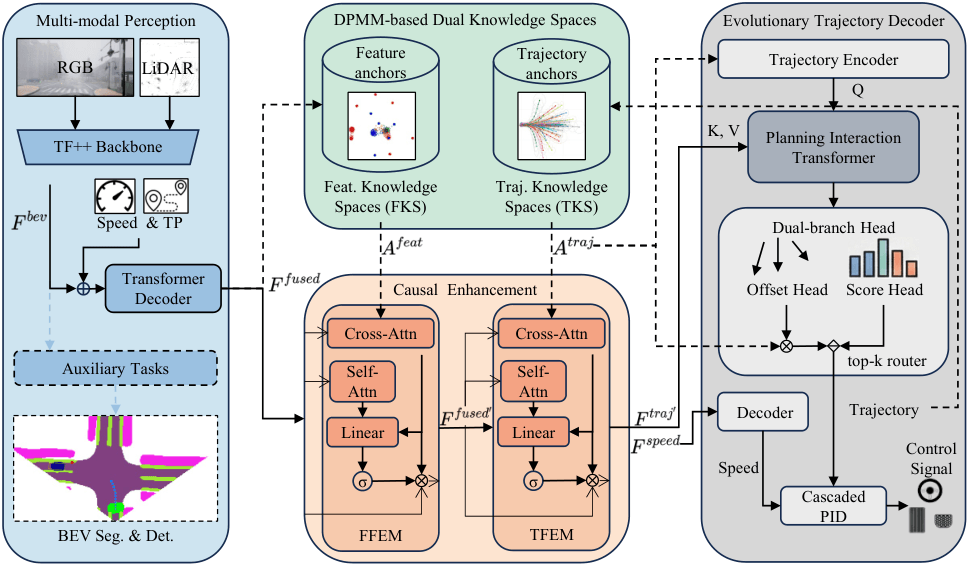
DeLL's central idea is to give the network an external, growing memory instead of relying solely on its fixed weights. That memory is built with a Dirichlet process mixture model (DPMM), a Bayesian non-parametric technique that decides for itself how many clusters the data needs. As new driving scenarios are encountered, it dynamically instantiates new cluster components (knowledge anchors), preserving historical knowledge in isolated, specialized distributions.
The framework maintains two of these spaces in parallel:
- Feature Knowledge Space (FKS) clusters the fused perception features coming out of the backbone. Its job is to catalog the kinds of scenes the car has encountered.
- Trajectory Knowledge Space (TKS) clusters expert ground-truth trajectories directly, building a growing library of physical maneuvers like sharp turns and lane changes.
Because DPMM is non-parametric, you never need to declare in advance how many driving behaviors exist. New clusters are born when the data warrants it, and existing ones can merge. The authors use memoVB as an efficient approximation, which decomposes global sufficient statistics into mini-batch summations, enabling online coordinate ascent updates, keeping the whole thing tractable during training.
Using causal inference to break spurious shortcuts
The clustered anchors are not just memory, they also serve as mediator variables in a causal adjustment scheme. DeLL implements front-door adjustment, a technique from Pearl's causal inference toolkit that lets you estimate the true effect of an input on an output even when there is an unobserved confounder, provided you can identify a mediator that sits cleanly on the causal path.
Concretely, the framework runs two cascaded modules that both use dual attention and a learned gate. The Fused Feature Enhancement Module cross-attends from the current scene features to the feature knowledge anchors, and the Trajectory Feature Enhancement Module does the same against the trajectory anchors. A sigmoid-gated MLP then decides how much of the causally-adjusted signal to blend back with the raw features. In effect, the model is asking: given the current messy input, which historical prototypes best explain what is going on, and how much should I trust them?
An evolving decoder that grows with the anchor pool
Traditional trajectory decoders have fixed-size output heads, which is awkward when your library of known maneuvers keeps expanding. DeLL replaces this with an evolutionary trajectory decoder that treats trajectory anchors as dynamic query tokens in a transformer. As the DPMM adds clusters, the token pool grows naturally. A dual-branch head then predicts a selection score for each anchor plus a geometric offset to refine it, and the final trajectory is chosen through Top-K routing. This is non-autoregressive, so all candidate trajectories are scored in parallel.
The numbers
The team built a lifelong learning protocol on top of the Bench2Drive benchmark, splitting roughly 512K frames into five sequential tasks: Emergency Braking, Traffic Sign Recognition, Merging, Overtaking, and Giving Way. Tasks are ordered by decreasing data volume, from 184K frames down to just 11K, to stress-test both forgetting and transfer.
After training through the full sequence, DeLL reaches a 74.69% average driving score against 70.55% for the Transfuser++ baseline. The more interesting numbers are on the lifelong-specific metrics:
| Metric | Baseline TF++ | DeLL |
|---|---|---|
| Forgetting Ratio (lower is better) | 44.50% | 33.97% |
| Process Forgetting Ratio | 40.25% | 29.80% |
| Backward Transfer | 52.83% | 79.63% |
| Forward Transfer | 41.11% | 42.88% |
| Multi-Ability Success | 45.23% | 52.08% |
Compared with adapted baselines, DeLL beats Experience Replay (which needs extra memory) and PackNet (which needs double the training time), while using the same 1x training budget. In the full-data setting, DeLL also edges past SimLingo and HiP-AD to a state-of-the-art 86.86% driving score.
What it is good for, and what it is not
DeLL is genuinely useful if you are building a driving stack that needs to keep learning after deployment, or if you want to test how new skills interact with old ones in a controlled setup. The dynamic knowledge spaces also give you interpretable clusters you can inspect, which is more than you get from a black-box policy.
The limitations are honest. The alternating optimization between DPMM updates and network training introduces computational overhead and training cost, and the framework operates within simulated environments, so the domain gap between CARLA and real-world deployment remains an open challenge. No code or pretrained weights have been released with the preprint yet, so reproducing the pipeline currently requires reimplementing the DPMM-plus-front-door machinery on top of Transfuser++.