
Tohoku University's Hexapod Climbs Natural Rock Without Any Cameras
A Tohoku University team built a hexapod climber whose grippers use 132 spring-loaded pins to grasp irregular rocks without any sensing.
 Pro
Takeaways
- Tohoku University unveiled a hexapod climbing robot with pin-array grippers, accepted to ICRA 2026.
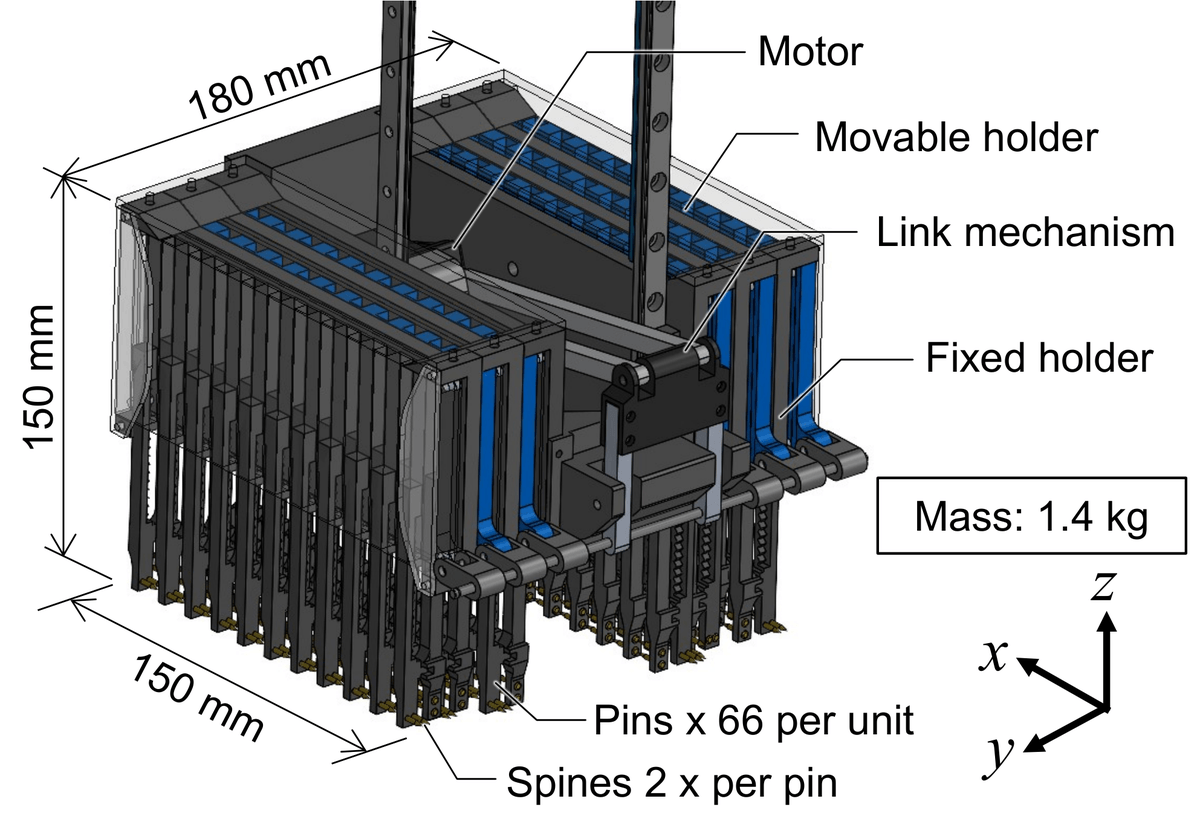
- Each foot packs 132 spring-loaded split pins that mechanically interlock with rock micro-asperities, driven by one actuator.
- The 15.7 kg robot climbed 10, 20, and 30 degree slopes indoors and traversed natural rocky ground outdoors.
- Statically, it held posture up to 65 degrees of incline before claws disengaged from polycarbonate.
- A Monte Carlo model treating pin contact as probabilistic accurately predicts grasp force variability.
- No perception is used; locomotion relies entirely on passive mechanical compliance and redundancy across six feet.
Climbing robots have long struggled with one of the messiest problems in mobility: how to hang onto rocks that look nothing like the neat convex handholds most grippers are designed for. A team from the Space Robotics Lab at Tohoku University has taken a mechanical swing at the problem, building a hexapod whose feet are dense arrays of spring-loaded pins that passively conform to whatever rough surface they land on. The paper, accepted to ICRA 2026, argues that carefully designed hardware can replace the elaborate perception and control stacks most climbing robots depend on.
Why irregular terrain breaks most climbers
Most legged climbers rely on end-effectors that only engage convex surfaces, which rules out concavities, loose grit, and vegetation. That description covers most natural rock. Pin-array grippers inspired by the contour gauges you find in a machine shop have shown promise for grasping oddly shaped objects, but they were mostly studied as standalone hands. According to the authors, this is the first report to study the climbing capability of a robot that exploits pin-array structures for locomotion.
The split-pin trick
Each pin is vertically split into two parts. The lower section carries an elastic element acting as a leaf spring and a metal spike, and the pins slide freely in holders that constrain their horizontal motion. The grasp sequence has three steps:
- Approach the surface roughly perpendicular.
- Press down so the pins passively conform to the terrain.
- Drive one holder sideways with a single motor, which loads the leaf springs and jams the metal spikes into microscale asperities on the rock.