
Tohoku's LIMBERO Climbs Steep Rock Walls Where Planetary Rovers Fail
A Tohoku University team built a 10 kg four-legged climbing robot with spine-hooked feet that scales rocky cliffs under full Earth gravity.
 Pro
Takeaways
- Tohoku University unveils LIMBERO, a 10 kg quadruped climbing robot with spine grippers, accepted at ICRA 2026.
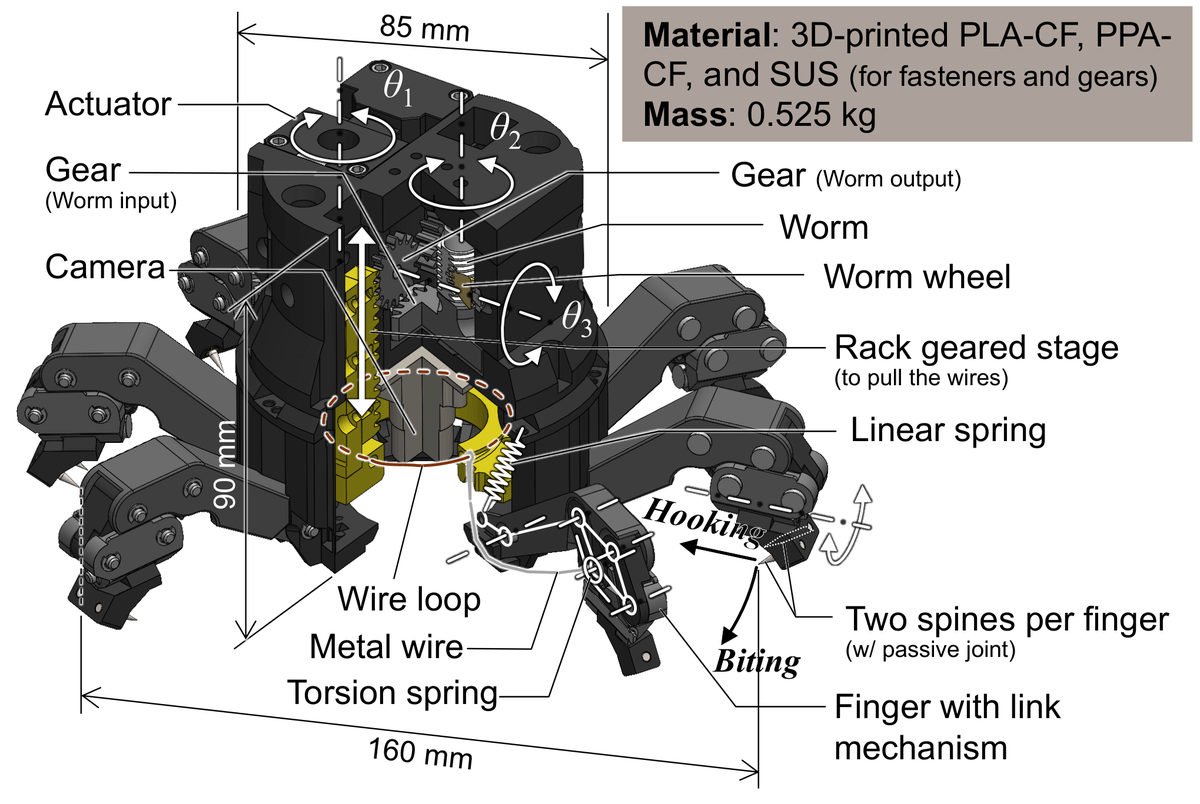
- Novel single-motor gripper couples finger-closing and spine-hooking, delivering over 150 N grip force at just 525 g.
- Sixteen spines per foot on passive roll joints distribute load and adapt to microscopic rock asperities.
- New algorithm computes a geometry-based graspability index directly on continuous rough terrain.
- First demonstration of a limbed climbing robot at this scale ascending rocky surfaces under full 1 G gravity.
- Targets lunar, Martian, and asteroid exploration terrain where wheeled rovers cannot operate.
Planetary rovers have a well-known Achilles heel: the moment the ground tilts past a certain angle or turns into a boulder field, wheels stop being useful. A team at Tohoku University's Space Robotics Lab has been chasing an alternative for years, and their latest robot, LIMBERO, is the first at its weight class to actually scale steep rock walls in full Earth gravity rather than a low-gravity mockup.
The paper, accepted at ICRA 2026, describes a 10 kg quadruped whose feet are replaced with spine-covered grippers that hook onto microscopic bumps and cracks in rough stone. A single motor drives coupled finger-closing and spine-hooking motions, producing over 150 N of grasping force from a 525 g end effector. A companion algorithm computes a geometry-based graspability index directly on continuous rough terrain, so the planner can pick footholds without pre-labeled holds.
Why wheels give up and legs take over
Lunar pits, Martian lava tubes, and asteroid boulders are the scientifically interesting targets that current rovers simply cannot reach. The community's answer has been limbed climbing robots that plant claw-like feet into rock, an approach pioneered by NASA JPL with multi-microspine grippers integrated into the LEMUR series for asteroid exploration. Tohoku's earlier prototype, HubRobo, a quadruped with a passive compliant spine gripper at each foot, was engineered down to 3 kg with a base height of 0.16 m.