
Tiny Neural Network Solves Queueing Theory's Hardest Merge Problem 69% Better
A neural operator learns to merge non-renewal arrival streams by mapping their moments and autocorrelations, breaking a decades-old bottleneck in queueing network analysis.
 Pro
Takeaways
- New neural operator merges non-renewal arrival streams by mapping moments and autocorrelations, replacing intractable analytical superposition.
- Trained on 500k Markovian Arrival Processes where exact Kronecker-based superposition provides ground truth labels.
- Only 11,224 parameters; five moments and short-range dependence descriptors are enough to identify the mapping.
- Second-moment error stays under 3 percent versus 30 to 3000 percent for classical Whitt and Albin approximations.
- Combined pipeline predicts steady-state distributions in three-station networks with 4.18 percent mean error.
- Inference runs 5000 instances in 0.004 seconds; code is open source.
Queueing theory has a stubborn open problem: when two arrival streams merge at a shared server, what does the combined stream look like? For Poisson traffic the answer is clean, but real systems rarely behave that way. A new paper proposes a small neural network that learns the merging operation directly from data, and then plugs into a larger pipeline to predict full steady-state distributions of feed-forward queueing networks.
The merge that nobody could compute
In factories, cloud services, and communication links, several traffic streams routinely flow into the same node. The mathematical operation of combining them is called superposition. While the superposition of Poisson processes remains Poisson, and the superposition of Markovian Arrival Processes (MAPs) admits an exact representation through Kronecker constructions, the superposition of renewal or general non-renewal processes is neither renewal nor Markovian in general.
That gap forces practitioners into three unappealing choices. Existing approaches either compress the merged stream into low-order variability summaries, rely on exact but computationally prohibitive Markovian representations, or focus exclusively on mean-value performance measures. The classical approximations from Whitt and Albin, standard fare in operations research textbooks, essentially replace the merged flow with a renewal surrogate characterized by a rate and a squared coefficient of variation. That works for coarse averages, but it throws away temporal correlations that dominate congestion behavior under heavy load.
A learned operator over statistical descriptors
The paper by Eliran Sherzer reframes the problem as a supervised learning task. Instead of predicting sample paths, the model predicts the statistical fingerprint of the merged stream. Given the first several moments and autocorrelation coefficients of two input streams, it outputs the first five moments plus short-range dependence descriptors of their superposition.
The trick to getting training labels: use Markovian Arrival Processes, which are the one non-trivial family where exact superposition is known via Kronecker sums. MAPs are two matrices D0 and D1 governing a hidden Markov chain, where D1 transitions produce arrivals. MAPs are used solely as a data-generation mechanism. Because MAPs are dense in the class of non-negative distributions and can approximate a broad family of stationary point processes, they provide a flexible domain over which to learn the operator. At inference, the model never sees a MAP again. It just takes descriptors as input, sidestepping the state-space explosion that kills exact methods.
Building the training set
Naive sampling of MAP matrices concentrates on boring, moderate-variability processes. To cover extreme regimes, the author designed three generators:
- A construction that forces near-deterministic alternation between fast and slow regimes, producing strong negative autocorrelation.
- A sticky two-regime construction where the process persists in the same regime, yielding strong positive autocorrelation and heavy tails.
- A tunable generator that mixes hyperexponential and Erlang phase-type distributions to broaden squared coefficient of variation, skewness, and kurtosis.
MAPs of up to 100 states per stream are sampled, meaning the exact Kronecker superposition can reach 10,000 states. The average labeling time per instance is approximately 7.6 minutes for smaller MAPs and 8.9 minutes for larger MAPs, executed on a Xeon Gold server for the bigger cases. The final datasets are 500,000 training, 10,000 validation, and 10,000 test samples.
The network itself is deliberately unglamorous: a fully connected feed-forward network with 5 hidden layers of sizes (50,50,70,70,50), totaling 11,224 parameters, batch size 64, weight decay 1e-5, learning rate 0.0001, trained for 150 epochs. Moments are log-transformed before training to handle their exponential scaling with order, and the loss is a weighted sum of MSE on log-moments and MSE on autocorrelation terms.
How compact is the descriptor?
One of the more interesting empirical findings is that this mapping does not need much information. Sensitivity experiments over combinations of input moments n, max lag n1, and polynomial order n2 show the operator saturates quickly. The best performance is obtained at n=5, after which additional moments do not improve accuracy. Regarding temporal dependence, n1=3 provides the lowest error, although only marginally better than n1=2. Quadratic autocorrelation terms are enough; higher-order polynomial powers add nothing. In other words, the superposition operator lives in a low-dimensional statistical world.
Accuracy versus the classics
Across 40 heterogeneous regimes split by variability and correlation strength, the neural operator produces uniformly small errors on the second through fifth moments of the merged stream. The comparison against Whitt's renewal method, Whitt's asymptotic method, and Albin's method is not close.
- The neural model's second-moment error stays under roughly 3 percent across all tested regimes.
- Whitt's methods typically produce errors ranging from about 30 percent up to several hundred percent, and exceeding 3000 percent when both streams are highly variable.
- Albin's method sits in between, with errors from about 10 to 130 percent.
- Autocorrelation predictions land in the 0.002 to 0.032 MAE range, two orders of magnitude smaller than the correlations themselves.
The pipeline this unlocks
The bigger payoff shows up when the superposition operator is combined with two previously published neural modules from Sherzer's 2025 paper: one that approximates the departure process from a G/GI/1 queue, and one that predicts its steady-state distribution. Together they form a decomposition pipeline for feed-forward networks with merging flows.
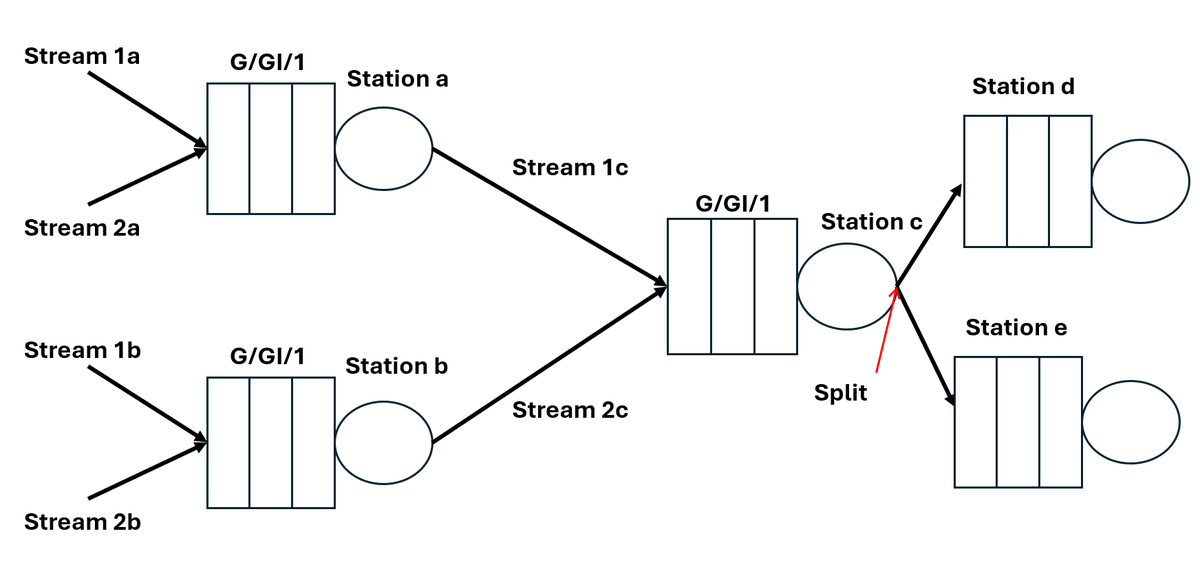
On a three-station topology where two external streams enter each of two upstream servers and their outputs merge at a third server, the pipeline reproduces steady-state distributions with an average Relative Error of the Mean of 4.18 percent, versus 10.73 percent for the Whitt and You (2019) benchmark. On the single-merge system, the neural decomposition averages 2.86 percent REM against 9.20 percent, roughly a 69 percent relative improvement.
Practical footprint
Inference is the strongest selling point for anyone building simulation or design tools. For 5,000 instances it took 0.004 seconds. Running the full three-station pipeline over 64 configurations takes 0.05 seconds end to end, including the preprocessing steps that renormalize time so mean inter-arrivals equal one.
Reasonable places this could matter:
- Simulation acceleration for capacity planning, where discrete-event runs currently dominate wall-clock budgets.
- Design-space exploration and optimization loops that need thousands of queue evaluations.
- Real-time performance approximation in systems where correlated bursty traffic breaks renewal-based dashboards.
Limits worth naming
The framework is currently restricted to feed-forward networks with single-server stations. Feedback loops are out of scope. Because arrival descriptors are propagated from one neural module to the next, small errors can compound as network depth grows, and the paper flags this as the main methodological weakness. A splitting operator, needed to handle probabilistic routing after a station, is discussed as future work rather than delivered here. Extremely heavy-tailed regimes beyond the training envelope are also not guaranteed to generalize.
Availability
The code and trained model are open source on GitHub. The pretrained superposition network is small enough to run on a laptop, and the paper's appendices provide the MAP generation algorithms, hyperparameter search space, and network specification needed to retrain or extend it.