
TimeAPN Cuts Forecasting Error by 54% by Predicting Signal Drift
TimeAPN is a plug-in normalization layer that models amplitude and phase shifts in the frequency domain, boosting long-horizon forecasts across four backbones.
 Pro
Takeaways
- TimeAPN is a plug-in normalization framework that models amplitude and phase drift for long-horizon time series forecasting.
- It predicts non-stationary factors (mean, phase, amplitude) as forecasting targets, then reintegrates them via denormalization.
- Uses discrete wavelet transform, FFT-based phase extraction, and separate MLP and TCN prediction heads.
- Tested on seven datasets across four backbones: FEDformer, DLinear, PatchTST, and S_Mamba, at horizons up to 720.
- Outperforms RevIN, NST, Dish-TS, SAN, and DDN in most settings; biggest gains on Weather, Electricity, Traffic.
- Code available at github.com/y563642-max/timeapn.
Long-horizon time series forecasting keeps running into the same wall: the statistics of the input drift over time. A model trained on last week's electricity load or last month's traffic pattern can degrade fast when the amplitude of the signal spikes or the phase of a seasonal cycle shifts. A framework called TimeAPN attacks that problem by explicitly forecasting how the non-stationary parts of a signal will evolve, and it does so in both the time and frequency domains.
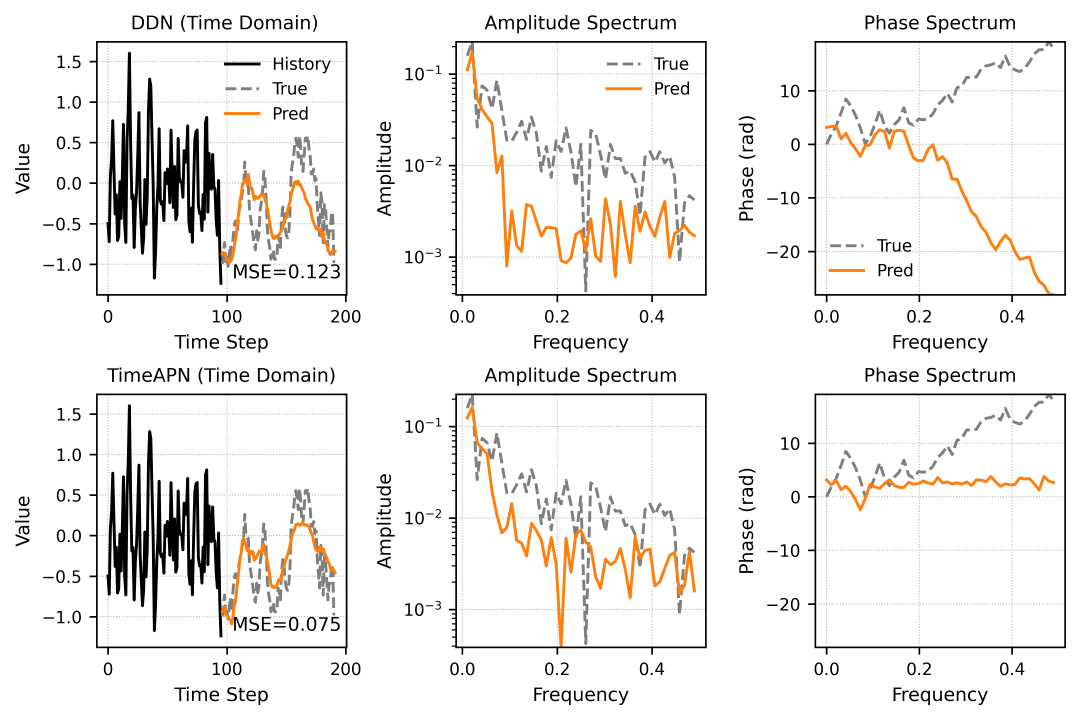
In multivariate long-term forecasting, non-stationarity often shows up as rapid changes in amplitude and phase, which produce severe distribution shifts and degrade predictive performance. The authors argue that the standard toolkit for handling this, reversible instance normalization and its descendants, has a blind spot: existing methods lean on first- and second-order statistics, implicitly assuming that distributions evolve smoothly and overlooking fine-grained temporal dynamics.
Why mean and variance fall short
The dominant approach so far, RevIN, standardizes each input window to zero mean and unit variance, then reverses the transform after prediction. Follow-ups like SAN refine this at finer granularity, eliminating non-stationarity in units of a local temporal slice rather than a global instance, and using a lightweight network module to independently model evolving statistical trends. A more recent method, DDN, adds wavelet-based frequency-domain normalization on top.
Means and variances describe global tendencies. In real signals, the amplitude (how strong the wave is) and the phase (where in the cycle you are) can change abruptly from one window to the next. If your normalizer assumes those change smoothly, your forecast inherits that assumption and drifts.