
Tilde's TildeOpen-30b Cuts Linguistic Errors Tenfold for 34 European Languages
Tilde's 30B open-weight model beats EuroLLM and Gemma 2 on Baltic, Slavic, and Finno-Ugric languages using curriculum learning and just 2 trillion training tokens
 Pro
Takeaways
- TildeOpen-30b is a 30B-parameter open-weight LLM covering 34 European languages, trained on just 2T tokens on the LUMI supercomputer.
- A three-phase curriculum learning strategy alternates between uniform and natural language distributions to boost low-resource language quality without extra compute.
- TildeOpen produces up to 10x fewer linguistic errors than Gemma 2 in Latvian and Estonian, and leads on MultiBLiMP (99.0%) and Belebele (84.7%) benchmarks.
- After instruction-tuning for translation, the model approaches GPT-4.1 quality (0.834 vs 0.842 COMET) while outperforming EuroLLM-22B across all source languages.
- The model is a base model only — no instruction-following or safety alignment yet; a specialized translation model is the planned next release.
- Fully open under CC-BY-4.0 on Hugging Face; paper available on arXiv.
Nearly 170 million Europeans speak a language that is only partially or poorly supported by today's AI models. Latvian, Estonian, Lithuanian, Finnish, and dozens of other European languages are systematically underrepresented in LLM training data, leading to models that hallucinate grammar, mangle morphology, and produce text riddled with errors. Latvian AI company Tilde set out to fix that with TildeOpen-30b, a 30-billion-parameter open-weight foundation model trained specifically for 34 European languages, and the results are striking.
The problem is structural, not just a data shortage
The root cause is not simply that smaller languages have less data. It is that every design decision in a typical LLM pipeline compounds the disadvantage. The imbalance has efficiency and cost consequences: longer sequences are required to encode the same amount of information in lower-resourced languages compared to English, making models less efficient and more expensive to run. This tokenizer inefficiency means a sentence in Estonian or Latvian burns more compute per word than the same sentence in English, both at training time and inference time.
Existing multilingual European LLMs largely address the problem by limiting the share of English rather than rebalancing the representation of smaller languages. For example, EuroLLM still allocates roughly 50% of its training data to English, 27% to major Western European languages, 14% to high-resource global languages, and only the remaining 9% to all other European languages combined. TildeOpen takes a different approach: instead of capping dominant languages, it actively lifts the floor for low-resource ones.

A three-phase curriculum that teaches balance
The core technical innovation is a curriculum learning strategy, a training schedule that deliberately controls which languages the model sees at each stage, rather than sampling from a fixed distribution throughout. The team upsample data for low-resource languages by up to 2.5 times, and adopt a curriculum learning approach with three phases: uniform language exposure during the initial phase (7.5% of training, 150B tokens) and final phase (25%, 500B tokens), while allowing a more natural data distribution during the intermediate phase (67.5%, 1.35T tokens).
The logic is elegant. The model starts by seeing all languages equally, building a solid multilingual foundation. It then spends the bulk of training on the natural distribution, absorbing as much high-resource data as possible. Finally, it returns to uniform sampling for the cooldown phase, reinforcing the low-resource languages just before training ends. Think of it as bookending the training run with equity.
The tokenizer was rebuilt from scratch with the same equity goal. The team design their tokenizer to achieve equitable language representation for focus languages, ensuring that the same content translates into a similar number of tokens across languages, iteratively adjusting data proportions during tokenizer training and evaluating the resulting tokenization efficiency using parallel translations from the FLORES 200 development dataset.

The architecture under the hood
The model is a 30B parameter dense decoder-only transformer based on the Llama 3 architecture, with 60 layers and a model dimension of 6144. It uses Group Query Attention with Rotary Position Embeddings, SwiGLU feed-forward layers, and a vocabulary size of 131,072 tokens. The training ran on 768 AMD MI250x GPUs on the LUMI supercomputer in Finland, consuming approximately 1.5 million GPU hours.
The model was trained using the 2 million GPU hours awarded through the AI Grand Challenge on the EuroHPC LUMI supercomputer, demonstrating Europe's capacity to develop world-class AI infrastructure in under a year. Total training data was 2 trillion tokens, sourced from large web crawls (MADLAD-400, HPLT, CulturaX, FineWeb 2), parallel translation corpora from OPUS, math data, and code from The Stack. Notably, Russian-language data went through an extra filtering step: the team used topic modeling to remove clusters related to geopolitics, war, and propaganda, removing about 5% of Russian documents.
Beating bigger models on less data
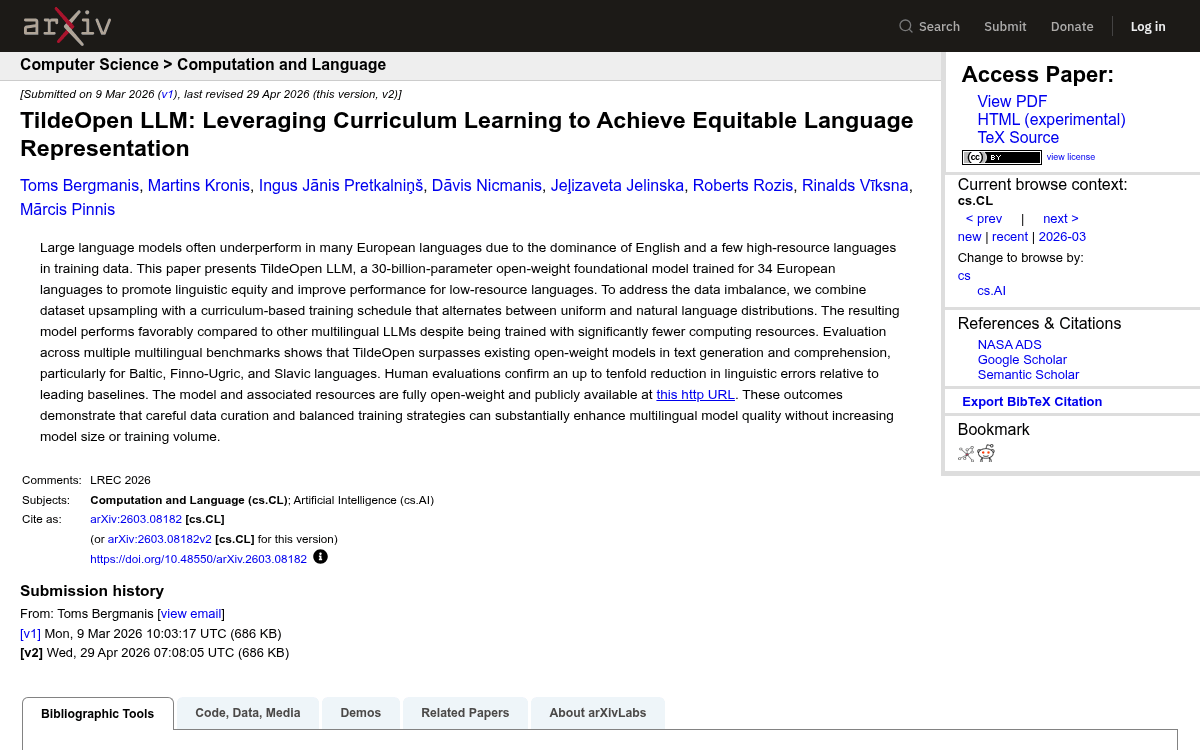
Evaluation across multiple multilingual benchmarks shows that TildeOpen surpasses existing open-weight models in text generation and comprehension, particularly for Baltic, Finno-Ugric, and Slavic languages, with human evaluations confirming an up to tenfold reduction in linguistic errors relative to leading baselines. The comparison is especially notable given the compute gap: EuroLLM trained on 4 trillion tokens, ALIA on 6.7 trillion, and TildeOpen on just 2 trillion.
On the five evaluation benchmarks used, the key results break down like this:
- MultiBLiMP (grammatical acceptability): TildeOpen scores 99.0%, beating EuroLLM (96.4%), ALIA (96.7%), and Gemma 2 (95.7%).
- Belebele (reading comprehension): TildeOpen leads at 84.7%, versus 82.5% for EuroLLM and 79.5% for Gemma 2.
- Per-character perplexity: TildeOpen improves over Gemma 2 by 13.8% for Baltic languages and 11.2% for both Romance and Finno-Ugric families.
- Translation quality (COMET): After instruction-tuning for translation, TildeOpen scores 0.834 average COMET vs. EuroLLM's 0.825, approaching GPT-4.1's 0.842.
- Linguistic error analysis (Latvian): TildeOpen produces fewer than 1 error per 100 words, vs. 3 for EuroLLM and nearly 10 for Gemma 2.
The one area where TildeOpen trails is parametric knowledge, question answering without context as measured by ARC and MMLU, where Gemma 2 stands out by a substantial margin. However, when American multiple-choice questions are replaced by national exams taken by pupils in European countries, TildeOpen shows substantially better results than EuroLLM and ALIA. This suggests the gap is partly a cultural mismatch in the benchmarks themselves.

What it is and is not good for
This foundational model is not yet adapted to follow instructions or aligned with safety features. The next version being built on top of this model will be a specialised translation model, leveraging TildeOpen LLM's multilingual foundation to provide high-quality translation capabilities across the supported European language pairs. In its current form, it is a base model meant to be fine-tuned.
Practical use cases where TildeOpen shines:
- Government and public services: Deploying sovereign AI that handles official EU languages without routing data through non-European infrastructure.
- Translation systems: The instruction-tuned translation variant already rivals GPT-4.1 on most language pairs.
- Low-resource NLP research: The model and its training dataset are fully open, making it a strong starting point for Baltic, Finno-Ugric, and Slavic language research.
- Fine-tuning for domain-specific tasks: Healthcare, legal, and education applications in languages that commercial APIs handle poorly.
The model does have real limitations. It excludes a range of Europe's regional and minority languages, such as Catalan, Galician, Welsh, and Basque, primarily due to limited availability of high-quality written data. Greek, Armenian, and Georgian were omitted due to the additional complexity of incorporating disjoint scripts. No formal safety or bias evaluation has been performed, and the model has not undergone human preference alignment.
The bigger picture: data strategy beats raw scale
Developed by a 12-person team at Tilde Research Lab, TildeOpen delivers benchmark results that rival or surpass those of Big Tech while costing a fraction to develop. The real lesson here is not that 30B parameters is a magic number. It is that thoughtful data curation and a structured training curriculum can compensate for a 2-3x deficit in training tokens. The team is currently extending TildeOpen's context length from 8k to 64k tokens, enabling the processing of entire books, long technical documents, and multilingual legal texts.
TildeOpen is released as open source under a CC-BY-4.0 license and is available on Hugging Face at TildeAI/TildeOpen-30b. The full paper includes the training data statistics, benchmark results, and a detailed memorization analysis showing the model does not reproduce training data verbatim. For anyone building multilingual applications in Europe, this is now the most credible open-weight starting point that does not treat Baltic and Slavic languages as an afterthought.