
Tianjin University's CAMO Explains Why AI Societies Behave the Way They Do
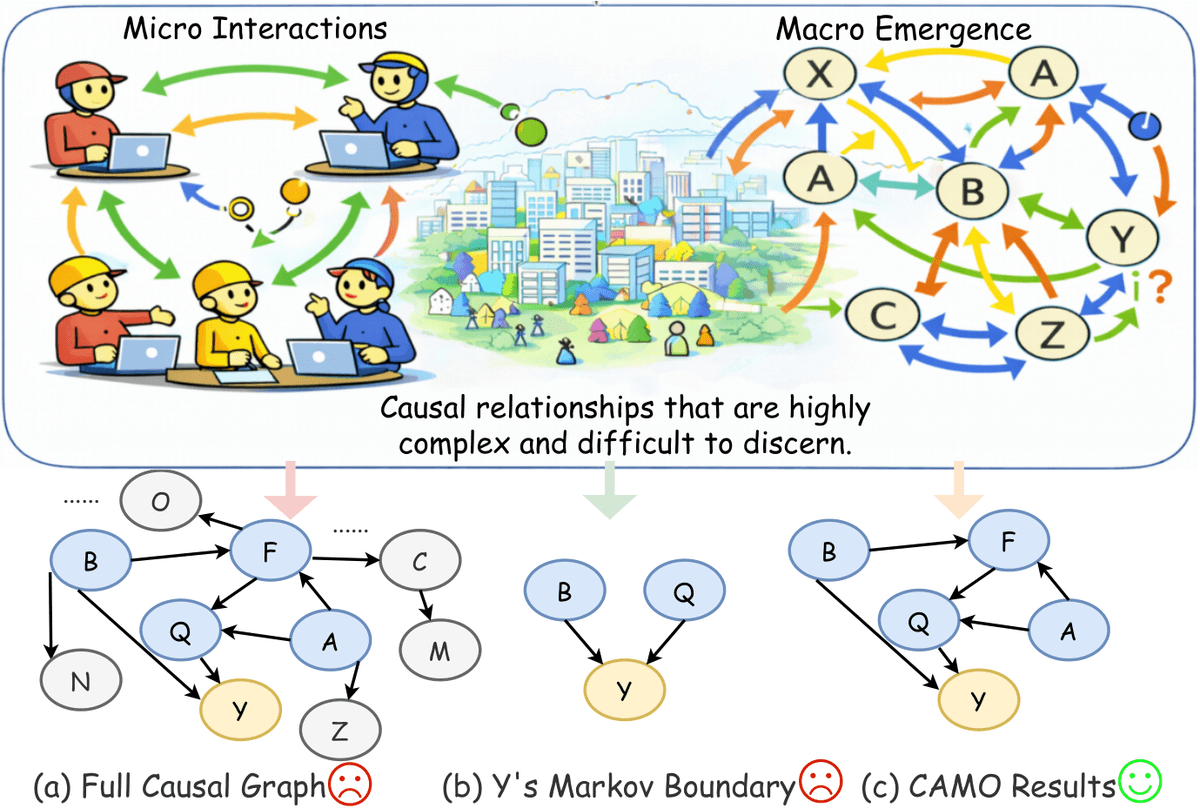
A multi-agent framework called CAMO traces how micro-level behaviors produce macro emergent outcomes in LLM agent simulations, using counterfactual probes to resolve causal ambiguity.
Takeaways
- CAMO automates causal discovery in LLM agent simulations, mapping micro behaviors to macro outcomes via a five-agent workflow.
- Outputs a computable Markov boundary and minimal explanatory subgraph around a target emergent variable Y.
- Uses simulator-internal counterfactual probes with paired random seeds to resolve ambiguous edge orientations.
- Hits 0.96 F1 on causal structure recovery vs. 0.85 for the strongest baseline on an O2O delivery benchmark.
- Tested on Smallville coordination, AgentSociety polarization, and inflammatory message spread with strong intervention-ranking results.
- Code is available at github.com/RisingDate/CAMO; paper at arxiv.org/abs/2604.14691.
Simulating societies with LLM agents has become a popular way to study coordination, polarization, and other collective phenomena. These simulations are good at showing that emergence happens, but rarely explain why it happens. A group from Tianjin University is proposing a framework called CAMO that tries to fix this by automatically discovering the causal chain linking individual agent behaviors to system-level outcomes.
From watching emergence to explaining it
LLM-empowered agent simulations have become a laboratory for studying complex social phenomena, with populations of agents making autonomous decisions that generate rich, non-linear interaction patterns. Frameworks like Smallville and AgentSociety can reliably reproduce behaviors like norm formation or opinion polarization from decentralized agent interactions. But these patterns provide limited insight into the causal mechanisms that generate them, which means interventions on prompts or agent policies remain heuristic and hard to generalize.
Existing LLM-assisted causal discovery methods don't help much. They are largely developed for static variable spaces and do not address how causal mechanisms produce emergent outcomes in adaptive multi-agent systems. A social simulation with feedback loops and evolving meso-level structures breaks the assumptions those methods rely on.
A minimal-but-sufficient causal interface
CAMO's core idea is to stop trying to recover the entire causal DAG of a simulation. Instead, it targets a specific emergent outcome Y (say, the degree of opinion polarization) and identifies the smallest set of upstream variables that both explain and let you intervene on Y. Formally, it produces two things: a computable Markov boundary around Y (the minimal conditioning set sufficient for prediction and intervention) and an