
ThReadMed-QA Exposes GPT-5 Collapsing to 41% in Multi-Turn Medical Chats
A new r/AskDocs benchmark shows even GPT-5 gets only 41% of medical dialogues fully right, with accuracy tripling in wrongness by turn three.
 Pro
Takeaways
- ThReadMed-QA benchmarks LLMs on 2,437 real r/AskDocs patient-physician threads, 8,204 QA pairs, up to 9 turns.
- Best model GPT-5 hits only 41.2% fully-correct; wrong answers roughly triple by turn three across all models.
- Strong single-turn models fall hardest: GPT-5 drops 16.2 points, Claude Haiku drops 25 by turn 2.
- New metric CCS finds 1 in 3 Claude Haiku threads swing between fully correct and fully wrong.
- New metric EPR: one wrong turn increases next-turn error probability by 1.9x to 6.1x.
- Full paper on arXiv, companion misconception study here.
Medical benchmarks like MedQA and MMLU have been telling us for years that large language models are almost ready to hand out clinical advice. A new benchmark called ThReadMed-QA pokes a large hole in that story by testing models on something exam questions cannot: what happens after the patient asks a follow-up.
The result is not flattering. Even the strongest model, GPT-5, achieves only 41.2% fully-correct responses, and all five models tested degrade significantly from turn 0 to turn 2, with wrong-answer rates roughly tripling by the third turn.
Why single-turn scores were hiding the problem
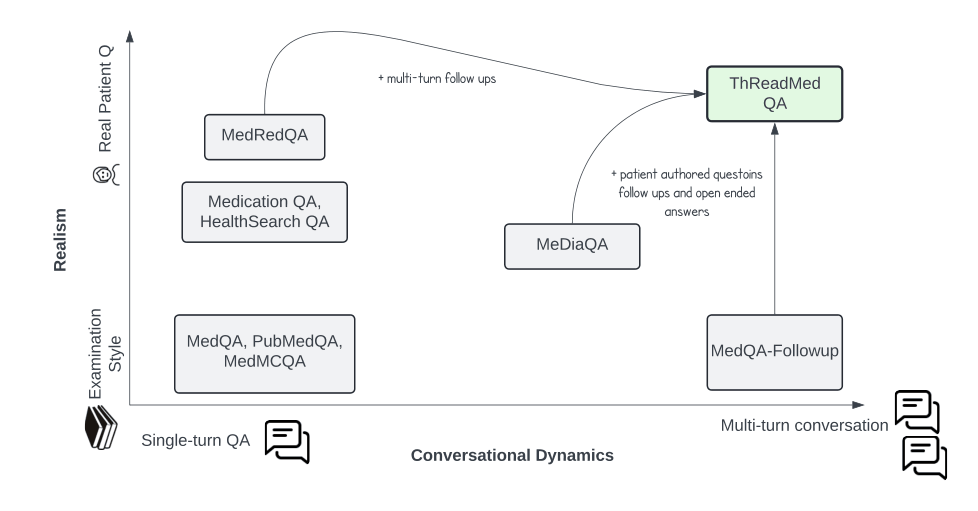
Most medical QA datasets are built from board exams or curated single questions. Medical question-answering benchmarks predominantly evaluate single-turn exchanges, failing to capture the iterative, clarification-seeking nature of real patient consultations. Real patients rarely stop at one question. They come back to clarify a symptom, push back on advice, or add a detail they forgot to mention, and each of those turns is a new chance for the model to get something dangerous wrong.
Prior multi-turn efforts have leaned on simulated patients or reformulated USMLE items. Unlike prior resources, ThReadMed-QA captures how real patients iteratively seek medical guidance, preserving the natural flow of follow-up questions, clarifications, and evolving concerns across turns, and is the first dataset to combine patient-authored questions, multi-turn interactions, and physician-verified responses within a single evaluation setting.
Inside the dataset
The authors mined r/AskDocs, a subreddit where responders must be verified as licensed medical professionals. They selected posts from January 2015 to June 2023, totaling approximately 1.8 million posts, then preprocessed to keep threads between the original poster and a physician, yielding 8,204 question-answer pairs within 2,437 conversation threads.
Two variants ship with the release:
- A full dataset of all threads with three or more QA turns (9,741 threads, 37,191 questions, 58.1% answered), which includes orphan follow-ups that never received a physician reply.
- A fully answered subset of 2,437 threads with 8,204 questions, retained only when every question has a physician response.
Evaluation runs on a stratified test split of 238 conversations (948 QA pairs). Scoring uses an LLM-as-a-judge with a rubric anchored on the actual physician reply as ground truth, checking safety, urgency handling, and whether the model proactively volunteered information a doctor would have offered.
The counterintuitive finding
The headline is not just that models get worse over turns, but which models fall hardest. Models with the strongest initial performance (GPT-5: 75.2; Claude Haiku: 72.3 out of 100) exhibit the steepest declines by turn 2, dropping 16.2 and 25.0 points respectively, while weaker models plateau or marginally improve. Being sharp on the opening question is not a good predictor of being reliable three turns in.
To make this quantifiable, the paper introduces two metrics beyond raw accuracy:
- Conversational Consistency Score (CCS): measures within-conversation reliability. CCS reveals that nearly one in three Claude Haiku conversations swings between a fully correct and a completely wrong response within the same thread.
- Error Propagation Rate (EPR): measures whether a mistake at turn N raises the risk of failure at turn N+1. EPR shows that a single wrong turn raises the probability of a subsequent wrong turn by 1.9 to 6.1 times across all models.

The rubric is also calibrated so scores are not just numbers. A score of 0.5 is not a near-miss but a clinically meaningful failure, and a score of 0.0 on a social turn that a physician used to deliver safety criteria is a patient safety event.
What this is good for, and what it isn't
ThReadMed-QA is useful if you are building a consumer-facing health assistant, evaluating a triage chatbot, or stress-testing an agent that will hold multi-turn conversations with non-experts. It is less useful as a diagnostic accuracy benchmark in the traditional sense, since r/AskDocs is a self-selected population asking about everything from rashes to mental health, not a controlled clinical distribution. Reddit responders are also verified as medical professionals but are not the patient's own physician with access to records.
The finding also echoes a broader trend documented in the related work LLMs Get Lost in Multi-Turn Conversation, suggesting the failure mode is not medicine-specific. It is a general reliability problem that medical dialogue happens to make dangerous.
Availability
A companion paper focused on misconception correction, Evaluating Large Language Models on Misconceptions in Multi-Turn Medical Conversations, uses the same underlying dataset and reports a similar collapse pattern: GPT-5 and Claude-Haiku correct false presuppositions around 85% on initial questions but drop to approximately 50% within two follow-ups. The preprocessing and filtering code is released via an anonymous repository for reproducibility. The main ThReadMed-QA paper does not yet list a public model or leaderboard, but the r/AskDocs extraction pipeline and evaluation rubric are described in enough detail to reproduce, and the CCS and EPR metrics are straightforward to reimplement on any multi-turn dialogue dataset.