
This RAG Chatbot Evaluator Catches 90% of Errors Reviewing Under 30% of Data
A new framework auto-generates test questions, uses LLMs as judges, and flags only uncertain cases for human review, cutting evaluation workload by more than half.
 Pro
Takeaways
- End-to-end chatbot evaluator that auto-generates test Q&A from the knowledge base, no manual test set required. Paper
- Uses categorical TRUE/FALSE/NOT GIVEN labels to separate hallucinations from refusals, unlike numeric-score frameworks.
- Three judging strategies: Single Prompt, Sequential Decision, and Adaptive K-step Reasoning with self-defined sub-questions.
- Per-step confidences multiplied into an aggregate score, with a threshold flagging uncertain cases for human review.
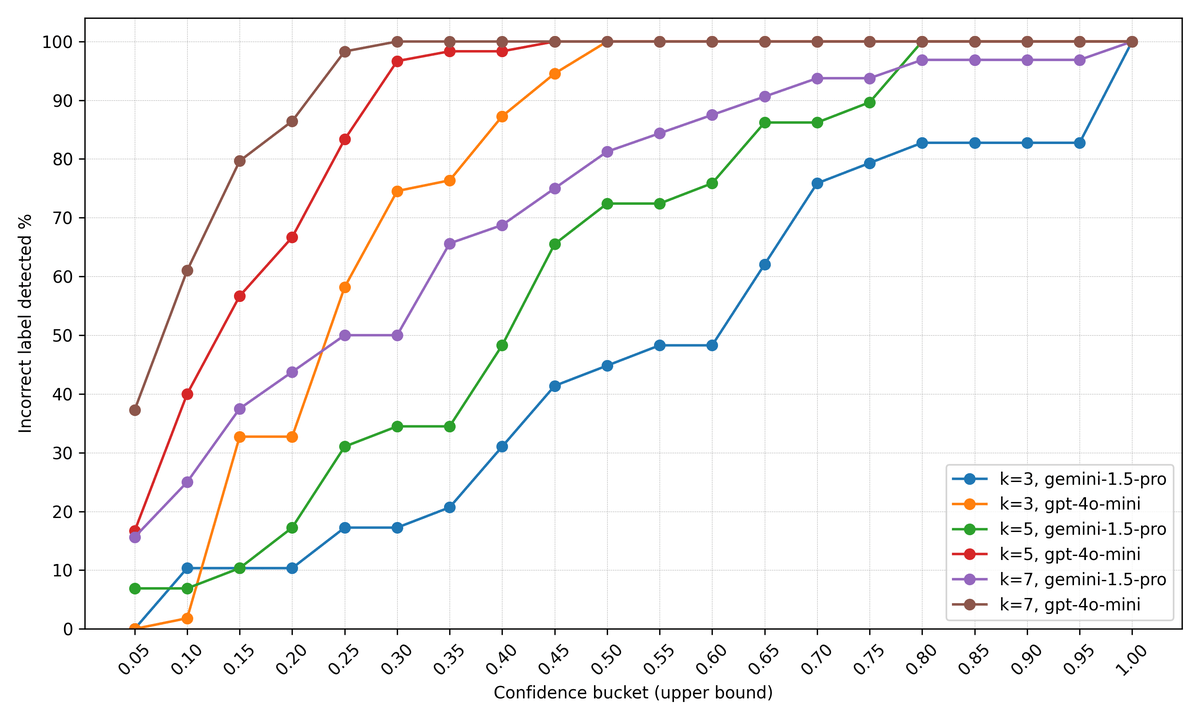
- gpt-4o-mini at K=5, threshold 0.4 caught over 90% of mislabels while reviewing under 30% of samples.
- Code and Vietnamese news dataset released on GitHub; framework is language and domain agnostic.
Evaluating a retrieval-augmented chatbot is still one of the messiest parts of shipping one. Teams either hand-write test sets that go stale, or lean on scoring frameworks that spit out numbers no one knows how to act on. A new paper from researchers at the University of Science in Ho Chi Minh City proposes a more autonomous approach: an end-to-end evaluator that builds its own test set, judges the chatbot's answers with an LLM, and only escalates the cases where it isn't sure.
The system is aimed squarely at a pain point that has emerged as RAG chatbots proliferate. LLM-based chatbots still hallucinate, and retrieval mechanisms may surface incomplete, outdated, or irrelevant documents that further degrade output quality. Existing toolkits like DeepEval and RAGAS support synthetic data generation and metrics like faithfulness or context recall, but they typically require developers to orchestrate dataset creation, evaluation, and filtering as separate steps, and they emphasize numeric scoring rather than end-to-end automation, often producing ambiguous correctness values without clear decision boundaries.
One pipeline, three moving parts
The framework only needs the target chatbot and its underlying knowledge base as input. From there, three components run in sequence:
- Automatic test generation. For each article in the knowledge base, an LLM is prompted to generate factual or inference-style question and answer pairs, with concise answers directly grounded in the article. The questions get sent to the chatbot; the reference answers become ground truth.
- LLM-as-judge scoring. Another LLM compares the chatbot's response against the reference and outputs one of three categorical labels instead of a numeric score.
- Uncertainty filtering. Per-step confidence values are aggregated across the reasoning chain, and anything below a threshold is flagged for a human.
The categorical labeling is deliberate. The three-label scheme (TRUE, FALSE, NOT GIVEN) separates incorrect answers from non-answers, which matters because the underlying cause of an error determines whether to adjust the generation model or expand the knowledge base.
Three judging strategies, escalating in complexity
The authors benchmark three ways of running the judge LLM:
- Single Prompt. One-shot: hand the model the question, expected answer, and chatbot answer, and ask for a label. Cheap but brittle.
- Sequential Decision. The model first checks whether the answer avoids the question, then compares it to the expected answer, classifying it as equivalent, incorrect, missing, or excessive. A final step decides whether missing or extra information changes the meaning.
- Adaptive K-step Reasoning. The LLM defines and answers its own intermediate questions up to K steps, then outputs a final label, a confidence score between 0 and 1, and an explanation.
The confidence aggregation itself is straightforward. Each step produces a confidence value in [0,1], and the overall score is the product across all steps. A low value at any step proportionally lowers the overall score, reflecting the intuition that one weak link undermines the whole reasoning process.
C = 1.0
for step in reasoning_chain:
    C *= step.confidence   # each c_i in [0, 1]
if C < tau:
    flag_for_human_review()
else:
    accept_label()
What the numbers say
The team tested on 300 Q&A pairs auto-generated from 50 Vietnamese news articles, with three annotators producing gold labels by majority vote. The chatbot under evaluation retrieves the top 5 passages via sentence-embedding search and generates responses with gemini-1.5-flash-002. Six judge models were tried across the GPT-4o and Gemini families, all with temperature set to 0.
Sequential Decision was the most consistent performer across models, hitting macro-average accuracies in the 0.82 to 0.88 range. Adaptive K-step Reasoning matched or exceeded it when paired with stronger judges: gemini-1.5-pro at K=3 reached 0.87, while gpt-4o-mini hit 0.86 with perfect FALSE-class accuracy. Single Prompt, unsurprisingly, dragged on the minority classes.
The uncertainty filter is where the framework earns its keep. At a threshold of 0.4 with K=5, gpt-4o-mini detected over 90% of mislabels while reviewing less than 30% of the dataset, whereas gemini-1.5-pro at the same point needed to review around 45% for lower coverage. That translates directly into a knob developers can turn between review cost and safety.
Where it fits, and where it doesn't
The framework is language-agnostic and does not depend on Vietnamese-specific features, so it should port to other RAG deployments backed by a document store. It is most useful for factual, retrieval-grounded QA where answers can be traced to a source. For more open-ended tasks, the higher degree of ambiguity may result in a large proportion of samples being flagged for human review, which can reduce the practical benefit of automation.
There are some rough edges worth knowing about. The confidence threshold is set by hand, so calibrating it for a new domain takes trial and error. Deeper reasoning chains help weaker models but cost more tokens per sample, and stronger models like gpt-4o-mini can get more conservative as K grows, flagging more samples for review even when they'd probably get it right. The authors flag automatic threshold calibration from a small validation set as future work.
Code and the dataset are available on GitHub, and the full write-up is on arXiv. If you're already running a RAG chatbot and doing spot-checks by hand, this is a reasonable template to steal: generate synthetic Q&A from your corpus, judge with a stronger model, and use aggregated per-step confidence to decide what actually needs human eyes.