
ThinkStream Beats GPT-4o on Live Video While Running 5x Faster
ThinkStream introduces a Watch-Think-Speak loop that lets a 3B video model reason incrementally over live streams while keeping latency under 0.5 seconds.
 Pro
Takeaways
- ThinkStream turns video reasoning into an incremental Watch-Think-Speak loop that runs alongside the stream.
- Reasoning-Compressed Streaming Memory keeps a short visual window and reuses past thoughts as long-term semantic memory.
- Streaming RLVR with format, time, and accuracy rewards teaches the model when to respond versus stay silent.
- ThinkStream-3B scores 75.0 on StreamingBench Real-Time, beating Dispider-7B (67.6) and edging out GPT-4o (73.3).
- Custom CUDA Graph inference backend gives a 5x decode speedup and keeps end-to-end latency below 0.5s per chunk.
- Code, models, and datasets to be released on GitHub, including 110K cold-start and 9K RLVR samples.
Most video language models are built for the wrong problem. They wait until the entire clip is available, dump every frame into context, and then reason about what happened. That works fine for offline QA on a 30-second clip, but it falls apart the moment you point one at a live camera feed, a screen recording, or an assistant that needs to react while the user is still cooking, driving, or walking through a scene.
A team from the Chinese Academy of Sciences and OPPO AI Center has released ThinkStream, a framework that tries to fix this by teaching a multimodal model to think in small increments as frames arrive, and to decide on its own when to speak up. The kicker: their 3B model beats several 7B and 8B streaming baselines and holds its own against GPT-4o on one streaming benchmark.
Why batch reasoning breaks on live video
Streaming video has three constraints that offline pipelines ignore. Reasoning must rely only on observations available up to the current moment, latency and memory need to stay stable as the stream grows indefinitely, and the system has to keep an up-to-date interpretation so it can respond when necessary.
Standard video LLMs violate all three. The model first consumes a long video context and only then performs multi-step reasoning to produce an answer, which introduces unacceptable latency and weakens the connection between reasoning steps and the evidence that triggered them. Longer chain-of-thought traces make the accuracy problem better but the latency problem worse. And if you naively keep every visual token in the KV cache, both memory and attention cost grow monotonically until real-time inference is impossible.
Watch, think, speak, repeat
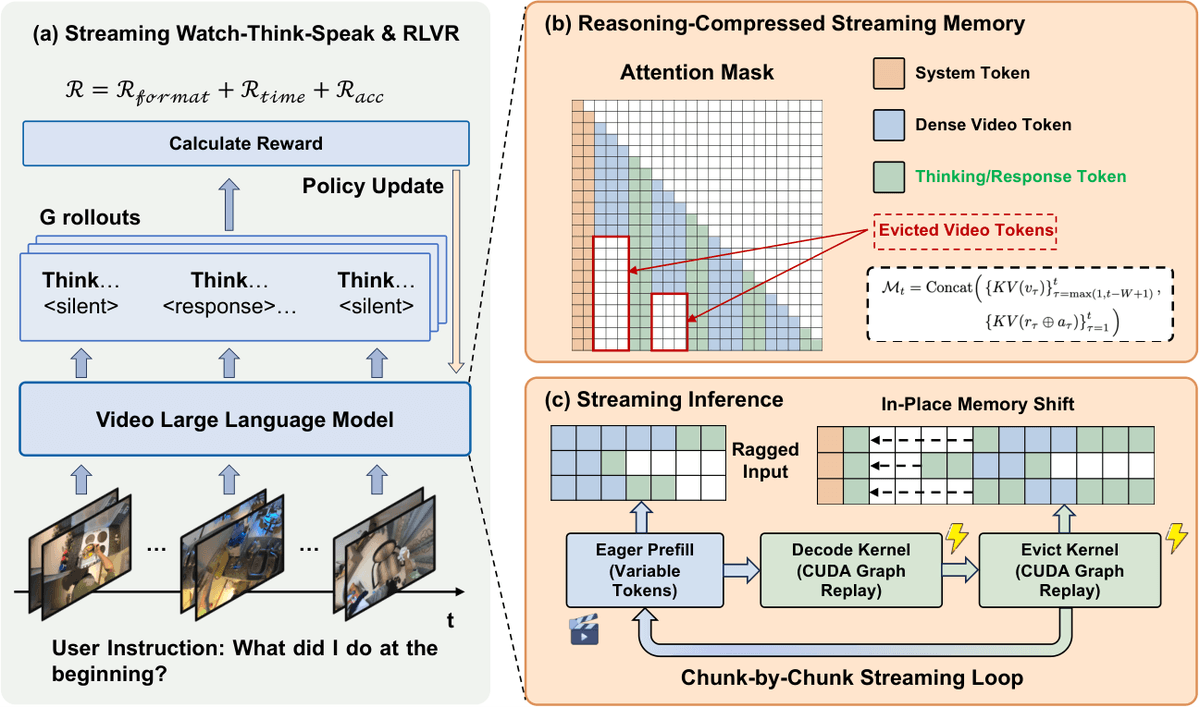
ThinkStream reframes the task as a loop. At each step the model observes a newly arrived video chunk and performs a short reasoning update that integrates the new evidence with previously accumulated context. Based on this evolving understanding, the model determines whether the available evidence is sufficient to produce a response, or whether it should remain silent and continue observing the stream.
The output at every step is a structured block: a <think> segment with the incremental reasoning, followed by either a <response> with content or a <silent> tag. No external classifier decides when to talk. By integrating a generative reasoning phase, the model autonomously determines whether to remain silent or respond, seamlessly unifying perception, reasoning, and reaction into a single generative process.

Turning thoughts into memory
The clever part is what happens to old frames. The framework introduces Reasoning-Compressed Streaming Memory, or RCSM, which treats the model's own reasoning traces as a compressed summary of what it already saw. Instead of storing the entire history of dense visual tokens, the model gradually replaces outdated visual features with the reasoning traces generated during the streaming reasoning process.
Concretely, the KV cache holds two things at any moment:
- A sliding window of recent visual tokens, capped at
Wseconds of frames. - The full history of reasoning and response tokens generated so far, which are far more compact than dense visual features.
When a new chunk arrives and the window is full, the oldest visual tokens get evicted. But their semantic content is already baked into earlier <think> traces, which stay. The result: visual memory is bounded by window size, while the semantic memory grows slowly enough that context length stays roughly flat over long streams.
Training the model to know when to shut up
Cold-start supervised fine-tuning on captioned data is not enough to get the timing right. The team adds a reinforcement learning stage using GRPO with three verifiable rewards:
- Accuracy reward: standard credit for matching ground truth on multiple-choice, yes/no, or counting questions.
- Format reward: zero unless the output conforms to the think/response/silent structure.
- Time reward: a linear decay within a predefined tolerance window, formulated as the maximum of zero and one minus the absolute difference between response step and ground-truth step divided by the tolerance, which penalizes both premature inferences and excessive latency.
The time reward is the interesting one. It forces the model to learn not just what to say but when a live user actually wants to hear it, which is a problem batch trained video models never have to face.
The numbers
On the OVO-Bench streaming benchmark, ThinkStream-3B achieves an overall average score of 59.66, significantly surpassing both its base model Qwen2.5-VL-3B at 51.00 and competing open-source online models such as Streamo-3B at 51.64. On StreamingBench Real-Time, the 3B model attains an average score of 75.00, vastly exceeding open-source online models like Dispider-7B at 67.63 and edging out proprietary GPT-4o at 73.28.
The efficiency story is just as important. The authors built a custom inference backend using CUDA Graphs for the decode-and-prune loop, since neither vanilla transformers nor vLLM/SGLang make it easy to evict arbitrary KV cache entries mid-stream. At batch size 1 the engine delivers 154.07 tokens per second versus the baseline's 30.06, roughly a 5x speedup, and scales to 766.87 tokens per second at batch size 8 versus 276.10 for the baseline.
Crucially, latency stays flat as the video gets longer. The baseline model's latency scales poorly and consistently violates the real-time threshold, fluctuating between 1.0 and 1.4 seconds per second of video, while ThinkStream's end-to-end inference latency remains flat and stays below the 0.5 second real-time threshold required for 2 FPS inputs.
Ablations that actually tell you something
The ablations do a good job of isolating what matters. A few results worth pulling out:
- Reasoning tokens are the memory: replacing the reasoning traces with plain discrete captions as memory drops average score from 56.9 to 48.7, worse than no memory at all. RLVR-optimized reasoning tokens push it to 64.8.
- Budget matters, but with diminishing returns: 20 reasoning tokens per second of video is the sweet spot. Going to 30 barely moves accuracy but pushes decode latency from 380ms to 505ms.
- Visual window of 20 seconds is enough: shorter windows tank the backward-tracing score, longer ones give nothing back.
Where it fits, and where it doesn't
The framework is a natural fit for anything that looks like a persistent camera feed with intermittent user interaction: real-time assistants watching a workflow, monitoring systems that need to fire an alert when something specific happens, or embodied agents that must react during a task rather than after it. The event-trigger training data explicitly covers cases where the model has to stay silent for long stretches until a condition is met.
Where it is less obviously useful: dense offline QA where you actually want the model to see the whole video before committing, high-stakes reasoning that benefits from unbounded chain-of-thought length, or scenarios where visual detail from long ago genuinely matters and cannot be summarized into text. RCSM assumes the reasoning trace is a good enough compression of the pixels, which will fail on tasks where fine-grained visual grounding on distant frames is essential.
The authors say code, models, and datasets will land on GitHub, including a 110K cold-start dataset with time-grounded reasoning traces and a 9K RLVR subset formatted for verifiable rewards. The recipe is also model-agnostic in a useful way: the same training pipeline applied to Qwen2.5-VL-7B lifts OVO-Bench average from 52.28 to 64.90, so the gains do not appear to be a 3B-specific artifact.