
Think While Watching Lets AI Watch Live Video and Answer 92% Faster
A memory-anchored streaming framework built on Qwen3-VL lets a video model keep watching while it thinks, cutting output tokens by 56 percent.
 Pro
Takeaways
- Think While Watching is a streaming video framework built on Qwen3-VL that keeps continuous segment-level memory across turns.
- It writes one compact memory note per video segment, then answers by attending over the accumulated memory bank.
- A segment-level streaming causal mask and dual positional encoding enforce strict causality without blocking ingestion.
- Improves single-round accuracy by 2.6% on StreamingBench and 3.79% on OVO-Bench versus Qwen3-VL Thinking.
- In multi-round streaming, output tokens drop 56% while accuracy holds; time to first token falls 92.6%.
- Three-stage CoT training data plus a dual KV cache inference pipeline; code is open-source.
Most video large language models still assume you hand them the whole clip up front, ask one question, and wait. That assumption breaks the moment you point a model at a live broadcast, a surveillance feed, or a robot camera, where questions arrive at arbitrary moments and later questions often depend on what was said or seen minutes ago. A team from the Institute of Automation at the Chinese Academy of Sciences and BAAI has released Think While Watching, a streaming framework that keeps a running segment-level memory and decouples perception from generation so the model can literally keep ingesting frames while it is still producing an answer.
The serialization trap in streaming video models
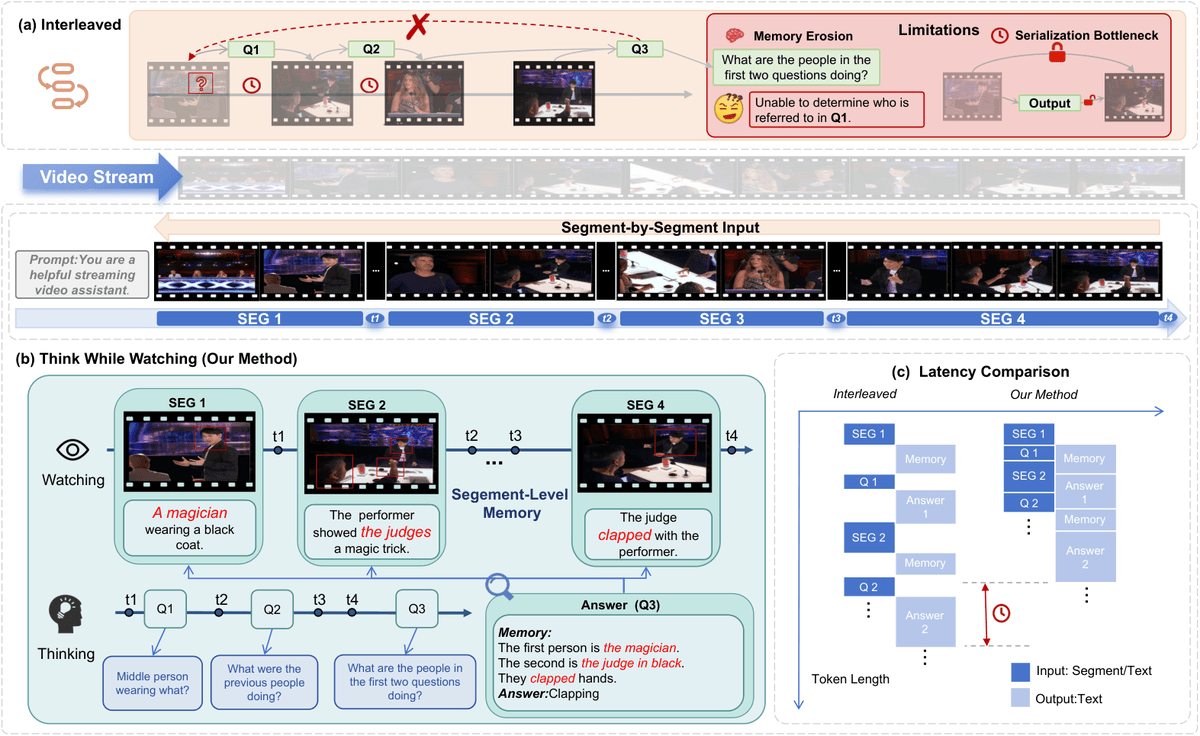
As MLLMs continue to advance, they remain largely focused on offline video comprehension, where all frames are pre-loaded before making queries, which is far from the human ability to process and respond to video streams in real-time. The dominant streaming recipe today, used in systems like VideoLLM-online and StreamChat, interleaves perception and generation. That pattern has two nasty side effects that the paper calls out directly.
- Memory Erosion: as new segments and new turns pile on, early visual evidence gets pushed out, so a question in turn five that references something from turn one often fails.
- Serialization Bottleneck: once the decoder starts generating tokens, it locks the positional encoding of the sequence, so new video frames cannot be ingested until decoding finishes.
The authors quantify how bad this gets: for Qwen3-VL-4B Thinking, accuracy in an online multi-round setting drops 40.39 percent compared to the offline setting on StreamingBench. The naive online baselines score 21.47 and 18.13 percent overall, versus 56.67 and 58.52 percent when the same models see the whole video offline. Streaming, done naively, essentially breaks these models.
Memory notes as the persistent state
Think While Watching treats the video as an ordered sequence of segments. For each arriving segment, the model writes exactly one compact text memory note that records entities, salient actions, scene changes, and short-range temporal relations, then appends it to a growing memory bank. When a question arrives, the model conditions on the current question, the dialogue history, and the accumulated memory prefix, letting attention implicitly pick out the relevant notes.
To make this actually causal during training, the authors introduce two mechanisms working together:
- A segment-level streaming causal mask that lets each generated unit attend only to received units up to its own arrival index, blocking any leakage from future segments.
- A streaming positional encoding built on MRoPE that assigns independent position indices to the input stream and the output stream, so newly arriving segments can be given correct positions even while decoding is still in progress with unknown output length.

Three stages of chain-of-thought training
Streaming chain-of-thought data with memory notes barely exists in the wild, so the team synthesized its own. The training corpus is split across three stages, each aligned with a specific behavior they want the model to acquire.
- Stage 1 (single-round CoT): 5,160 short-video instances from VideoChatOnline-IT, teaching the model to write segment notes and answer one query.
- Stage 2 (multi-round CoT): 2,752 multi-round dialogues covering 8,513 rounds, extending memory reuse across turns.
- Stage 3 (long-range CoT): 1,500 long YouTube videos (tutorials, lectures, and continuous longform recordings), 100 to 300+ frames each, targeting long-term recall, uncertainty handling, and robustness to distractor segments.
GPT-5.2 was used to generate the memory-anchored CoT annotations, and every example is verified to contain exactly one output item per input unit (S segments plus Q questions produce S+Q outputs). The generation prompt enforces strict causality, forbids leakage of reference answers into reasoning, and requires all evidence to be video-grounded.
Watching and thinking in parallel
The inference side is where the engineering gets interesting. Think While Watching uses a dual KV cache that separates continuous visual ingestion from autoregressive text decoding. Because the streaming attention mask is not a standard causal pattern (query and key lengths can differ), the system picks its attention backend adaptively: Flash Attention when the pattern is standard causal, and memory-efficient attention when the custom streaming mask must be enforced.
The latency payoff is dramatic. On StreamingBench with Qwen3-VL-4B, time to first token drops from 31,203 tokens under the offline Thinking baseline to 2,304 tokens under the streaming pipeline, a 92.6 percent reduction, while overall accuracy stays comparable.
What the numbers look like
The results are measured under two protocols: single-round, where many segments stream in but one question is answered, and multi-round, where many questions are interleaved with the stream. Built on Qwen3-VL, the framework improves single-round accuracy by 2.6 percent on StreamingBench and 3.79 percent on OVO-Bench. In multi-round mode, accuracy is preserved while output tokens drop by 56 percent.
| Setting (Qwen3-VL-4B) | StreamingBench Overall | OVO-Bench Overall | Avg Tokens |
|---|---|---|---|
| Thinking (offline) | 58.52 | 50.70 | 689 / 472 |
| Thinking (online, naive) | 18.13 | 16.21 | 482 / 361 |
| TWW single-turn (S3) | 60.04 | 55.02 | 571 / 379 |
| TWW multi-turn (S3) | 57.40 | 51.80 | 303 / 256 |
The training also transfers to offline benchmarks: Video-MME climbs from 68.89 to 73.41 percent and LV-Bench from 53.47 to 57.68 percent, suggesting the memory-writing habit is genuinely useful for long-range reasoning, not just for streaming.
Where it still breaks
The paper is refreshingly explicit about failure modes. Even after Stage 3, the model still trips on three recurring issues:
- Long-range recall of fine details: the coarse event trace survives but a specific identity, side, or object attribute from an early segment can be lost when memory notes over-compress.
- Premature commitment: under partial evidence, the model sometimes answers immediately instead of deferring until decisive frames arrive.
- Distractor contamination: visually salient but task-irrelevant segments can override the true earlier evidence during retrieval.
Ablations confirm that memory notes are load-bearing: removing them drops multi-turn accuracy from 57.40 to 52.35 percent. Segment granularity matters too. Longer 120s/60s segments cut decoding tokens to 230 but lose about two points of accuracy, while shorter 30s/15s segments preserve accuracy but push token counts to 380.
Why it matters for anyone building live video assistants
The practical takeaway is that for anything resembling a live video assistant, whether that is livestream monitoring, a wearable that describes what a user is doing, an embodied agent navigating a real environment, or a video moderation system that must answer follow-up questions about earlier moments, the interleaved perception-generation pattern is quietly capping what these systems can do. Decoupling ingestion from decoding with a dedicated positional scheme and keeping a compact per-segment memory bank appears to be a reasonable recipe for pushing streaming accuracy closer to offline numbers without paying the token bill of a full rethink at every turn.
The code is available on GitHub, and the method is built on top of open Qwen3-VL checkpoints at 2B, 4B, and 8B scales, so the barrier to trying it on a real streaming workload is relatively low.