
Texas A&M's Visual Chronometer Catches AI Video Models Running in Secret Slow-Motion
A new predictor called Visual Chronometer recovers the true physical frame rate of any video, exposing severe temporal drift in models like Sora-2 and Veo.
 Pro
Takeaways
- New paper defines chronometric hallucination: video models generate motion at unpredictable physical speeds.
- Visual Chronometer predicts Physical FPS from raw frames, hitting 9% MAPE versus 40-96% for top VLMs.
- Audit shows Sora-2, Veo, LTX and Wan all produce videos slower than their stated frame rate.
- Trained on 465K clips with augmentations simulating fast shutter, motion blur, and rolling shutter.
- User study: PhyFPS-corrected videos preferred 44% of the time versus 19% for originals.
- Proposed uses include dataset relabeling, post-processing, and reward signals for DPO alignment.
Video models can render photorealistic frames, but ask them to show a hummingbird's wings or a person falling onto a bed and something feels off. The motion looks smooth, yet the physical speed is wrong. A new paper from researchers at Texas A&M University gives this failure a name, chronometric hallucination, and proposes the first dedicated tool to measure it.
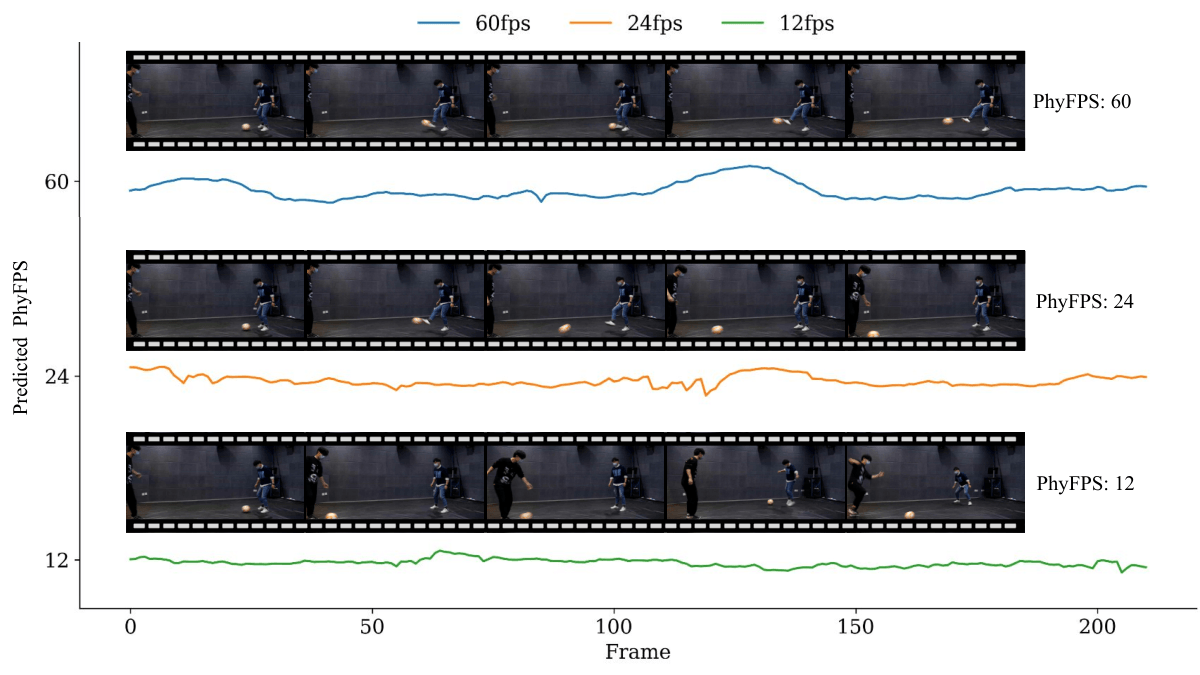
The work introduces Visual Chronometer, a predictor that recovers the Physical Frames Per Second (PhyFPS) of a video directly from its visual dynamics, ignoring whatever the file metadata claims. The authors distinguish this intrinsic PhyFPS from the nominal meta FPS by defining it as the true frame rate that aligns with the real-world passage of time.
Why generators lose the pulse of time
Internet-scale video datasets are mixtures of varying capture and editing regimes, encompassing standard-rate footage, extreme slow-motion, and accelerated time-lapses. During training, models are typically blind to these inherent physical speeds; a time-lapse and a slow-motion video might be fed into the network identically. The result is a model that produces plausible frame-to-frame transitions but has no idea how fast the world inside those frames is actually moving.
The authors point to two concrete failures from current systems: a hummingbird hawk-moth rendered in extreme slow-motion despite its naturally high wing-beat frequency, and a person falling onto a bed at a velocity significantly slower than standard gravity. Neither prompt asked for slow motion. The models just picked a time scale.
How Visual Chronometer works
The architecture is straightforward. It adopts VideoVAE+ as the foundational video encoder to extract compact spatiotemporal latent representations. A learnable query then cross-attends to those tokens and an MLP regresses a single scalar: the log of PhyFPS. Working in log space keeps optimization stable across frame rates that span two orders of magnitude, from 2 FPS to 240 FPS.
The interesting piece is the training data. Because most internet videos have unreliable frame-rate metadata, the team built a clean dataset from high-frame-rate academic sources (Adobe240, BVI-VFI, UVG) and synthesized lower rates using three physics-grounded augmentations that mimic real camera hardware:

- Sharp Capture: uniform subsampling that preserves crisp edges but shows stutter, like a fast-shutter sports camera.
- Motion Blur: averaging a window of high-rate frames to simulate exposure integration, giving the model velocity cues from blur.
- Rolling Shutter: progressive column-wise time offsets that reproduce the skewed artifacts common in CMOS sensors.
The final dataset spans 18 physical frame rates and 465,535 clips, uniformly standardized to 128 frames. Ablating the motion blur and rolling shutter augmentations pushes MAE from 3.46 up to 5.12, so these aren't optional decorations.
Auditing Sora-2, Veo, Wan, and friends
The team built PhyFPS-Bench-Gen, a set of 100 prompts covering diverse entities, motion types, camera behaviors, and scene contexts, with no speed-manipulation keywords allowed. They ran it against a long list of open and closed generators. The pattern is consistent: the predicted PhyFPS is generally higher than the assigned Meta FPS across almost all videos. In plain terms, most generated videos are secretly slow-motion.
A few highlights from the audit:
| Model | Meta FPS | Predicted PhyFPS | Pct. Error | Intra CV |
|---|---|---|---|---|
| Sora-2 | 30 | 36.21 | 28% | 0.13 |
| Veo-3.1-Fast | 24 | 35.83 | 57% | 0.17 |
| Wan2.1-T2V-1.3B | 24 | 26.28 | 31% | 0.11 |
| LTX-Video | 24 | 46.52 | 99% | 0.10 |
| CogVideoX-5B | 24 | 38.26 | 75% | 0.12 |
LTX-Video's huge absolute error but low intra-clip variation suggests something interesting: its temporal representations are internally consistent, and the high absolute errors may primarily stem from inaccurate meta FPS metadata rather than structural chronometric hallucination. The fix could be as simple as bumping its stated meta FPS from 24 to around 46.
The perceptual payoff
To check whether accurate PhyFPS actually helps humans, the authors ran a user study with three variants of each generated clip: the raw output, a globally re-timed version, and a dynamically re-timed version that adjusts each segment independently.

Both post-processed variants significantly outperform the hallucinated original outputs at 19.0%. Interestingly, the global correction at 44.2% is preferred over the dynamic local correction at 36.9%. The team suspects varying the playback rate within a single short clip introduces its own jitter, so a stable averaged rate wins.
VLMs are not the answer
A tempting shortcut would be to just ask Gemini or Qwen to estimate frame rate. It doesn't work. All tested VLMs fail catastrophically at physical estimation for both video inputs and unrolled image sequences. Some collapse to a constant answer: Seed-1.6-Flash degenerates to predicting exactly 30 FPS for all inputs regardless of the actual dynamics. Visual Chronometer's VC-Common variant hits 9% MAPE against 40-96% for the VLMs.
What this unlocks
Beyond scoring existing models, the authors sketch three practical uses. First, as an automated annotator to relabel training corpora with true PhyFPS so future models can condition on it. Second, as a post-processing tool that re-times generated clips to feel natural, exactly what the user study validated. Third, as a reward model for preference optimization pipelines like DPO, giving generators a physics-grounded signal instead of pure perceptual smoothness.
The limitations are worth naming. VC-Common only covers common web frame rates (12 to 60 FPS), while VC-Wide handles the full range but with lower precision. Very short clips under 8 frames give the model too little kinematic evidence, and pushing inference windows to 128 frames actually hurts because it loses the variance-reduction of sliding-window ensembling. The sweet spot sits around 32 to 64 frames.
The project page is live at the Pulse of Motion site, though code and model weights are not yet public. For anyone building or evaluating video world models, this is the missing ruler that measures whether the simulated clock is actually ticking at the right speed.