
Texas A&M's TATIC Teaches Robots to Read a Two-Second Push
A new framework lets robots decode both what humans mean and how to move from brief physical nudges, without external force sensors.
 Pro
Takeaways
- TATIC decodes brief physical nudges into both task-level intent and motion parameters using a causal TCN.
- Torque-based contact estimation removes the need for external force sensors, cutting operator fatigue.
- Five interaction operators supported: Guide, Yield, Slow, Stop, and Switch.
- Achieves 0.904 Macro-F1 on intent recognition across 500 episodes on a 7-DoF arm.
- Task-aligned canonical frame preserves 0.871 F1 on reconfigured layouts where world-frame baseline drops to 0.614.
- Hardware validated on collaborative desktop disassembly with video demonstration.
Picture a robot arm helping you disassemble a desktop computer. You suddenly notice it is about to bump a nearby capacitor, so you nudge it aside. That quick push should mean two things at once: move over here (a motion adjustment) and slow down because things just got tricky (a task-level change). Today's robots are usually good at one interpretation or the other, but rarely both.
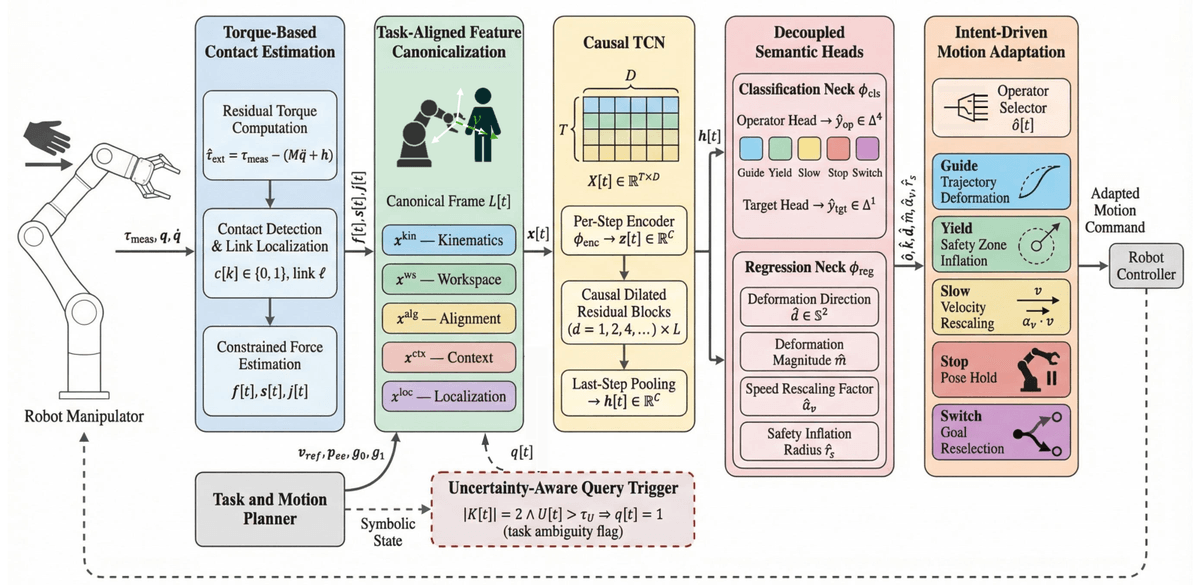
A team from Texas A&M has proposed TATIC, a framework that reads brief physical corrections and jointly decodes them into high-level semantic intent and low-level motion parameters. It uses torque-based contact force estimation and a task-aware Temporal Convolutional Network (TCN) to jointly infer discrete task-level intent and estimate continuous motion-level parameters from brief physical corrections.
The gap between pushing and meaning
Robotics has two mature but disconnected traditions for handling human input. Foundation-model-based approaches primarily rely on vision and language inputs and lack mechanisms to interpret physical feedback, while traditional physical human-robot interaction methods leverage physical corrections for trajectory guidance but struggle to infer task-level semantics.
Existing pHRI methods also typically require sustained kinesthetic guidance, which gets tiring during long tasks. TATIC works from brief taps and nudges instead, and it does so without an external force/torque sensor by reading joint torques directly.
Five operators the robot can recognize
The authors define a compact vocabulary of interaction operators that a human can convey through touch alone:
- Guide: push the trajectory in a specific direction by some magnitude
- Yield: inflate the safety buffer around a workspace region
- Slow: scale down execution speed while keeping the path
- Stop: hold current pose (software hold, resumable with a tap)
- Switch: choose between two candidate next goals
Each operator carries operator-specific continuous parameters, like a unit direction and displacement for Guide, or a speed multiplier for Slow. The network outputs both the discrete class and its associated regression targets in a single forward pass.

How it works under the hood
The pipeline has three main stages. First, contact detection uses the residual between measured joint torques and the expected torques from rigid body dynamics. When the residual crosses a threshold for a few consecutive samples, contact is declared and the contact force and on-link position are estimated by minimizing torque residuals under physical constraints.
Second, features are packed into a canonical local frame aligned with the robot's reference motion direction. This is the trick that makes the model generalize: two contacts that mean the same thing but happen in different world locations end up looking similar in the canonical frame. The feature vector combines kinematics, workspace clearance, alignment scores against candidate goals, a planner ambiguity flag, and contact localization.
Third, a causal multi-task TCN jointly infers discrete task-level intent and continuous motion-level geometric parameters from brief physical corrections. The model uses six residual blocks with dilated causal convolutions, weighs its six task losses with learned homoscedastic uncertainty, and totals roughly 0.63M trainable parameters.
The numbers
The dataset comprises 500 in-distribution episodes across 100 trajectories on a 7-DoF manipulator, plus 250 out-of-distribution episodes on 50 reconfigured layouts. Contact durations range from about half a second to two seconds, confirming these really are brief interactions.
Across all five operators the model hits a 0.904 Macro-F1 score, with Switch topping the ranking at 0.951 and the Guide/Yield pair being the hardest to separate because both look like lateral pushes. The ablation on canonicalization is the most striking result: the world-frame baseline collapses from 0.889 F1 on in-distribution test to 0.614 on the reconfigured layouts, while the canonical frame holds at 0.871.
What it is good for, and what it is not
The obvious use case is shared manufacturing or disassembly work where a human handles fiddly bits (loosening latches, releasing fasteners) and the robot handles the rest. The authors validate exactly this scenario on collaborative desktop disassembly with a 7-DoF arm and RGB-D cameras, using cuRobo to generate nominal reference motions that TATIC then adapts.
Limitations are honest and specific. The intent vocabulary is fixed at five operators, so anything outside Guide/Yield/Slow/Stop/Switch is out of scope. There is no personalization to individual operators yet, so idiosyncratic pushing styles are not modeled. And code and model weights are not released with the paper, though a demonstration video of the hardware experiment is available.
The real breakthrough here is treating physical contact as a dual-purpose channel that carries both geometry and semantics at the same time. Most pipelines force you to pick one lane. By combining torque-based estimation with a canonicalized temporal model, TATIC shows that a two-second push can be enough to change a robot's mind about what to do next.