
Texas A&M's NexusFlow Trains AI on Mismatched Datasets Without Relabeling
A plug-and-play alignment module uses invertible flow layers to share knowledge between tasks that only have partial, region-split labels.
 Pro
Takeaways
- NexusFlow is a plug-and-play module for partially supervised multi-task learning across structurally different tasks.
- It aligns per-task features in a shared latent space using invertible affine coupling layers borrowed from normalizing flows.
- Invertibility prevents representational collapse; a Lipschitz bound links latent alignment to actual feature alignment.
- On nuScenes with Boston-only map labels and Singapore-only tracking labels, it matches or beats a fully supervised oracle.
- On NYUv2 with segmentation, depth, and normals split across subsets, it improves all three tasks over MTPSL.
- Uses about half the GPU memory of MTPSL and matches baseline training time; code at github.com/ark1234/NexusFlow.
Training a single model to do many things at once is one of the oldest promises in computer vision, but it usually assumes every image comes with every label. Real datasets almost never work that way. A team from Texas A&M, Worcester Polytechnic, Bosch Research, and collaborators has released NexusFlow, a lightweight module that lets a multi-task model learn from data where each sample only carries labels for one task, even when the tasks look nothing alike.
The messy reality of multi-task labels
Multi-Task Learning (MTL) trains one network to solve several problems at once, sharing a backbone to save compute and improve generalization. Partially Supervised MTL (PS-MTL) is the version that matches how data actually arrives in industry: datasets frequently lack labels for some tasks, or contain incomplete and unreliable annotations, so every image is annotated for a subset of the tasks and silent about the rest.
Prior PS-MTL work handled a friendly version of this. Significant progress has been made when tasks are homogeneous dense predictions, thanks to their natural interdependence, enabling joint training for tasks such as semantic segmentation, depth estimation, and surface normals estimation. Those tasks all output a value per pixel, so their features live in similar spaces. The authors argue this setup is too clean. In production, one task might be dense pixel-wise segmentation and another might be sparse instance-level tracking, and the labels for each often come from entirely different geographies or capture rigs.
A harder benchmark: Boston for maps, Singapore for tracks
To force the issue, the authors define a new PS-MTL protocol on the nuScenes autonomous driving dataset. Ground-truth annotations for the mapping task are only provided for scenes in Boston, while annotations for the tracking task are only provided for scenes in Singapore. That means the model never sees a single frame with both labels, and the two supervision signals come from different cities with different road layouts, signage, and driving conventions. It is structural disparity (dense grid vs. sparse instances) plus a domain gap, stacked on top of each other.
Existing PS-MTL methods buckle under this. In the paper's experiments, prior state-of-the-art PS-MTL methods, MTPSL and JTR, designed for homogeneous dense prediction tasks can even degrade baseline performance in our setting. Naively mixing incomplete supervision hurts more than it helps.
The idea: align features through an invertible detour
NexusFlow's trick is to leave the base model alone and add a small side network per task that maps intermediate features into a shared latent space where they can be compared. Each side module has two pieces:
- A feature aggregator: a small MLP (or deformable attention) that compresses the task feature to a fixed-size embedding.
- An invertible affine coupling layer, borrowed from normalizing flow models like RealNVP. The embedding is split in half, and one half scales and shifts the other via small MLPs. Because the transformation is bijective, no information is lost.
The training objective adds one auxiliary loss on top of the normal per-task losses: pull each task's projected latent z_i toward the mean of all the tasks' latents. That is O(n) rather than the O(n²) pairwise matching earlier methods used, which is why the module scales cleanly beyond two tasks.
Why bother with invertibility? A regular CNN alignment head can cheat by squashing everything into a low-dimensional blob that trivially matches across tasks, which is called representational collapse. The coupling layers are bijective: they preserve all task-relevant information while enabling flexible transformations into a shared canonical space. This invertibility is essential; unlike conventional CNN-based alignment modules, the coupling layers prevent representational collapse.
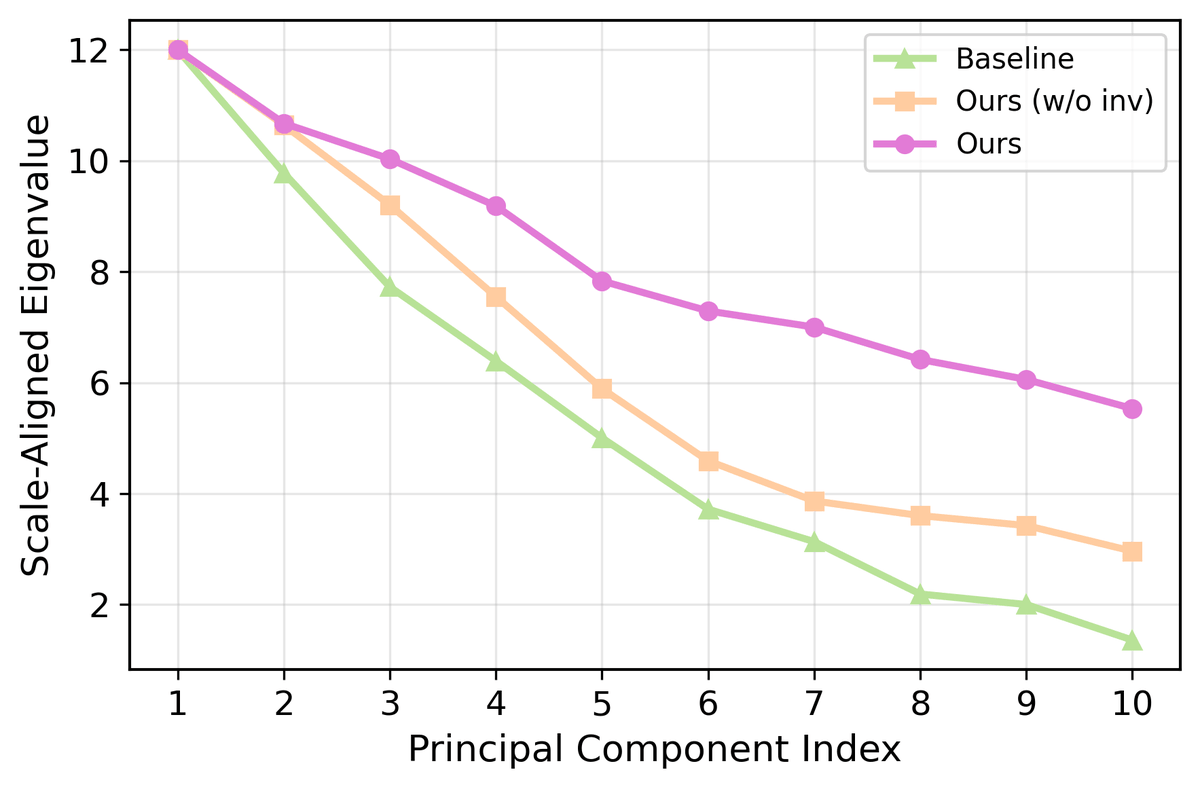
The paper backs this with a Lipschitz-based lemma showing that shrinking the alignment loss in latent space provably shrinks an upper bound on the distance between the original task features. PCA scree plots also show slower eigenvalue decay for the full model than for a variant without the invertible layer, meaning the shared representation keeps more independent directions.

What the numbers say
On the Boston/Singapore split of nuScenes, NexusFlow closes almost the entire gap to a fully supervised oracle that sees every label:
| Method | AMOTA (track) | IDS | Lanes IoU (map) | Drivable IoU |
|---|---|---|---|---|
| Oracle (full sup.) | 0.323 | 696 | 31.4 | 71.4 |
| Baseline (UniAD) | 0.289 | 1025 | 27.1 | 62.7 |
| MTPSL | 0.255 | 1089 | 27.0 | 59.6 |
| JTR | 0.197 | 774 | 25.1 | 57.6 |
| NexusFlow (two-stage) | 0.329 | 690 | 37.1 | 64.5 |
The two-stage NexusFlow actually edges past the fully supervised oracle on AMOTA (0.329 vs 0.323) and on Lanes IoU (37.1 vs 31.4). ID switches drop by roughly a third versus the baseline, which matters for downstream planners that rely on stable track IDs.
The team then stress-tests generality on NYUv2 with three homogeneous dense tasks: 13-class segmentation, depth, and surface normals. They cluster the dataset into three subsets and give each subset labels for only one task. NexusFlow improves segmentation IoU from 26.75 to 31.70, cuts depth absolute error from 0.6511 to 0.6055, and lowers normal mean error from 35.17 to 31.88, beating MTPSL on all three.
Cost and where it fits
Efficiency is a real selling point. Compared to MTPSL, which needs pairwise cross-task projections, NexusFlow trains in about 8 hours on a single A100 (versus 10 for MTPSL) and uses roughly half the GPU memory, 4554 MiB against 8900 MiB. That is because the center-based alignment scales linearly in the number of tasks.
Practically, this is aimed at teams that want to combine open source or partner datasets that were each labeled for a single purpose without paying to relabel everything. The autonomous driving experiment is the obvious motivating case: mapping datasets from one region can pair with tracking datasets from another, and the model still improves on both. The plug-and-play design means it drops into an existing backbone-plus-heads architecture like UniAD without rewriting the heads.

What it does not solve
The paper's own ablation flags a sensitivity to the depth of the coupling stack. With four coupling layers, AMOTA sits at 0.292; with six it jumps to 0.329, and with eight it collapses back to 0.247. That is a narrow sweet spot and will likely need retuning per architecture. It also still trails the fully supervised oracle on NYUv2, where labels are far denser and the domain gap is milder, suggesting the biggest wins come specifically from the disparate-task, disparate-domain regime.
Code is available on GitHub, and the pipeline is designed to sit between a shared encoder and task heads with minimal surgery, so it should be straightforward to try on other backbone-plus-heads systems.