
TERMINATOR Cuts Reasoning Model Overthinking by 55% and Speeds Inference 2x
A new probe classifier learns to detect when a reasoning model has already solved the problem, cutting chain-of-thought lengths by up to 55%.
 Pro
Takeaways
- TERMINATOR is a lightweight probe classifier that early-exits reasoning models when the final answer first appears in the CoT.
- Cuts chain-of-thought length by 14-55% on MATH-500, AIME 2025, HumanEval, and GPQA, with over 2x latency reduction.
- Introduces hindsight-optimal reasoning length: retrospectively mark the earliest logical arrival of the final answer.
- Uses an LRM-driven extract-identify-verify pipeline to label roughly 110,000 CoTs at token-level granularity.
- Tested across Qwen3-8B/14B and Ministral-3-8B/14B; best or second-best on 28 of 32 metrics.
- Limitation: assumes final answer literally appears in the CoT, so it fails on open-ended generation tasks.
Large reasoning models have a bad habit: they figure out the answer, then keep talking. They second-guess, explore alternatives, restate the problem, and burn thousands of extra tokens before finally committing to a solution they already had. A new paper introduces TERMINATOR, a lightweight early-exit classifier that watches a model's hidden states during reasoning and pulls the plug the moment the final answer appears in the chain-of-thought.
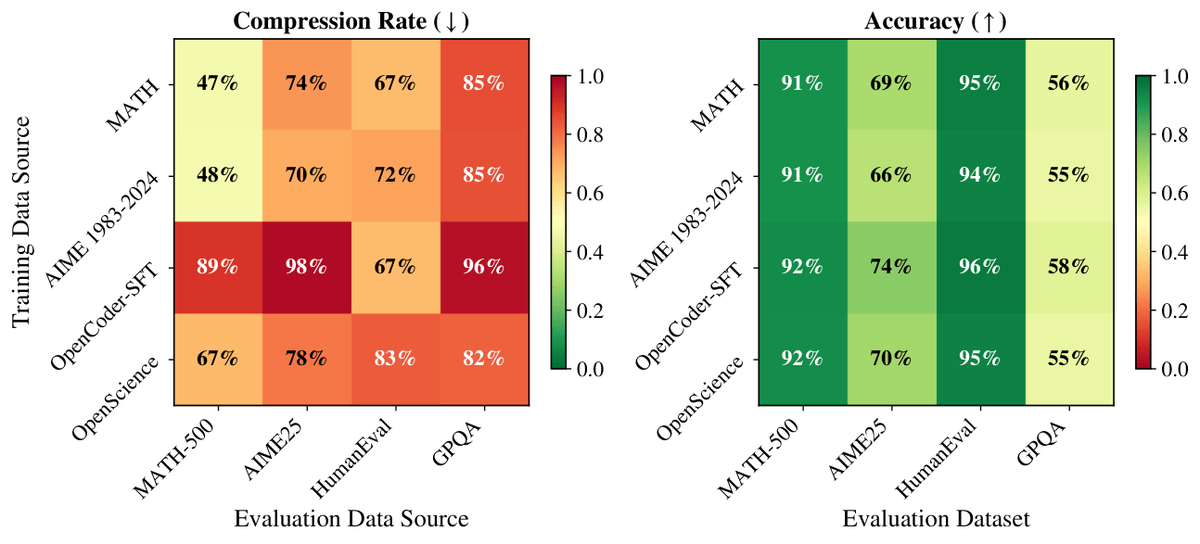
The results are substantial. TERMINATOR achieves significant reductions in CoT lengths of 14%-55% on average across four challenging practical datasets: MATH-500, AIME 2025, HumanEval, and GPQA, while outperforming current state-of-the-art methods and reducing inference latency by more than 2x compared to the original LRM.
The overthinking tax
Reasoning models like DeepSeek-R1 and Qwen3 use test-time compute to think through a problem before answering. That works, but it isn't cheap. LRMs spend a significant amount of their reasoning tokens double-checking their work and exploring different solutions when they have already generated the final answer that they will eventually settle on much earlier in the CoT, a phenomenon known as overthinking.
Prior work has shown that reasoning traces can often be cut in half with almost no accuracy loss. The catch is knowing where to cut. The optimal exit point depends on both the task and the model, and existing early-exit methods rely on coarse heuristics: probing at paragraph breaks, injecting fake </think> tokens at fixed intervals, or waiting for repeated intermediate answers to agree. TERMINATOR takes a more direct route.
Hindsight is a training signal
The core insight is what the authors call hindsight-optimal reasoning length. Given a completed CoT, you can look back and find the earliest position where the model logically arrived at the final answer it eventually committed to. Everything after that point is wasted compute. If you had a classifier that could recognize that moment in real time, you could cut generation there.
The authors first show this moment is not invisible. There is a sharp transition in token-level confidence around the first occurrence of the final answer, formed by aligning each CoT's first answer position to zero and averaging across samples. Because these CoTs span math, science, and coding datasets, this transition suggests a consistent cross-domain signal. Token usage also shifts: words like hmm and okay appear more often before the answer, while another shows up more after.

Building the dataset
The hard part is getting labels at scale. You need to identify the exact token position where each of tens of thousands of CoTs first commits to its final answer, and regex won't cut it because numbers repeat, math expressions have many equivalent forms, and Python functions get generated line by line with commentary in between.
The authors solve this with a three-step LRM-driven pipeline:
- Extract the final answer from the solution (usually inside
\boxed{}). - Identify a text span in the CoT that both precedes and contains the earliest logical arrival of that answer.
- Verify that the span actually contains the answer, with retry-and-feedback loops if it doesn't.
They use Qwen3-30B-A3B-Thinking-2507 for this pipeline and successfully label roughly 70-80% of CoTs across AIME (1983-2024), MATH, OpenCoder-SFT, and OpenScience.
The classifier itself
TERMINATOR is small. The model reuses the same transformer block from the LRM and adds a prediction head. The weights of the transformer block are copied from the final block of the LRM, which performs slightly better than random initialization, and the prediction head is randomly initialized. It runs over the LRM's final-layer hidden states and produces a binary prediction at every generated token: has the final answer arrived yet or not?
Because early-exit is heavily class-imbalanced (most tokens are pre-answer), training uses class-weighted binary cross-entropy with inverse frequency weights. At inference, a sliding window of the 10 most recent predictions is used, and generation stops when the majority vote crosses the exit threshold. This makes the method robust to a single spurious prediction firing early.
What the numbers look like
On Qwen3-8B, the vanilla model averages 32.7 seconds per MATH-500 problem. TERMINATOR drops that to 14.1 seconds, roughly a 2.3x speedup, with the classifier itself only adding about 10.8% overhead. On Qwen3-14B it's even better proportionally, since the classifier size stays fixed while the base model grows.
Across four models (Qwen3-8B, Qwen3-14B, Ministral-3-8B-Reasoning, Ministral-3-14B-Reasoning) and four benchmarks, TERMINATOR achieves best or second best performance on 28 out of 32 metrics. Compared to Dynasor, which cuts tokens aggressively but tanks accuracy on hard problems, TERMINATOR keeps accuracy essentially matched to vanilla while still delivering large compression.
Where it breaks
The method has real limitations. It assumes the final answer literally appears somewhere in the CoT, which fails for open-ended generation. On very hard problems, the confidence signal is less crisp. On AIME 2025 and GPQA examples, the authors note that predicted probabilities don't show the same sharp transition seen on MATH-500 and HumanEval, so exiting cleanly is harder.
There's also the exit-vs-commit gap: occasionally the LRM's reasoning first arrives at answer X, then later revises to Y, and TERMINATOR exits at X. In those rare cases, cutting early costs accuracy that the full CoT would have recovered.
Why this matters beyond the headline
The real contribution is the training signal itself. Every prior early-exit method uses some form of consistency label: repeatedly force the model to answer at checkpoints, and mark the first spot where the forced answer matches the eventual answer. That's expensive, coarse, and tied to the exact prompt injection you use.
Hindsight-optimal labeling instead marks the token where the answer first logically appears in the natural reasoning trace. It's a cleaner supervision signal, and combined with token-level (rather than chunk-level) prediction, it gives the classifier the granularity to exit immediately after the answer emerges. The authors also compared a chunk-level variant trained on the same labels; it substantially underperforms, showing that both ingredients matter.
For anyone deploying reasoning models in production where each request costs real money in GPU-seconds, this is a practical lever. The pipeline is a one-time cost that pays for itself in the first few hundred thousand inference calls. Code is referenced throughout the paper as available in the authors' codebase, though the arXiv preprint is the primary artifact for now.