
Tencent's UniCom Beats Every Open Unified Model on Knowledge-Heavy Image Editing
Tencent Hunyuan's UniCom compresses SigLIP features 18x along the channel dimension, matching top unified models on generation while leading knowledge-heavy image editing benchmarks.
 Pro
Takeaways
- Tencent Hunyuan released UniCom, a unified multimodal model built on compressed continuous SigLIP features
- Channel compression from 1152 to 64 dims preserves reconstruction quality and speeds T2I convergence by roughly 3.8x
- Attention-based compressor beats MLP projection at preserving semantic structure for downstream VQA tasks
- Transfusion-style single-transformer prediction outperforms query-based MetaQuery designs on editing fidelity
- UniCom leads open unified models on KRIS-Bench (70.11) and WorldEdit (4.12) knowledge-intensive editing
- Weights and code available on GitHub and Hugging Face
A team from Tencent Hunyuan, Peking University, and Zhejiang University has released UniCom, a unified multimodal model that generates and edits images by predicting compressed continuous semantic features instead of the discrete visual tokens most competing systems rely on. The bet pays off: it hits state-of-the-art or competitive numbers on text-to-image benchmarks and dominates knowledge-heavy editing evaluations, all without a VAE in the editing loop.
The tokenizer trap
Every unified multimodal model has to decide how to turn pixels into something a transformer can predict. Current unified models typically rely on discrete visual tokenizers, but discretization discards fine-grained semantic information, and directly modeling continuous representations like CLIP or SigLIP poses significant challenges in high-dimensional generative modeling, resulting in slow convergence and training instability.
Neither path is great. Vector-quantized tokens throw away texture and fine spatial detail that matter for photorealism and text rendering. Continuous SigLIP-style embeddings preserve semantics but live on a high-dimensional, non-smooth manifold that diffusion models struggle to navigate. UniCom's core claim is that there is a middle ground you can reach with a very specific compression choice.
Squeeze the channels, keep the tokens
The authors ran a systematic ablation on where to compress. They started from SigLIP2-SO400M features at 1024 tokens x 1152 dimensions, then tried shrinking either the sequence length or the channel dimension.

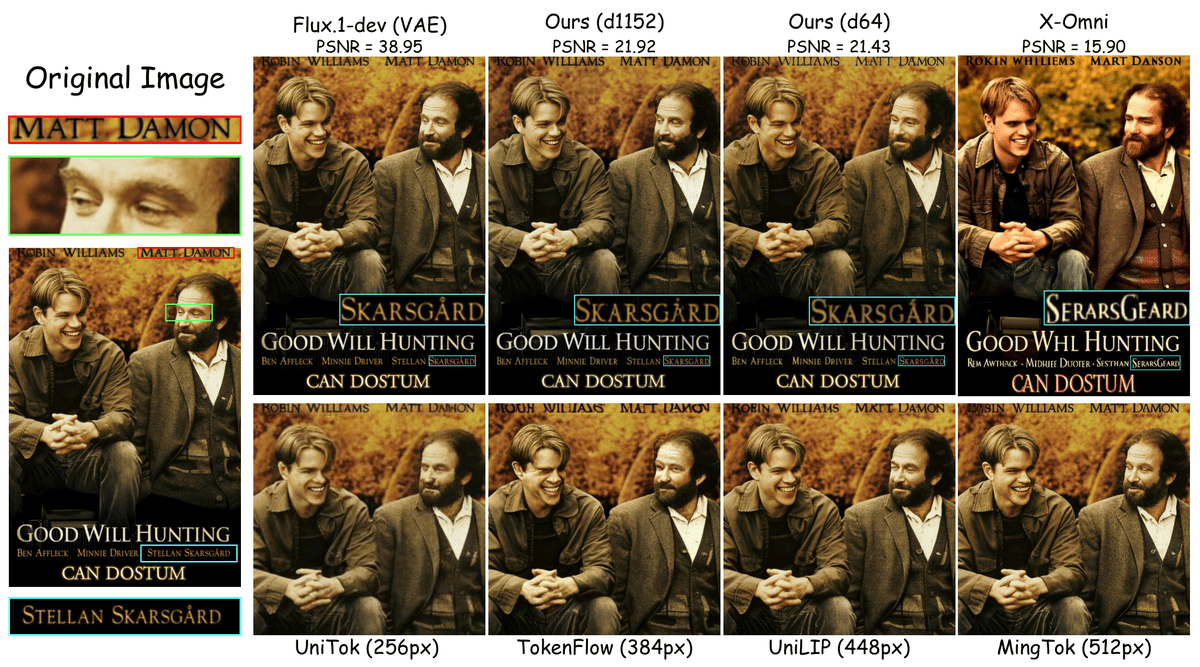
The results are striking. Reducing the channel dimension is significantly more effective than spatial downsampling for both reconstruction and generation. Cutting the sequence to 256 tokens pushed reconstruction FID from 0.40 up to 0.72, while compressing channels down to just 64 dimensions with an attention-based projector only moved FID to 0.56, an 18x compression ratio with almost no quality loss. On the generation side, the compressed d=64 target converged roughly 3.8x to 5x faster than training against raw SigLIP features.
The compressor itself matters too. A plain MLP treats each visual token independently, which scrambles the semantic structure. Swapping in a shallow multi-head attention module (following UniTok) preserves the neighborhood structure of the original SigLIP2 embeddings, visible both in t-SNE plots and in downstream VQA benchmarks where MHA compression beat MLP compression across GQA, SEED, ChartQA, and OCRBench.
Transfusion beats query bottlenecks
With a compressed target in hand, UniCom's authors compared two ways of predicting it. Pathway I is a Transfusion-style setup where one transformer interleaves discrete text tokens and continuous image latents, using causal attention for text and bidirectional attention inside image spans. Pathway II is the query-based design popularized by MetaQuery and BLIP3-o, where a frozen MLLM answers a set of learnable queries that condition a separate diffusion decoder.

Pathway I won on both convergence speed and editing fidelity. The query bottleneck compresses spatial layout too aggressively, so edits that need to preserve exact structure (identity, text placement, object position) suffer. The full-sequence Transfusion path keeps dense spatial correspondence between the reference image and the output, which is why UniCom can edit without pulling in VAE latents as a shortcut for identity preservation.
How it is put together
The production system stacks known components in a specific way:
- Vision encoder: SigLIP2-SO400M-Patch16-NaFlex, kept frozen throughout training
- Compressor: multi-head self-attention module projecting 1152 dims down to 64 dims per token, with 1024 tokens preserved
- LLM backbone: Qwen-2.5-7B-Instruct, connected to the vision encoder via a two-layer MLP
- Diffusion decoder: initialized from FLUX.1-dev, trained with a flow-matching plus LPIPS perceptual loss
- Training: four stages (alignment, pre-training, continued training, supervised fine-tuning) with a native-resolution strategy across 33 aspect-ratio buckets anchored at 1024x1024
Interestingly, the team feeds uncompressed SigLIP features for understanding tasks (to keep fine detail) but the compressed 64-dim latents for editing (to keep context length manageable across multi-turn edits).
Where the numbers land
On text-to-image benchmarks UniCom is competitive rather than dominant, but on the harder world-knowledge evaluations it pulls ahead of every open unified model tested.
| Benchmark | UniCom | BAGEL | Mogao | FLUX.1-dev |
|---|---|---|---|---|
| GenEval Overall | 0.87 | 0.88 | 0.89 | 0.82 |
| DPG-Bench | 85.92 | 85.07 | 84.33 | 84.00 |
| WISE Overall | 0.58 | 0.52 | - | 0.50 |
| ImgEdit-Bench | 4.22 | 3.20 | - | - |
| KRIS-Bench Overall | 70.11 | 56.21 | - | - |
| WorldEdit Overall | 4.12 | 2.76 | - | - |
The editing gap is the real story. Built on compressed continuous representations, the model shows exceptional capabilities in text-to-image generation, precise image editing, and fine-grained controllable generation. On KRIS-Bench and WorldEdit, which require the model to understand biological transformations, geographical facts, or cultural context before editing, UniCom outscores every other unified system by double-digit margins. The team attributes this to keeping semantically rich SigLIP2 features as the prediction target rather than discretizing them or replacing them with VAE latents.
What is different and what is missing
The paper is clear about the trade-off. Even with 18x channel compression, some information leaks: pure compressed features underperform the uncompressed baseline on OCR-heavy tasks like OCRBench (36.0 vs 55.4). The team's fix is to concatenate the compressed and original SigLIP features along the sequence dimension for understanding, which recovers baseline performance and adds a small bump on text-centric evaluations.
Other limitations the authors flag:
- Training the compression modules jointly with the diffusion decoder is still compute-heavy, and the full unified model requires substantial resources for high-resolution work
- Very fine-grained textures can still degrade slightly under aggressive channel compression
- The framework has only been validated on images; extending to video or long multimodal reasoning is future work
Available now
UniCom is not just a paper. Weights and code are released on GitHub and Hugging Face, with a project page hosting generation and editing samples. For anyone building on unified multimodal stacks, the practical takeaway is concrete: if you are working with ViT-based semantic features and struggling with generative modeling stability, compress the channel dimension aggressively before you touch the sequence length, and use attention rather than an MLP to do it.