
Tencent's ROMI Beats RAMBO by 18.6% on Offline AI Training
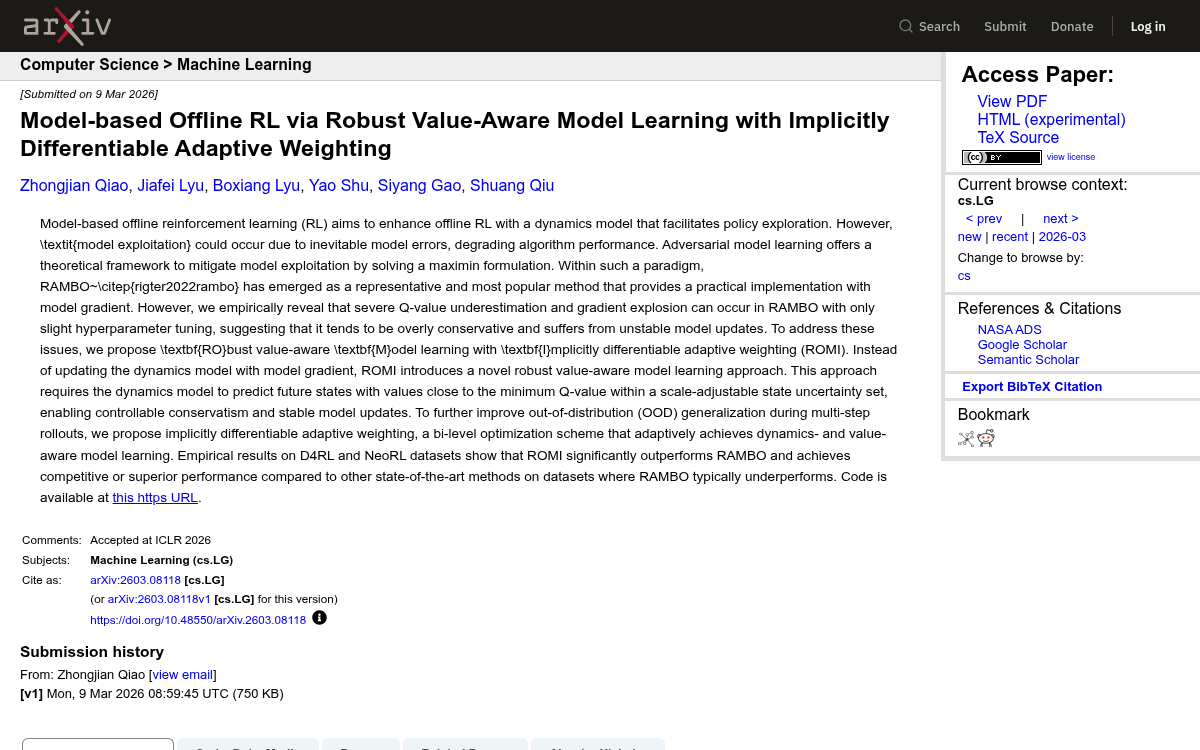
ROMI fixes RAMBO's instability and over-conservatism in model-based offline RL, beating it by 18.6% on D4RL benchmarks with a cleaner bi-level optimization approach
 Pro
Takeaways
- ROMI fixes two critical bugs in RAMBO (the dominant adversarial model-based offline RL method): Q-value collapse and gradient explosion from model gradient updates.
- The core fix replaces model gradients with a Wasserstein-based state uncertainty set, giving direct, stable control over conservatism via a single radius parameter
ξ. - A bi-level optimization scheme (IDAW) adaptively reweights training samples to balance dynamics accuracy and value-aware conservatism during multi-step rollouts.
- ROMI scores 953.5 total on 12 D4RL MuJoCo tasks vs. RAMBO's 804.1 (18.6% improvement), beating all compared baselines including MOBILE and Count-MORL.
- The method adds ~25-30% runtime overhead over RAMBO but uses nearly identical GPU memory; the conservatism level
ξmust be set before training. - Code is open-source and built on top of OfflineRL-Kit, making it easy to drop into existing RAMBO pipelines.
Offline reinforcement learning is one of the most practically important corners of modern RL research. The core idea is simple: instead of letting an agent explore a live environment (expensive, dangerous, or impossible in many real-world settings), you train it purely from a pre-collected dataset. The catch is that the agent can easily fool itself by exploiting regions of a learned world model that look good on paper but don't reflect reality. A new paper from researchers at CityUHK, Tencent, UChicago, and HKUST proposes ROMI, a method that fixes the most stubborn failure modes of the dominant approach in this space.
The offline RL tightrope
The standard playbook for model-based offline RL is to learn a dynamics model from the dataset, roll out synthetic trajectories inside it, and train a policy on the combined real-plus-synthetic data. This buys you data efficiency and better generalization to unseen states. But it introduces a new hazard: model exploitation. The policy discovers transitions in the learned model that look rewarding but are simply artifacts of model error -- regions where the model is confidently wrong.
The leading fix for this is adversarial model learning, a framework that casts the problem as a minimax game. The problem is formulated as a two-player zero-sum game against an adversarial environment model, where the model is trained to minimize the value function while still accurately predicting the transitions in the dataset, forcing the policy to act conservatively in areas not covered by the dataset. The most popular practical implementation of this idea is RAMBO, published at NeurIPS 2022.
What's broken in RAMBO
RAMBO works by adding an adversarial loss term to the model's training objective, weighted by a coefficient λ. The problem the ROMI authors discovered is that this coefficient is essentially untunable in practice. In the original RAMBO implementation, λ is set to 3e-4 -- an extremely small value that nearly zeroes out the adversarial term. When the authors tried bumping it to slightly larger but still small values like 0.05 or 0.1, things fell apart fast.
Specifically, the paper identifies two failure modes:
- Severe Q-value underestimation: The policy becomes overly pessimistic, refusing to take actions that are actually fine because the value estimates have collapsed to unrealistically negative numbers.
- Gradient explosion: The adversarial loss gradient blows up during training, causing complete training collapse on 7 out of 9 tested datasets when
λ = 0.1.
The root cause is the use of model gradient -- backpropagating through the value function into the dynamics model to make it adversarial. This encourages the model to seek out regions with sharp value drops, which destabilizes training and makes the conservatism level nearly impossible to control. RAMBO is essentially forced to keep λ tiny to avoid collapse, which defeats the purpose of adversarial training.
ROMI's two-part fix
ROMI (Robust value-aware Model learning with Implicitly differentiable adaptive weighting) replaces RAMBO's model gradient approach with two complementary mechanisms.
Part 1: Robust Value-Aware Model Learning (RVL)
Instead of using gradients to push the model toward adversarial states, ROMI reframes what the model should be learning. The key insight is to use the Wasserstein distance to define a "state uncertainty set" around each predicted next state. Using a dual reformulation (Proposition 4.1 in the paper), minimizing over all possible adversarial dynamics within a Wasserstein ball is equivalent to finding the minimum value state within a small ball around the predicted next state. The model is then trained to predict next states whose values are close to this minimum -- essentially, the most pessimistic plausible outcome.
The conservatism level is now controlled by a single geometric parameter ξ, the radius of the state uncertainty ball. Larger ξ means more conservatism. Crucially, the paper proves (Proposition 4.2) that Q-values stay bounded under this scheme, which is exactly what RAMBO fails to guarantee in practice. The authors verified that even at ξ = 10 (extreme conservatism), neither Q-value collapse nor gradient explosion occurs.
Part 2: Implicitly Differentiable Adaptive Weighting (IDAW)
The RVL loss alone only enforces value-awareness on in-distribution data. During multi-step rollouts, the model visits out-of-distribution (OOD) states, and without dynamics-awareness, prediction errors compound across steps. To fix this, ROMI introduces a bi-level optimization scheme:
- Inner level: A weighting network assigns a per-sample weight to each transition in the dataset. The dynamics model is updated via weighted maximum likelihood estimation (MLE), which keeps it grounded in the actual dynamics.
- Outer level: The weighting network itself is updated by minimizing the RVL loss, using implicit differentiation through the inner update. This means the weights are chosen to prioritize samples that help the model be appropriately conservative, not just accurate.
The result is a model that simultaneously learns the true dynamics (inner level) and learns which data points matter most for value-aware conservatism (outer level). The paper proves this bi-level scheme converges at rate O(1/√K).

Benchmark results
ROMI was evaluated on two standard offline RL benchmarks: D4RL (the most widely used suite, featuring MuJoCo locomotion and Antmaze navigation tasks) and NeoRL (a benchmark designed to simulate more realistic, narrow data distributions). Baselines included model-free methods CQL and IQL, and model-based methods MOPO, RAMBO, Count-MORL, and MOBILE.
On the 12 D4RL MuJoCo datasets:
- ROMI achieves a total normalized score of 953.5, versus RAMBO's 804.1 -- an 18.6% improvement.
- ROMI outperforms RAMBO on 11 out of 12 datasets.
- ROMI also beats MOBILE (857.7) and Count-MORL (927.5), achieving the best or tied-best score on 11 of 12 datasets.
- The gains are largest on datasets where RAMBO typically struggles, like
hopper-medium-replay(102.0 vs. 77.2) andwalker2d-medium-expert(113.3 vs. 73.7).
On the 9 NeoRL datasets, ROMI achieves a total score of 472.2, beating all baselines including MOBILE (456.4), IQL (461.2), and RAMBO (382.8). On the harder Antmaze tasks, ROMI scores 186.5 total versus MOBILE's 173.4 and RAMBO's 94.6.
What this costs you
The bi-level optimization isn't free. One limitation of ROMI is that additional computational cost for bi-level optimization is required compared to the original RAMBO. In practice, ROMI runs at roughly 28-30 seconds per epoch versus RAMBO's 22-24 seconds -- about a 25-30% runtime overhead. GPU memory usage is nearly identical (~3.3 GB). Another limitation is that the conservatism degree governed by ξ has to be specified before training, unlike methods that support runtime adjustment. You'll need to tune ξ per task from the set {0.01, 0.1, 1.0, 10}, which adds a hyperparameter search step.
When should you use it?
ROMI is a strong choice when:
- You're already using or considering RAMBO for model-based offline RL.
- Your dataset is narrow or has limited coverage (NeoRL-style), where model exploitation is a serious risk.
- You need stable training -- ROMI's bounded Q-value guarantee is practically meaningful, not just theoretical.
- You're working on locomotion or navigation tasks where multi-step rollout quality matters.
The code is available on GitHub, built on top of the OfflineRL-Kit codebase. The implementation is relatively self-contained: the key difference from RAMBO is entirely in the dynamics model training loop, making it straightforward to swap in for existing RAMBO-based pipelines.