
Tencent's DSH-Bench Exposes Where 19 Image AI Models Actually Break Down
DSH-Bench exposes hidden weaknesses in 19 subject-driven image generation models with a new 459-subject, 5,508-prompt benchmark and a cheaper, more human-aligned evaluation metric
 Pro
Takeaways
- DSH-Bench is a new open benchmark for subject-driven text-to-image generation with 459 subjects across 58 categories and 5,508 prompts -- 15x more subjects than DreamBench.
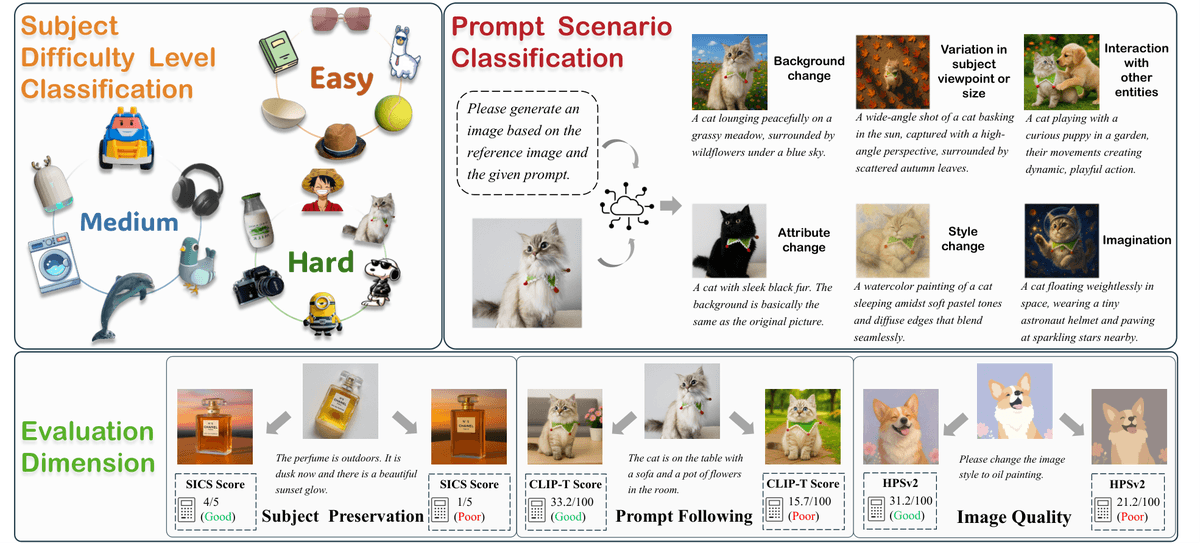
- Subjects are classified into easy, medium, and hard difficulty tiers; prompts into 6 scenario types (background change, viewpoint, interaction, attribute, style, imagination).
- New metric SICS (Subject Identity Consistency Score), based on fine-tuned Qwen2.5-VL-7B, beats GPT-4o-based evaluation by 9.4% in human correlation at a fraction of the $400+ per-model cost.
- Evaluation of 19 models shows no single model is robust across all categories; all models degrade on hard subjects and interaction-heavy prompts.
- On the leaderboard, Nano-Banana (Gemini 2.5 Flash Image) leads overall; FLUX.1 Kontext [dev] is the top open-source model.
- Benchmark, images, prompts, and code are fully open-sourced on GitHub; paper available on arXiv.
Ask any image generation model to recreate your specific coffee mug in a new scene, and you are doing subject-driven text-to-image (T2I) generation -- the task of synthesizing novel images that faithfully preserve a reference subject while following a text prompt. Models like DreamBooth, IP-Adapter, and FLUX.1 Kontext have made this feel almost routine. But how do you actually know which one is better, and where each one breaks down? A team from Tencent argues the answer is: you probably don't, because existing benchmarks are too narrow to tell you.
Their response is DSH-Bench, a new open benchmark that stress-tests 19 leading models across 459 subjects, 58 categories, and 5,508 prompts -- and comes with a new evaluation metric that correlates with human judgment better than GPT-4o while costing a fraction of the price.
Why current benchmarks fall short
Current benchmarks are limited by insufficient diversity and comprehensiveness in subject image collection, which restricts the thoroughness of model evaluation. Crucially, they fail to disentangle the inherent difficulty of the reference subjects from the complexity of the prompt scenarios. This matters more than it sounds. Models that effortlessly reconstruct simple geometries -- like a tennis ball -- frequently fail to preserve the intricate structural details of complex artifacts like a camera. If your benchmark only tests easy subjects, you will never see this gap.
The scale problem is stark. The widely utilized DreamBench comprises merely 6 categories and 30 subjects. In sharp contrast, DSH-Bench scales up the dataset to 58 distinct categories and 459 unique subjects -- representing a substantial increase of 9x and 15x, respectively. Meanwhile, the best prior benchmark, DreamBench++, evaluated subject preservation using GPT-4o calls -- a method that requires approximately 20,000 API calls to GPT-4o per model, incurring prohibitive computational costs exceeding $400 for each evaluation.

Building a smarter benchmark from the ground up
DSH-Bench is built around a three-tier taxonomy. The top level separates photorealistic from non-photorealistic subjects. The second level distinguishes animals, humans, and objects. The third level breaks down into 58 fine-grained categories derived from COCO and ImageNet ontologies. Notably, 33% of DSH-Bench's categories are entirely absent from the DreamBench++ distribution.
Once subjects are collected, each one is assigned a difficulty level based on how hard it is for a model to preserve its visual details:
- Easy: Smooth, uniform surfaces like a plain ceramic mug -- minimal challenge for detail preservation.
- Medium: Objects with discernible high-frequency features, like a cylindrical container with legible text.
- Hard: Non-uniform textures and multi-scale geometric details, like a book cover with fine calligraphy.
To verify that difficulty labels reflect intrinsic image complexity rather than model-dependent heuristics, the authors computed three model-independent metrics: Canny edge density, GLCM contrast, and JPEG bits/pixel. All three metrics increase monotonically from Easy to Hard, each with statistically significant positive Spearman correlation (p<0.01). The difficulty labels are grounded in objective image properties, not circular model-based definitions.
Prompts are organized into six scenario types, each probing a different capability:
- Background change (BC): Place the subject in a new environment.
- Viewpoint/size variation (VS): Change camera angle, lighting, or scale.
- Interaction with entities (IE): The subject interacts with other objects, potentially causing occlusion.
- Attribute change (AC): Modify color, shape, or other properties.
- Style change (SC): Alter the artistic style.
- Imagination (IM): Depict the subject in a fictional or imagined scene.
Two prompts are generated per scenario per subject using GPT-4o, then reviewed by five human annotators, yielding a final set of 5,508 prompts.

A cheaper, better evaluation metric
The paper's most practically useful contribution may be the new Subject Identity Consistency Score (SICS). The core idea is to replace expensive GPT-4o calls with a fine-tuned open model that has been explicitly trained to judge subject-level consistency.
The process works in three steps:
- Five human annotators label 5,000 image pairs, scoring subject preservation and writing explanations for each score.
- Qwen2.5-VL-7B is fine-tuned on this annotated dataset. Including chain-of-thought explanations helps the model learn the underlying reasoning, not just the labels.
- The fine-tuned model is prompted to focus on core visual attributes rather than global semantics, avoiding the background and style biases that plague CLIP-based metrics.
Experimental results demonstrate that SICS achieves superior alignment with human evaluations compared to existing methods, outperforming DreamBench++ by 9.37% in Kendall's tau and 5.31% in Spearman correlation. Critically, the 1,600 image pairs used for the human-alignment study are completely held out from the 5,000 pairs used to train SICS, so the improvement is genuine generalization, not overfitting.
What 19 models reveal about the state of the field
Running all 19 models through DSH-Bench surfaces findings that prior benchmarks would have missed entirely:
- No model is universally robust. The evaluation reveals that no single method demonstrates consistently robust performance across all categories, highlighting that hierarchical taxonomy sampling is critical for mitigating potential evaluation biases.
- Hard subjects break everyone. All methods exhibit degraded performance on hard subject images. It is crucial to enhance models' ability to encode and reconstruct complex subject details more effectively in future research.
- Scenario robustness is weak. The Interaction with Entities (IE) scenario is the hardest -- requiring a model to place a specific subject in physical contact with other objects while respecting occlusion and plausibility. Attribute change, style transfer, and imagination prompts also degrade subject preservation scores across the board.
- There is a subject preservation vs. prompt following trade-off. The leaderboard reveals a Pareto frontier: models that score highest on keeping the subject faithful tend to score lower on following the text instruction, and vice versa.
On the overall leaderboard, Nano-Banana (Google's Gemini 2.5 Flash Image model) exhibits relatively strong overall performance. Among open-source models, FLUX.1 Kontext [dev] performs best. But even Nano-Banana leaves significant room for improvement on the hardest subject categories.

Who should care and what to do with it
If you are training or fine-tuning a subject-driven generation model, DSH-Bench gives you something existing benchmarks cannot: a breakdown of exactly where your model fails. Does it collapse on hard-textured objects? Does it struggle when the prompt requires physical interaction? Does it trade away subject fidelity to follow creative prompts? Those are now answerable questions.
The benchmark is publicly available at github.com/sunriverhzy/DSH-Bench, including subject images, prompts, and code. The SICS metric is also included, giving teams a drop-in replacement for CLIP/DINO similarity scores that better tracks what humans actually care about -- at a cost far below GPT-4o-based evaluation.
The deeper takeaway is about the gap between benchmark performance and real capability. Models that look competitive on DreamBench's 30 subjects and 6 categories can look significantly weaker when evaluated on a distribution that actually reflects the diversity of real-world subjects. DSH-Bench does not just raise the bar -- it reveals which parts of the bar were never being measured in the first place.