
TeleAI's MARIS Teaches AI to Spot 158 Marine Species Through Murky Water
A new benchmark and framework tackle underwater instance segmentation with 158 fine-grained marine categories, using depth cues and marine-aware prompts to handle murky visuals.
 Pro
Takeaways
- MARIS is the first large-scale fine-grained benchmark for underwater open-vocabulary instance segmentation, with 158 subclasses.
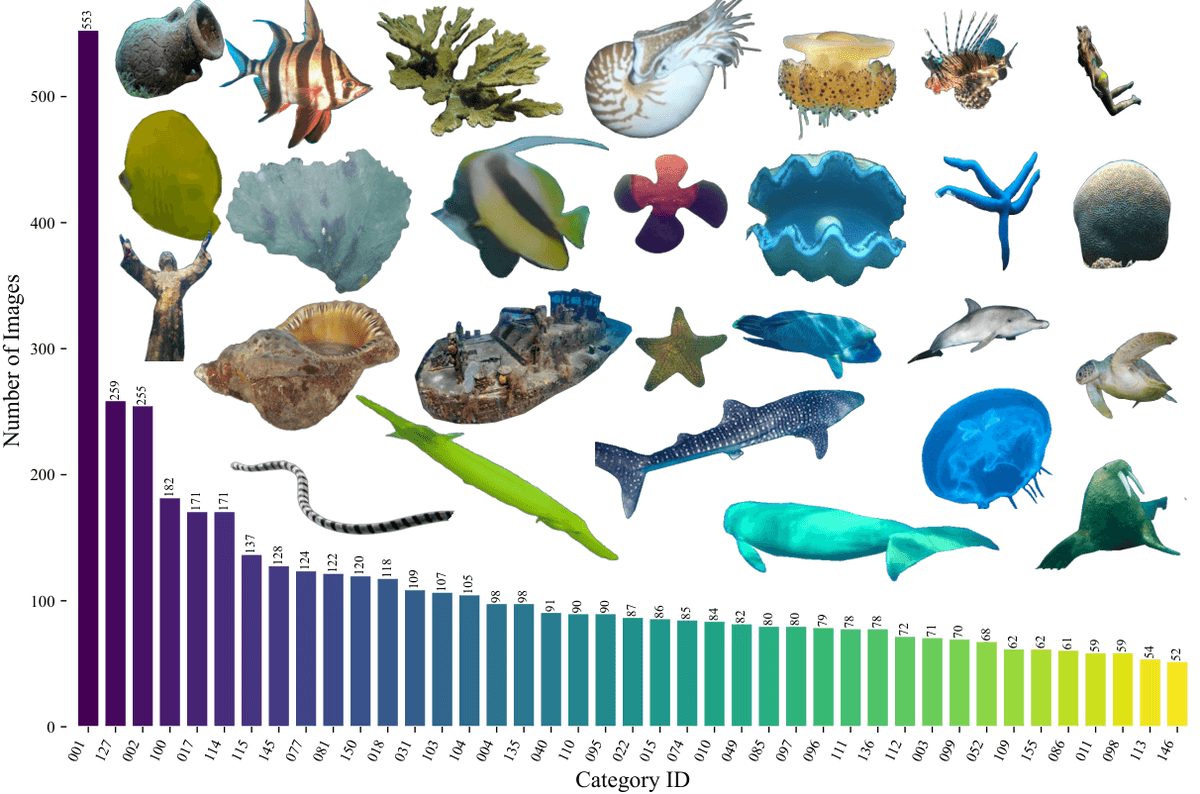
- Dataset contains 16K+ images, 9 super-classes, and splits with 74 unseen validation categories for open-vocabulary evaluation.
- Framework combines a Geometric Prior Enhancement Module using Depth Anything V2 with a Semantic Alignment Injection Mechanism.
- Reaches 56.71 mAP in-domain and 46.18 mAP cross-domain on ConvNeXt-L, beating MAFT+ by 3-6 points.
- Uses only around 23M trainable parameters compared to 108-408M for competing baselines.
- Code, weights, and preprocessing scripts released at github.com/LiBingyu01/MARIS.
Recognizing marine life in underwater images is one of computer vision's messier problems. Water distorts everything: colors wash out, contrast drops, and light scatters unpredictably. Most segmentation models can only identify a fixed list of species they were trained on, which is useless when a submarine drone stumbles onto something new. A team from TeleAI and collaborating universities has released MARIS, both a benchmark and a framework aimed at open-vocabulary instance segmentation for underwater scenes.
MARIS is the first large-scale fine-grained benchmark for underwater open-vocabulary instance segmentation, featuring a limited set of seen categories alongside diverse unseen ones. On top of the dataset, the authors propose a two-part architecture that consistently beats existing open-vocabulary baselines on both in-domain and cross-domain evaluation, with code and weights on GitHub.
Why underwater breaks open-vocabulary models
Open-vocabulary segmentation, where a model uses a vision-language model like CLIP to recognize categories it never explicitly trained on, has worked reasonably well on natural images. Transferring those systems to underwater imagery falls apart for two distinct reasons the authors document carefully.
The first is visual degradation. Underwater images are captured through a medium that induces significant color attenuation, low contrast, and light scattering, which can make organisms whose body colors resemble the surrounding environment visually indistinguishable. A CLIP visual encoder trained on terrestrial photos has no defenses against this.
The second problem is semantic. Existing underwater datasets such as UIIS10K and USIS10K provide labels for fewer than 20 categories, with many marine organisms crudely grouped into broad classes such as fish and plants. Amphora and Blue Parrotfish get lumped together. Models have no fine-grained target to learn, and CLIP's text encoder has weak priors for marine biology to begin with.