
Tel Aviv University Trains a Diffusion Model to Draw Geometry Answers
Researchers at Tel Aviv University show a plain diffusion model, trained on rasterized shapes, can approximate classical geometry problems that have no known efficient solvers.
Takeaways
- Tel Aviv University researchers, with a Google DeepMind collaborator, turn geometric problem solving into image generation. Paper.
- A standard visual diffusion model tackles the Inscribed Square, Steiner Tree, and Simple Polygon problems with no specialized architecture.
- Instances are rasterized to 128x128 grayscale images; solutions are painted on top by denoising Gaussian noise.
- Different random seeds yield diverse valid solutions, which is useful when a problem admits many correct answers.
- Approach avoids the parametric encodings used by prior diffusion-based combinatorial solvers, keeping the pipeline generic.
- Accepted to CVPR 2026; code and demos on the project page.
A team from Tel Aviv University, working with a collaborator at Google DeepMind, has shown that an off-the-shelf image diffusion model can solve hard geometric problems by treating them as pictures rather than equations. The paper, titled Visual Diffusion Models are Geometric Solvers, is authored by Nir Goren, Shai Yehezkel, Omer Dahary, Andrey Voynov, Or Patashnik, and Daniel Cohen-Or, and has been accepted to CVPR 2026.
The core claim is unusual. By training a standard visual diffusion model in pixel space, you can reason directly about geometric configurations without ever encoding coordinates, graphs, or specialized primitives. The model looks at a rasterized shape and paints the answer on top of it.
Painting the answer instead of computing it
The authors demonstrate the idea on three classical problems that are notoriously hard to solve exactly:
- The Inscribed Square Problem. A long-standing question in geometry that asks whether every Jordan curve contains four points forming a square. Also known as Toeplitz's conjecture, it remains unsolved in the general case.
- The Euclidean Steiner Tree Problem. Asks for the shortest network connecting a set of terminal points, with the freedom to add auxiliary junction points. It is NP-hard.
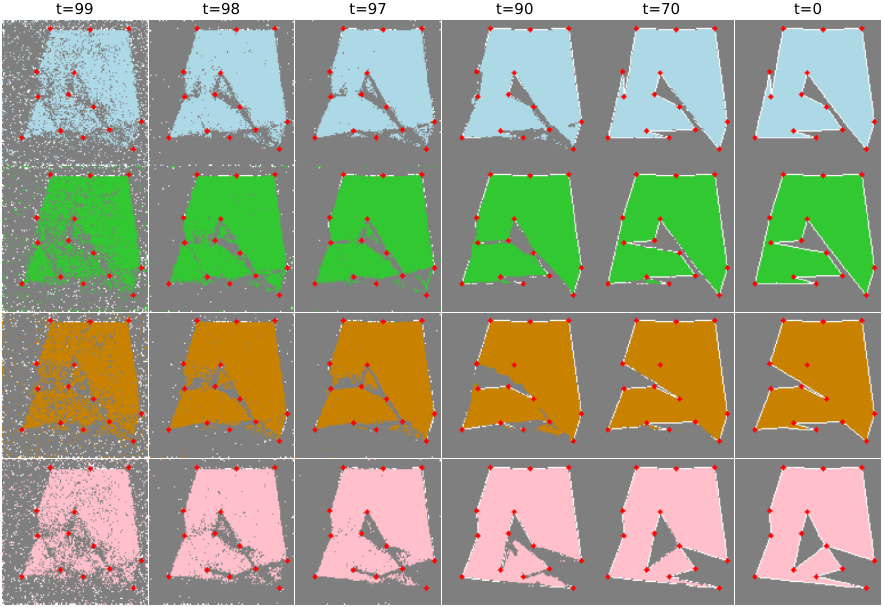
- The Simple Polygon Problem. Given a set of points, construct a non-self-intersecting polygon that passes through all of them, often under an area-optimality constraint.
Rather than parameterizing points, edges, or angles, the method encodes each instance as a picture and generates another picture as the answer. Classical geometric problems become conditional image generation tasks: given a closed curve or a set of terminal points, encode it as a binary image and train a diffusion model to generate the corresponding solution image.