
Tel Aviv's DiG-Net Reads Hand Gestures from 30 Meters With a Webcam
Researchers built the first gesture recognition system that reliably reads dynamic hand signals from up to 30 meters away using only a standard RGB camera.
 Pro
Takeaways
- DiG-Net recognizes dynamic hand gestures from up to 30 meters using only an RGB camera, far beyond the ~7 meter prior limit
- Achieves 97.3% accuracy across 13 gesture classes, outperforming Swin, ViViT, TimeSformer, MViT, I3D, and X3D baselines
- Combines depth-conditioned deformable alignment (DADA) with spatio-temporal graphs and Graph Transformer encoders
- Novel RSTDAL loss uses Beer-Lambert physics to widen the classification margin for hard, distant samples
- Runs at 15-25 FPS on an NVIDIA Jetson Orin Nano without quantization, viable for real-time robotics
- Published in ACM Transactions on Human-Robot Interaction; code and data promised on publication
A team led from Tel Aviv University has released DiG-Net, a dynamic gesture recognition model that reads hand signals from as far as 30 meters using only a standard RGB webcam. The work, appearing in ACM Transactions on Human-Robot Interaction, targets a specific gap in assistive robotics: existing systems can classify a wave or a pointing hand up close, but they collapse the moment the user steps back more than a few meters.
The problem is not just resolution. At long range, a gesture occupies a tiny patch of pixels, subtle finger motion smears across frames, and the difference between a static stop palm and a dynamic go-back sweep can vanish inside a single low-res frame. Prior long-range gesture methods typically cap out around seven meters, and most rely on RGB-D cameras that only work indoors.
Why standard architectures break at distance
The researchers frame the challenge as a fusion problem: spatial cues degrade with range, so temporal cues have to carry more of the signal. Fast, subtle hand motions might be nearly imperceptible in any single low-resolution frame, yet can be captured by analyzing differences across consecutive frames. Standard video transformers like Swin, ViViT, and TimeSformer assume reasonably clean spatial input. At 25+ meters, that assumption breaks.
DiG-Net's design responds to this with three coupled components:
- DADA (Depth-Conditioned Deformable Alignment) blocks that warp feature maps based on per-pixel depth estimates, compensating for atmospheric attenuation and defocus blur
- Spatio-Temporal Graph modules that treat the video as a graph of nodes across space and time, then do message passing to model local motion dynamics
- Graph Transformer encoders that apply self-attention across graph nodes to link early and late phases of a gesture

The preprocessing pipeline is worth flagging because it borrows some clever tricks. Each input video is passed through a pretrained ResNet to embed each frame, then K-Means clustering picks the most representative r frames from the sequence, avoiding redundancy from near-duplicate frames. YOLOv3 then crops the user's full body, which the authors argue is more stable than trying to detect the tiny hand region directly at range.
Baking physics into the loss function
The other core contribution is the Radiometric Spatio-Temporal Depth Attenuation Loss (RSTDAL). Rather than treating all training samples equally, RSTDAL uses the Beer-Lambert attenuation coefficient (a physics model for how light weakens through a medium) to widen the classification margin for gestures captured at greater distances or with subtler motion. The intuition is that the model gets penalized more heavily for ambiguous predictions on the hard examples, forcing it to learn distance-robust representations rather than leaning on fine-grained appearance features that degrade with range.
The numbers
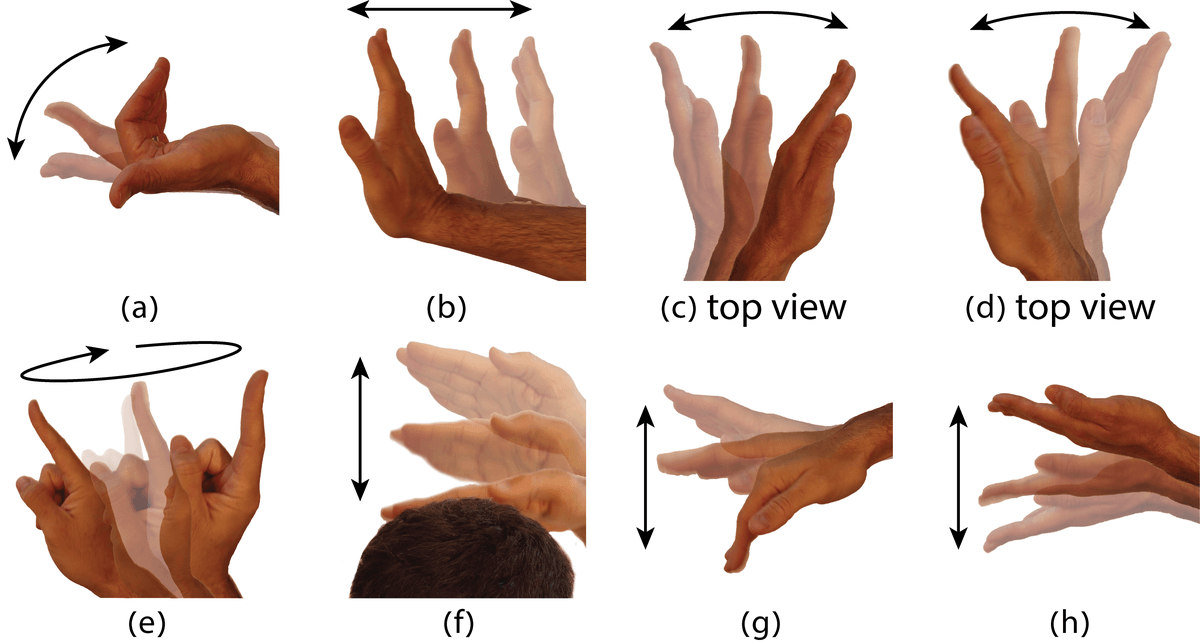
The evaluation covers 13 gesture classes (eight dynamic, four static, plus a null class) collected from 16 participants at distances between 2 and 30 meters, indoors and outdoors, producing 4,790 training samples after augmentation and a separate 458-video test set. DiG-Net hits 97.3% recognition accuracy overall, compared to the next-best baseline (MViT) at 87.9%.
| Model | Success (%) | DWA | GSS | mAP (%) | Inference (ms) |
|---|---|---|---|---|---|
| Swin | 80.5 | 0.84 | 0.85 | 78.1 | 38 |
| ViViT | 78.3 | 0.82 | 0.84 | 77.5 | 44 |
| TimeSformer | 83.4 | 0.85 | 0.87 | 81.3 | 49 |
| MViT | 87.9 | 0.88 | 0.90 | 85.1 | 26 |
| I3D | 84.3 | 0.86 | 0.88 | 82.4 | 31 |
| X3D | 86.2 | 0.87 | 0.89 | 78.8 | 29 |
| DiG-Net | 97.3 | 0.92 | 0.96 | 94.9 | 35 |
The team also introduced two new metrics: Distance-Weighted Accuracy (DWA), which up-weights correct predictions at greater distances, and Gesture Stability Score (GSS), which measures how consistently a model classifies the same gesture across frames. These matter because a robot deployment can't tolerate flickering predictions.
A user study with ten human participants offers useful context: at 25-30 meters, humans hit 68% accuracy on static gestures and 84% on dynamic ones. DiG-Net beat the humans, holding 94.9% under the same long-range dynamic conditions.
What it can and can't do
Ablations show every component matters. Removing the Graph Transformer drops accuracy to 87.5%, and swapping RSTDAL for standard cross-entropy loss drops it to 90.1%. Deployed on an NVIDIA Jetson Orin Nano, the model runs at 15-25 FPS on 8-32 frame sequences without any quantization or TensorRT acceleration, which matters for embedded robotics.
Failure modes are honest and predictable. Under severe clutter or interference accuracy falls to 90.1%, and severe blur or synthetic fog drops it to 88.3%. Confusion still tends to appear between visually similar gestures (turn-around vs. pointing, go-back vs. stop) when hand visibility is severely degraded. And the dataset was collected from participants in a single geographic region without balanced ethnicity or hand-size measurements.
The trained models and datasets are slated to be publicly released upon publication acceptance, though not yet available at the time of the arXiv posting. For anyone building assistive robots, drones that respond to bystander signals, or industrial safety systems where operators need to communicate across a factory floor, this is the first framework that makes long-range gestural control plausible with commodity hardware.