
Tehran's SBL-FE Teaches AI to Learn from Strangers Without Shared Rewards
A new bandit algorithm lets an agent learn from watching others act, even when it has no access to their rewards or intentions.
 Pro
Takeaways
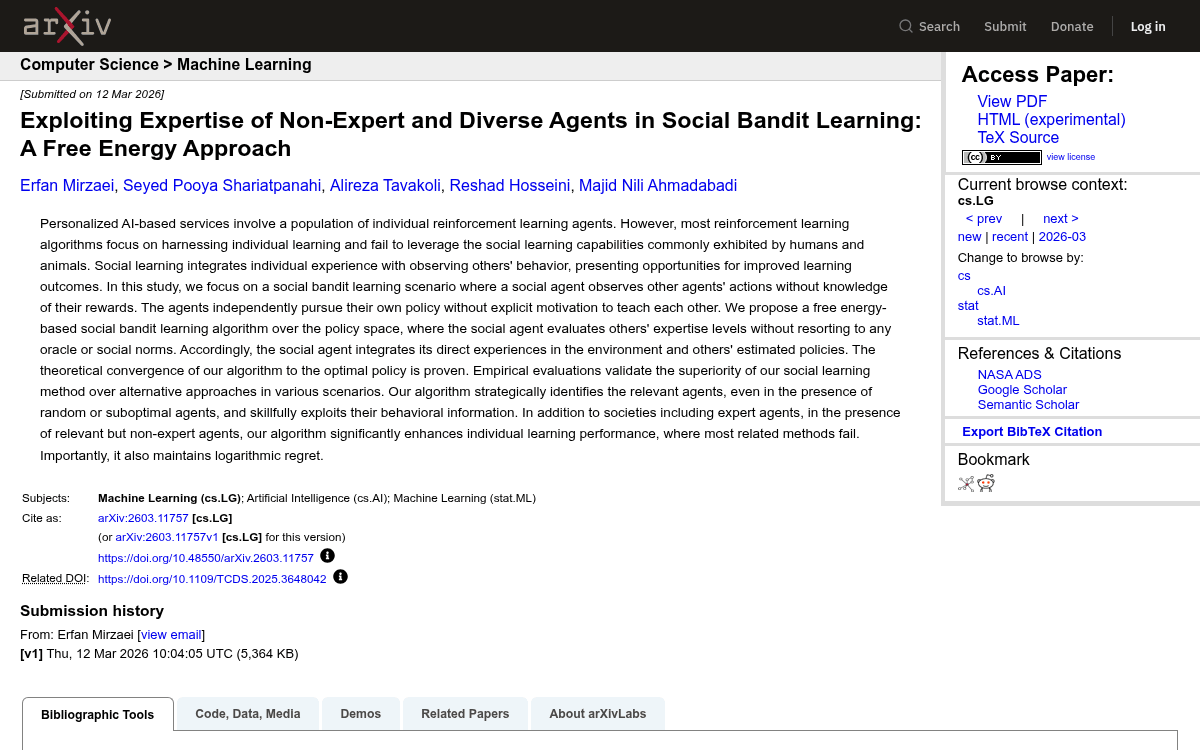
- SBL-FE is a new social bandit algorithm that learns from watching other agents' actions without seeing their rewards. Paper
- It scores each peer by minimizing a free energy that combines Thompson Sampling uncertainty, policy entropy, and observed behavior.
- Convergence to the optimal policy is proven and logarithmic regret is preserved.
- It handles opponents, random peers, sub-optimal agents, and peers with different action sets in one framework.
- Beats TUCB and OUCB baselines on 10-armed Bernoulli bandits, especially when few peers are relevant.
- Published in IEEE TCDS; no public code release accompanies the paper.
Most reinforcement learning agents live in a solitary world. They interact with an environment, receive rewards, and update their policy. Humans and animals, on the other hand, learn a great deal by simply watching what others do. A new paper from the Cognitive Systems Lab at the University of Tehran, Exploiting Expertise of Non-Expert and Diverse Agents in Social Bandit Learning, formalizes this intuition into a bandit algorithm called SBL-FE that ships with a convergence proof.
The setting is deliberately harsh. A social agent observes the actions of other agents interacting with the same environment, but it never sees their rewards, their goals, or any other private information. The other agents may be solving completely different tasks, may be random, may be adversarial, or may share the social agent's objective. The algorithm has to figure out who is worth imitating without ever being told.
Why observing without rewards is hard
Existing social bandit methods usually take shortcuts. Cooperative bandits let agents share rewards outright. Imitation learning assumes a clearly labeled expert. Prior social UCB variants such as TUCB and OUCB assume that other agents are, on average, choosing the optimal arm more often than chance, which breaks the moment the crowd contains random or misaligned agents.
The authors argue this optimism is fragile in the real world. Personal AI tutors, recommender systems, and driving assistants form societies of agents that are owned by different companies, run under different reward functions, and have no incentive to broadcast their internals. A social learner in that world needs a way to judge others using only observed actions, and it needs to handle early trials where its own experience is too thin to trust.

Free energy in policy space
SBL-FE, short for Social Bandit Learning based on Free Energy, borrows the free energy minimization framework used to model bounded-rational decision makers. Free energy here is a physics analogy: it balances expected utility against an information cost that penalizes deviating from a reference policy. The clever move is that the authors do this optimization in policy space rather than in reward or utility space, because policies are all the social agent can actually observe.
For every other agent i, the social agent computes a candidate behavior policy that minimizes a three-term free energy:
- KL divergence between the candidate policy and the social agent's own Thompson Sampling policy. This anchors decisions to personal experience and its uncertainty.
- Entropy of the candidate policy. Lower entropy is preferred because the optimal bandit policy is greedy, but the term only bites once the agent has enough evidence to commit.
- KL divergence between the candidate policy and the observed policy of agent
i, estimated with an exponential moving average over its actions.
The social agent then picks the candidate with the lowest free energy across all peers and itself. Early on, when Thompson Sampling uncertainty is high, the term dominated by personal experience is weak, so the agent leans more on peers whose observed behavior looks informative. As its own estimates sharpen, the KL to its Thompson policy pulls harder, and irrelevant peers naturally drop out. The authors prove this converges to the optimal policy and preserves logarithmic regret.
What the experiments show
Evaluation is on 10-armed Bernoulli bandits with optimality gaps of 0.05, 0.1, and 0.2, averaged over 500 runs of 2,000 trials each. Peers include optimal agents, sub-optimal agents, random agents, adversarial opponent agents, P-optimal agents whose competence drifts over time, and individual learners running Thompson Sampling, UCB, or epsilon-greedy.

A few results stand out:
- When no useful peer is present, SBL-FE quickly recognizes this and falls back to plain Thompson Sampling. TUCB, by contrast, stays optimistic about worthless observations and its regret balloons.
- When peers use weaker individual learners such as UCB or epsilon-greedy, SBL-FE still beats a solo Thompson Sampling agent. It exploits diversity: sometimes the slower learners happen to explore a useful arm first.
- Given a mix of an opponent, a random agent, and an epsilon-greedy learner, the algorithm converges its selection probability onto the only relevant peer within a few hundred trials.
- With P-optimal agents whose reliability changes over time, the free energy signal tracks the switch, meaning the mechanism is adaptive rather than a one-shot judgment.
- It also handles peers with different action sets by simply ignoring observations outside its own arms, and it degrades gracefully under uniform observation noise.
What it is and is not good for
SBL-FE is a stochastic multi-armed bandit method, not a full deep RL algorithm. It fits problems where the exploration budget is small, reward channels are private, and agent populations are heterogeneous. Personalized recommenders, AI tutors that observe each other's action logs, and clinical trial style adaptive experiments are the kind of use cases the authors point to.
The limitations are honest. The algorithm's published version in IEEE Transactions on Cognitive and Developmental Systems shows that when every peer's optimal action is genuinely sub-optimal for the social agent, greedy selection over free-energy-minimum policies can briefly steer it wrong before its own Thompson estimates recover. Extending the method to full Markov Decision Processes with long-horizon tasks is listed as future work, and there is a per-trial cost of O(NK) to update free energies across N peers and K arms. The paper does not appear to release a public code repository, so anyone wanting to try SBL-FE will need to implement Algorithm 1 from the pseudocode and the hyperparameters given in the appendix.
The bigger contribution is conceptual. It shows that a self-referenced evaluation measure, built entirely from observable policies and a physics-inspired free energy, can identify who to learn from in a crowd of strangers, without oracles, without shared rewards, and without any assumption that the majority is competent.