
TechWolf's WorkRB Is the First Open Benchmark Built to Fix Hiring AI
A 19-author consortium spanning academia, industry, and public institutions releases the first shared benchmark for job matching, skill extraction, and workforce AI.
 Pro
Takeaways
- WorkRB is the first open-source benchmark for work-domain AI, unifying 13 tasks across 7 groups (GitHub).
- Covers job/skill recommendation, candidate matching, normalization, and skill extraction as unified ranking problems.
- Supports up to 28 languages via dynamic loading of ESCO and other multilingual ontologies.
- Pip-installable with modular base classes; proprietary tasks can be plugged in locally without sharing data.
- Baselines include JobBERT-v1/v2/v3, CurriculumMatch, ConTeXTMatch, Qwen3-Embed, BM25, TF-IDF.
- Built by 19 authors from TechWolf, Avature, Malt, Ghent, Copenhagen, WAPES, and others (paper).
Work-domain AI powers a surprising amount of infrastructure. Every hiring platform, every talent management system, every public employment service is stitched together from job matching, skill extraction, and job normalization models. Nobody agrees on how to measure whether any of it actually works. A new benchmark called WorkRB is trying to fix that, with backing from an unusually broad coalition.
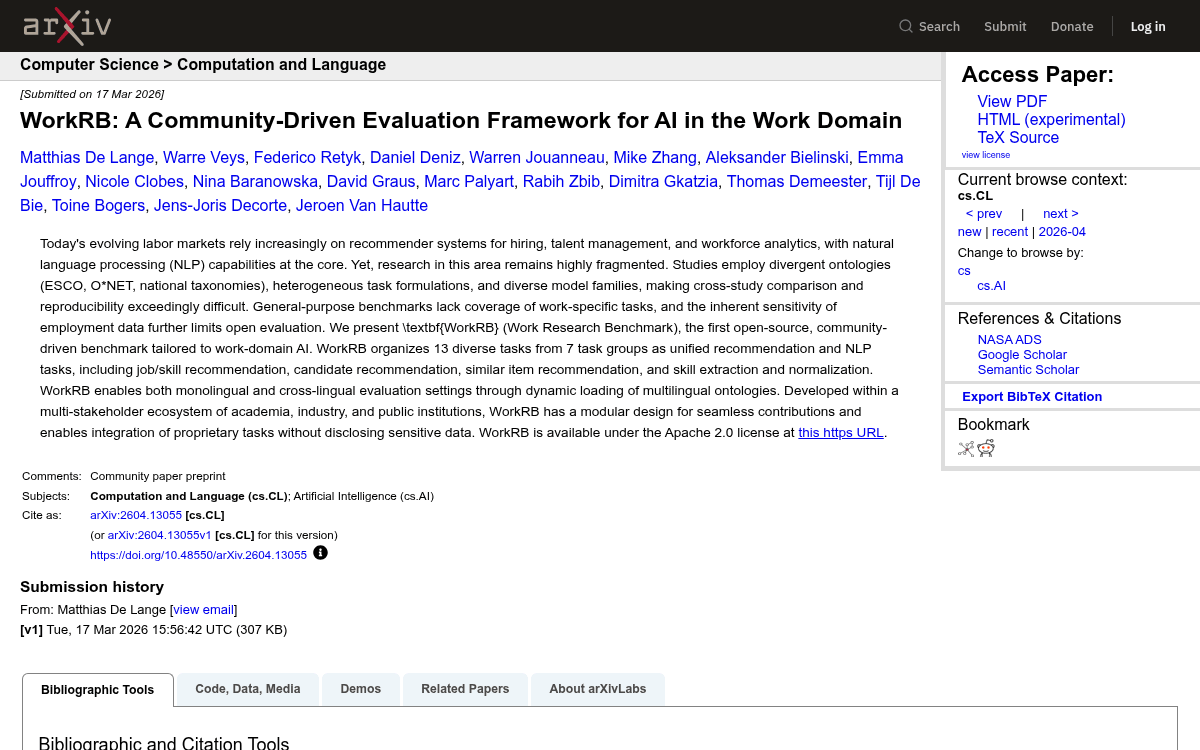
WorkRB (Work Research Benchmark) is presented as the first open-source, community-driven evaluation suite tailored to work-domain AI. It was built by 19 authors across TechWolf, Avature, Malt, the University of Copenhagen, Ghent University, Leiden University, Edinburgh Napier, WAPES (the World Association of Public Employment Services), and others. That mix directly reflects the problem the project is trying to solve.
Why work AI evaluation is a mess
The core issue is fragmentation. Studies employ divergent ontologies (ESCO, O*NET, national taxonomies), heterogeneous task formulations, and diverse model families, making cross-study comparison and reproducibility exceedingly difficult. Employment data is also legally radioactive: career histories and compensation records are personal data under GDPR, and under the EU AI Act, employment AI is classified as high-risk. Most useful evaluation datasets therefore sit locked inside private companies.