
Technion's SEMUS Beats StarCraft's Hardest Maps Using Ensemble Disagreement
SEMUS uses ensemble kurtosis to steer exploration and cut variance in multi-agent RL, beating baselines on super-hard SMAC maps.
 Pro
Takeaways
- SEMUS is a new multi-agent RL algorithm from Technion combining ensemble critics with selective exploration and uncertainty weighting.
- It uses excess kurtosis of the critic ensemble to decide when and where agents should explore, avoiding random wandering.
- A novel truncated TD(λ) variant clips off-policy targets by an uncertainty score instead of the standard retrace ratio.
- Bhattacharyya-distance regularization against the ensemble mean keeps critics diverse at O(N) cost instead of O(N²).
- Mixed on- and off-policy actor gradients balance stability and sample efficiency, with a proven bias bound tied to ν and KL divergence.
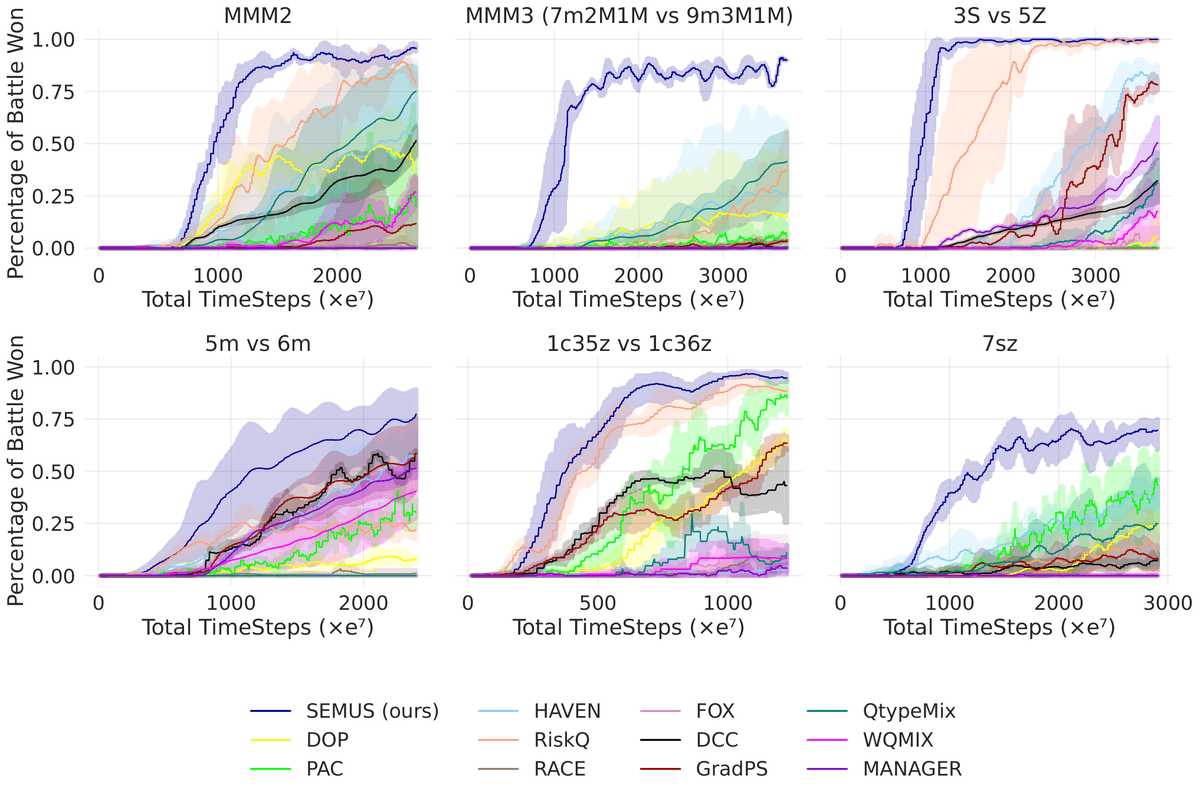
- Achieves state of the art on super-hard SMAC maps including MMM2 and MMM3, plus MACF and sparse Predator-Prey. Full paper.
Multi-agent reinforcement learning has a well-known efficiency problem. Adding more agents blows up the joint action space, and each agent's exploration adds noise that destabilizes the others. A new algorithm called SEMUS from Technion researchers tackles both issues at once by using an ensemble of critics whose disagreement is measured with kurtosis rather than variance, then using that same signal to down-weight noisy learning updates.
The result is a cooperative MARL system that reaches state-of-the-art performance on super-hard StarCraft II maps, sparse Predator-Prey grids, and a stochastic driving task, while using a relatively small ensemble of 10 critics.
Why standard MARL wastes samples
In centralized training with decentralized execution (CTDE), agents share a global critic during training but act independently at test time. CTDE methods remain vulnerable to the curse of dimensionality, as the joint action space grows exponentially with the number of agents and hinders effective exploration. Every extra teammate also injects variance, because your Bellman target depends on what everyone else happened to do that episode.
Existing fixes attack one side of the problem or the other. Entropy-based exploration (as in PAC) tends to send agents wandering into redundant states. Off-policy MAPG methods like DOP boost sample use but introduce bias, and their tree-backup truncation can chop off useful trace information. SEMUS unifies exploration, variance reduction, and off-policy stability into one framework.

Kurtosis as an uncertainty signal
The core idea is to give every agent a shared ensemble of N sub-critics, then compute the excess kurtosis of their Q-value estimates for each action. Kurtosis is the fourth standardized moment of a distribution and, unlike variance, is sensitive to the tails rather than the magnitude of disagreement.
Why does that matter? The normalization in kurtosis reduces sensitivity to the magnitude of deviations. The authors show a clean toy result: if each critic's estimate is either the baseline value or shifted by some constant with probability p, then variance scales with the square of that shift, while kurtosis depends only on p. In practice, that means kurtosis reliably flags when critics disagree without being fooled by how extreme a single outlier prediction happens to be.
SEMUS uses this signal in two ways:
- Exploration. At each step, the agent computes mean excess kurtosis across its actions. If it is positive, the agent boosts action logits by their per-action kurtosis before the softmax. Otherwise, it defaults to epsilon-greedy. Exploration only happens where the ensemble is actually confused.
- Variance reduction. The centralized critic is trained with a new truncated TD(λ) variant. Instead of the retrace clip
min(1, π/μ), SEMUS clips bymin(w, π/μ), wherewis an uncertainty weight bounded between 0.5 and 1 derived from raw kurtosis. High-uncertainty transitions contribute less to the target.
Diversity without paying for it
Ensembles only help if the members actually disagree in useful ways. Rather than the standard trick of random initialization plus varied minibatches, SEMUS adds a Bhattacharyya distance regularizer between each ensemble member and the ensemble mean.
A key trick is computational. The natural formulation would penalize pairwise distance between every pair of critics, which is O(N²). The authors prove that regularizing each member against the mean is a lower bound on pairwise diversity, dropping the cost to O(N). That is what lets them run N=10 without blowing up training time; the ensemble adds roughly 2.3x latency and 10x memory over a single critic.
Mixed on- and off-policy actors
The actor side interpolates between on-policy and off-policy gradient estimators with a mixing coefficient ν. The authors derive a bound showing bias grows with the KL divergence between the current joint policy and the behavior policy that generated the replay data, scaled by ν/(1-γ)². In their ablations, ν=0.5 is a sweet spot, with values above that degrading performance as the off-policy bias dominates.
Benchmark results
SEMUS was tested against a large slate of recent MARL baselines including DOP, PAC, RiskQ, HAVEN, RACE, FOX, DCC, GradPS, QtypeMix, weighted QMIX, and MANAGER. The evaluation covers three environments:
- SMAC - the StarCraft Multi-Agent Challenge, including super-hard maps MMM2, MMM3, and 1c3s5z vs 1c3s6z.
- Multi-agent car following (MACF) - two cars must reach a goal together, with a probabilistic crash penalty for overspeeding. This tests aleatoric uncertainty handling.
- Predator-Prey - including sparse variants where four agents must simultaneously catch prey on progressively larger grids.

The clearest wins come on the hardest maps. On MMM2, SEMUS reaches a 0.94 win rate versus the mixed actor variant's 0.83 and pure on-policy's 0.65. On MACF, it converges to essentially zero overspeed events by the end of training, while RACE stays around 80 and RiskQ around 136. The two-corridors experiment is particularly telling: with kurtosis-guided exploration, agents use the long corridor 44% of the time before the short one closes and adapt in 0.1M steps. Without it, adaptation takes roughly 4M steps.
When it will and will not help you
SEMUS is aimed squarely at cooperative CTDE settings with discrete actions and small-to-medium team sizes, where the joint action space is punishing and variance from teammates is a real issue. If you are running purely on-policy MAPPO on a task that already converges cleanly, the ensemble overhead is unlikely to pay off.
The main limitations are practical. You are paying 10x memory for the ensemble even with the diversity trick, and hyperparameters like β, C₁, and C₂ matter. Ablations show that pushing β too high hurts on standard SMAC maps, though it helps on sparse exploration tasks like Sparse Predator-Prey. The paper does not appear to include a public code release, so anyone wanting to reproduce the results will need to build on top of an existing DOP or PAC codebase and add the kurtosis, Bhattacharyya, and truncated TD(λ) components themselves.
What is genuinely new here is the argument that a single statistical quantity, ensemble kurtosis, can simultaneously drive selective exploration and per-sample credit weighting in a large joint action space, and that a cheap mean-based diversity regularizer is enough to keep the ensemble useful. That combination is the reason the method holds up on the hardest StarCraft maps where value-decomposition baselines have historically struggled.