
Technion Gives Drone Swarms a Geometric Rule to Eliminate Sensor Blind Spots
A new geometric framework identifies exactly where sensors must sit in a robot formation to avoid silent disturbances being blocked at steady state.
 Pro
Takeaways
- New Technion paper geometrically characterizes when disturbances become invisible at sensors in distance-based formations.
- Proves flexible-network transmission zeros are measure-zero rare but analytically intractable for design rules.
- For infinitesimally rigid formations, the blind-spot condition collapses to a single affine hyperplane.
- The hyperplane depends only on the actuator position, centroid, and polar moment of inertia.
- Intersecting safe half-planes yields a convex global transmission polygon guaranteeing full-rank sensing.
- Sensors should sit near the centroid; peripheral agents are the most vulnerable to signal blocking.
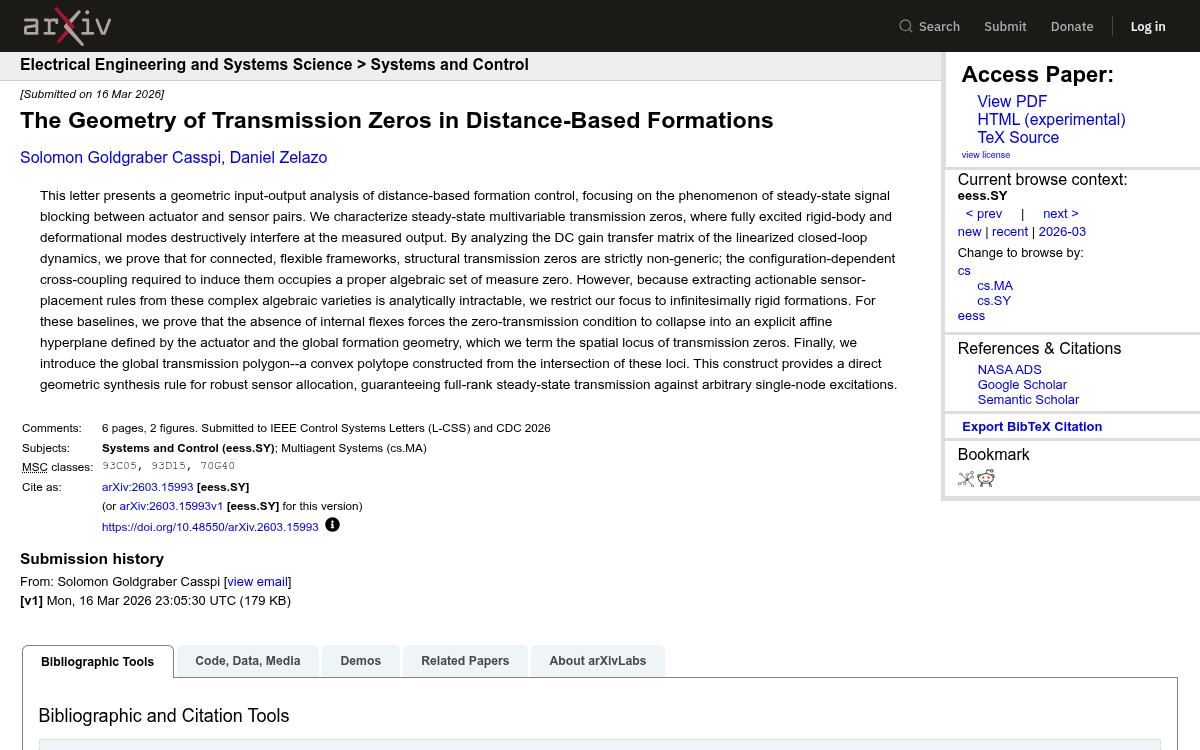
Picture a swarm of drones holding a formation using nothing but relative distance measurements. A gust of wind hits one drone, and you would expect a nearby sensor drone to see the effect ripple through the network. Sometimes, due to the pure geometry of the formation, that disturbance is perfectly cancelled out before it reaches the sensor. It becomes invisible. A new paper from the Technion, The Geometry of Transmission Zeros in Distance-Based Formations, works out exactly when this happens and gives a clean geometric rule for placing sensors so it never does.
The invisible-signal problem
Distance-based formation control is the backbone of many decentralized multi-agent systems. Agents maintain a shape using only local relative measurements, driven by gradient-descent laws derived from edge-tension potentials, which keeps them robust in GPS-denied environments. The catch is a classical multivariable control phenomenon called a steady-state transmission zero. When a disturbance hits one node, perfect destructive interference can cause certain disturbance directions to vanish entirely at the measured output, leaving the sensor blind in that direction.
Prior work in consensus networks tied these blind spots to shortest paths and residual graph structure, and a recent companion paper from the same authors handled the case where an actuator sits exactly at the center of a pure rotation and simply cannot excite a mode. This letter tackles a different failure mode: every mode is successfully excited and measured, yet the spatial configuration still induces a steady-state transmission zero.
Why "almost never" is not good enough
The first result is a rarity theorem. By analyzing the DC gain of the linearized closed-loop dynamics, the authors show that for connected, flexible frameworks, structural transmission zeros are strictly non-generic and occur only on an algebraic set of measure zero. In plain terms, if you drop a random flexible formation into the world, the probability of hitting one of these blind configurations is zero.
Measure-zero does not mean harmless, though. These bad configurations live on complex algebraic varieties, and the internal flex modes generally have no closed-form spatial description. That makes them impossible to translate into a design rule you can hand to an engineer laying out sensors.
Restrict to rigid formations, and geometry collapses
The key move is to specialize to infinitesimally rigid formations, meaning frameworks whose only zero-energy modes are the three rigid-body motions (two translations and one rotation) and that admit no internal flexes. In that regime, the messy algebraic zero-set collapses into a single scalar condition on the rotational mode.
Substituting the explicit geometric form of the rotational mode turns the rank-drop condition into a linear equation in the sensor coordinates. The result, called the spatial locus of transmission zeros, is an affine hyperplane orthogonal to the relative position vector between the actuator and the center of mass, located in the half-plane opposite the actuated agent.
Two invariants control everything:
- The center of mass
p_cmof the formation. - The polar moment of inertia
J_p, which acts as a spatial scale. Formations with larger spatial spread push the zero-transmission hyperplane further from the center of mass, expanding safe sensor regions; compact formations pull it closer.
One useful subtlety: because the DC gain matrix has a strictly positive trace from the translation baseline, the rank drops from 2 to 1, never to 0. A sensor on the locus is not fully blind but suffers severe directional signal blocking.
A polygon you can actually draw
Since you rarely know in advance which node a disturbance will hit, the authors intersect the safe half-planes from every possible actuator into a single convex region: the global transmission polygon. Place your sensor on any agent inside this polygon and you are guaranteed full-rank steady-state transmission against arbitrary single-node excitations. Three immediate consequences fall out:
- The polygon always contains the center of mass, so it is never empty. Sensors should therefore be allocated to agents nearest the formation centroid, while peripheral agents are more likely to be vulnerable.
- A collocated actuator-sensor pair can never produce a steady-state transmission zero, which matches engineering intuition but now has a clean proof.
- The condition is reciprocal: if the map from agent i to agent j is blocked, so is the map from j to i.
Validation and honest limitations
The numerical study uses a 4-agent asymmetric formation with polar moment 16 and center of mass at the origin. Placing the sensor on an agent that sits exactly on the transmission-zero hyperplane drives the minimum singular value of the transfer function to zero as frequency approaches zero, confirming the rank drop. Removing an internal bracing edge to make the framework flexible breaks the exact cancellation and restores full DC rank, illustrating why the flexible case is generic but analytically messy.
What the paper does not deliver:
- No code or open-source implementation is released alongside the letter.
- Results are restricted to formations in the plane. Extending to three or more dimensions requires generalizing the rank-drop conditions and navigating the non-commutative Lie algebra of SO(d).
- The analysis is linearized around the target equilibrium and covers only steady-state behavior, not transient response or nonlinear observability.
- It applies to infinitesimally rigid graphs; flexible frameworks still need the intractable algebraic treatment.
For anyone building swarm control stacks, cooperative SLAM systems, or distributed sensing networks that rely on rigidity-based coordination, the practical takeaway is compact: compute the centroid and polar moment of your target formation, draw the transmission polygon, and assign your leader-follower sensor roles to nodes that sit inside it. The design rule ends up simpler than the derivation that justifies it.