
TaxoNet Beats GPT-4o at Rare Plant Recognition by Fixing How AI Learns
A new embedding framework called TaxoNet reshapes decision boundaries for rare plant species and beats GPT-4o and Gemini-2.5 by 2x on species accuracy.
 Pro
Takeaways
- TaxoNet introduces a dual-margin loss that applies frequency-aware margins to both target and non-target classes, fixing prototype misalignment for rare species.
- The method beats GPT-4o and Gemini-2.5 by roughly 2x on species-level accuracy on iNaturalist plants.
- On tail genus recall in Auto-Arborist, TaxoNet hits 57% versus 44% for LDAM, the previous strongest baseline.
- Norm-guided sample selection uses embedding norm as a proxy to prioritize rare or morphologically diverse samples, avoiding oversampling memorization.
- The framework was validated across urban tree, citizen-science, and herbarium specimen datasets under domain shift and open-set conditions.
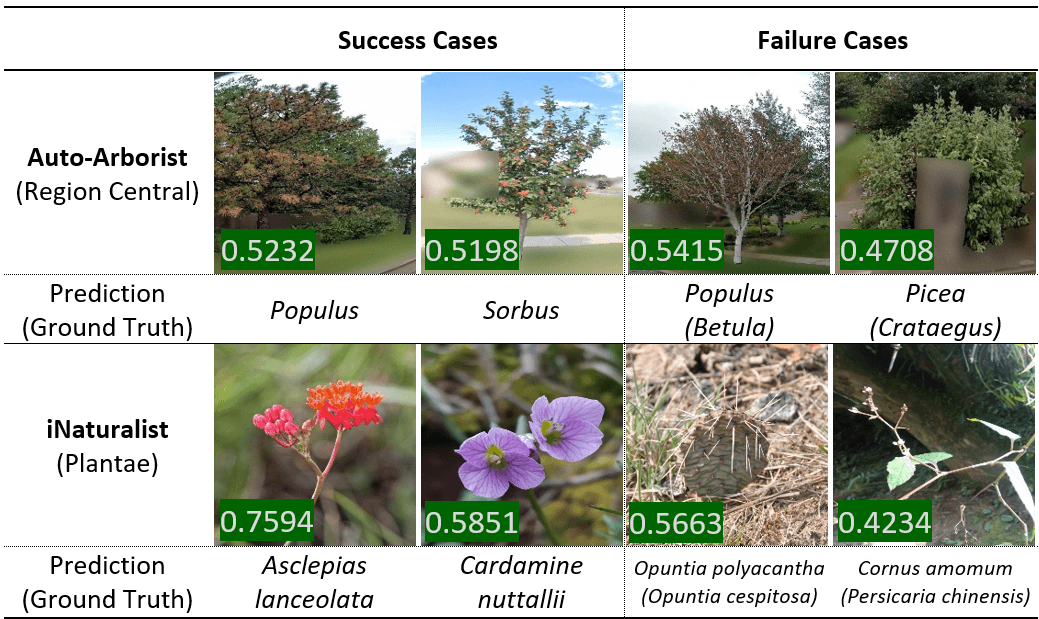
- Failure cases involve visually ambiguous same-genus species or leaf-only shots, pointing to multi-view or multimodal extensions.
Identifying plants from photos sounds like a solved problem until you look at the actual data. A handful of common species show up thousands of times, thousands of rare species show up barely at all, seasons change how leaves look, and new species that were never in the training set keep appearing in the wild. A team from Max Planck Institute for Security and Privacy, Changwon National University, and AiV has released TaxoNet, an embedding framework built around a new loss function that tackles all four problems together, and it outperforms both specialized baselines and general-purpose multimodal models like GPT-4o.
The messy reality of ecological image data
Most computer vision work on plant classification treats each challenge in isolation. There is fine-grained recognition (telling Acer rubrum from Acer saccharum), long-tail learning (handling rare classes), domain adaptation (handling seasonal or regional shifts), and open-set recognition (flagging unknown species). In deployment they all show up at once.
Real-world ecological data often exhibits long-tailed distributions, where a few common taxa dominate observations while rare ones, many of them endemic, endangered, or invasive, remain underrepresented. That distribution is exactly backwards from what conservation needs, since the uncommon species are usually the ones worth monitoring.

Why standard losses collapse on rare classes
The authors identify a specific failure mode they call prototype misalignment. In margin-based softmax classifiers like AM-Softmax or ArcFace, each class has a learned prototype vector. During training, gradients from every batch pull embeddings toward their own prototype and push them away from every other prototype.