
TARS Robotics' World In Your Hands Boosts Robot Success Rates by 8x
TARS Robotics released 1,000+ hours of in-the-wild human manipulation data with millimeter-accurate motion labels, boosting robot success from 8% to 60% in cluttered scenes.
 Pro
Takeaways
- WIYH ships 1,045 hours and 125,400 clips of in-the-wild human manipulation with millimeter-scale 6D wrist trajectories.
- Oracle Suite is a wearable rig (chest cameras, gloves with IMUs and tactile sensors, Orin backpack) that auto-labels 3D actions.
- Cluttered-scene robot success jumped from 8% to 60% when human data was co-trained with 500 UMI robot clips.
- Cross-embodiment VLA pretraining on WIYH lifted rose insertion and gift packing success from 15% to 70%.
- Benchmark shows GPT-4o, Qwen3-VL, and Doubao-Seed all fail at vertical spatial referring and progress verification.
- Dataset and hardware released under CC BY-NC-SA 4.0 for non-commercial research use.
Robots can imitate a human folding towels, but only if someone painstakingly recorded that human, frame by frame, with expensive motion capture rigs bolted to a lab ceiling. That data bottleneck is why manipulation policies still struggle the moment you move them into a real hotel room or supermarket aisle. A new open-source ecosystem from TARS Robotics called World In Your Hands (WIYH) tries to break that bottleneck by shipping over 1,000 hours of human manipulation data collected in the wild with millimeter-scale motion accuracy, plus the wearable hardware that captured it.
When the authors used WIYH data alongside a small set of robot demonstrations, success rates on cluttered scenes jumped from 8% to 60%, a nearly eight-fold gain on the setting where imitation policies typically fall apart.
The data problem that keeps robots in the lab
Vision-language-action (VLA) models have adopted the LLM playbook of massive pretraining, but they lack an internet-scale corpus of dexterous hand behavior. Existing human-manipulation datasets have three chronic problems that the paper targets: they are shot in constrained lab rigs, they miss key modalities like 3D action or precise language, and they do not support end-to-end benchmarking from perception to control.
WIYH's answer is to make data collection portable and cheap enough that skilled workers can wear the rig during their actual jobs. The captured footage covers authentic operational workflows across sectors including hotel laundry, supermarket assembly, and logistics, which is a different flavor of data than either scripted lab demos or scraped YouTube clips.
Inside the Oracle Suite
The hardware is a three-piece wearable called Oracle Suite. It splits sensing across a chest unit, a pair of gloves, and a backpack, all synchronized in hardware.

- H-FPVHive (chest): two fisheye cameras, two pinhole cameras, and four infrared lenses, with hardware sync across all cameras and IR used to localize the gloves.
- H-Gloves: six IMUs per side, five fingertip pressure sensors, and three fisheye cameras per glove for visual tracking. The tactile sensors have a resolution of 5 mN and a range of 0.2 N to 50 N.
- H-Backpack: power plus an NVIDIA Orin for onboard compute and storage.
The interesting engineering trick is the auto-labeling pipeline. Online, it runs lightweight visual-inertial odometry and IR detection. Offline, it refines those coarse estimates with structure-from-motion. Fusing IR, IMU, and RGB streams yields 6D wrist trajectories with mean positional error under 5 mm, validated in a motion-capture room by attaching mocap spheres to the gloves and comparing trajectories.
What is actually in the dataset
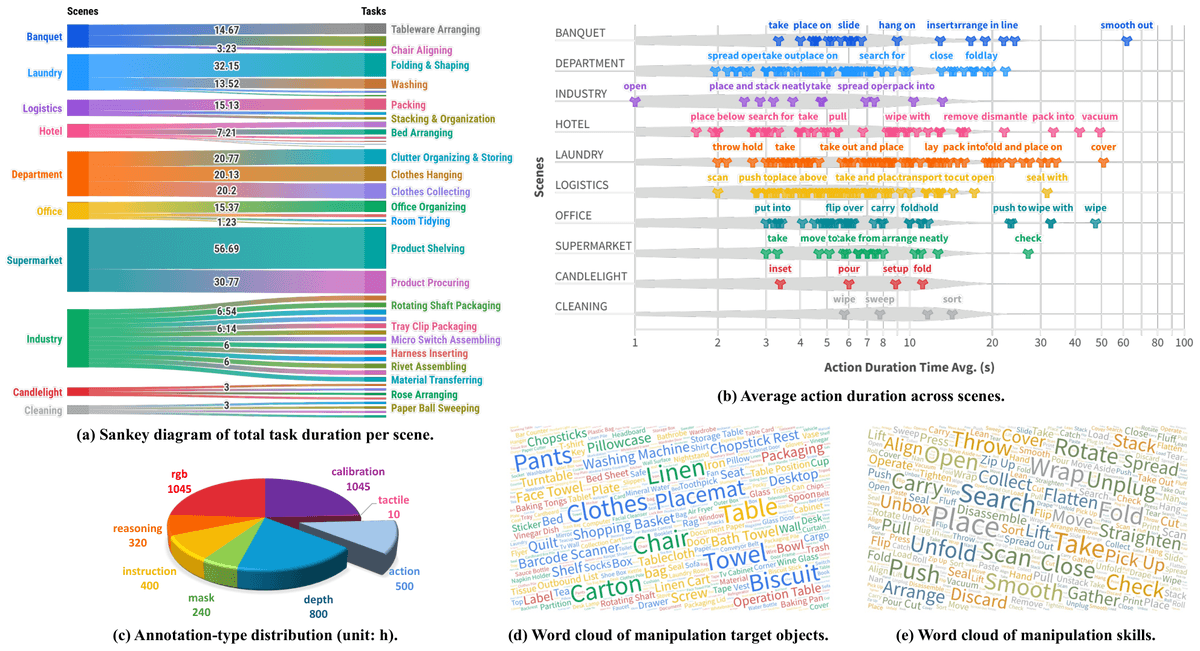
WIYH contains 1,045 hours across 125,400 clips, spanning ten scene categories including banquet halls, laundry rooms, hotels, offices, supermarkets, and industrial settings. The differentiator against prior work is that everything is collected in the wild by skilled practitioners, capturing authentic decision-making, and every clip carries the full multimodal stack: RGB, depth, masks, 3D action, tactile, camera calibration, language instructions, and VLM-grade annotations.
Labeling happens in three stages. Atomic action labeling segments video with Qwen2.5-VL-72B, then humans define skill and target object, reviewers check boundaries, and instructions are augmented. Perception labeling uses SAM for instance masks and FoundationStereo for depth from the binocular chest cameras. Vision-language labeling then adds chain-of-thought reasoning, spatial referring, subtask prediction, and completion verification.

How much does human data actually help a robot?
The team ran two experiments to show that human data transfers to robot policies despite the embodiment gap.
Cross-embodiment pretraining. The authors pretrained StarVLA-PI on WIYH, then post-trained on 150 gripper-based teleop samples for two tasks (rose insertion and gift packing). Without pretraining the model hit 15% success. With VLM-only pretraining, 30%. With full VLA pretraining on human data, 70%. Human-hand-to-robot-gripper transfer works even though the embodiments do not match.
Retargeting co-training. Here the team combined UMI robot data collected in a single-object setting with human hand data retargeted to a low-DoF dexterous hand. The revealing result shows up in cluttered multi-object scenes:
| Robot data | Human data | Cluttered scene success |
|---|---|---|
| 200 clips | 0 | 0.0% |
| 200 clips | 800 clips | 32.0% |
| 500 clips | 0 | 8.0% |
| 500 clips | 800 clips | 60.0% |
Scaling robot data from 200 to 500 clips barely moved the needle. Adding human demonstrations drove a 52-point jump. The interpretation is that human data expands both the observation domain (varied clutter, heights, occlusion) and the action domain in ways robot teleop cannot economically cover.
Where the VLMs still fumble
WIYH ships a Human-centric Vision-Language benchmark with three tasks: spatial referring, subtask prediction, and completion verification. Testing GPT-4o, Doubao-Seed-1.6-Vision, Qwen3-VL-Plus, and Qwen3-VL-4B revealed a consistent pattern. Models are decent at high-level task decomposition (subtask prediction sits around 70-77%) but weak at fine spatial grounding (spatial referring below 50%, with GPT-4o at 10%) and at judging whether a task is actually complete (all models hover near chance at 51-57%).
Vertical spatial reasoning is called out as a specific failure mode. Models handle in-plane relations like "between A and B" but break when A and B sit at different heights, which is exactly the geometry that matters for a manipulator.
What ships, and what does not
- Dataset, hardware design, and a wiyh-devkit are open source under CC BY-NC-SA 4.0 (research use only, no commercial redistribution).
- The dataset opened for access starting in late 2025, staged for research institutions and industry partners.
- A high-fidelity simulation environment is flagged as future work, so today's benchmarks are real-world only.
- Faces in RGB streams are optionally blurred in the public release, no audio is recorded, and identity metadata is not shipped.
Where this fits
WIYH is best thought of as pretraining fuel for VLA models rather than a plug-and-play robot policy. If you are training a manipulation foundation model and running out of dexterous demonstration data, this is currently one of the largest and most richly annotated resources available, and the paper provides evidence that pretraining transfers even when the target robot is a gripper or a low-DoF dexterous hand. Anyone hoping for turnkey performance on their specific hardware will be disappointed: retargeting still requires task-specific robot data, and the tactile signal, while present, is low-resolution force sensing rather than a high-density skin.