
TAPS Forces Diffusion LLMs Like LLaDA to Stop Repeating Themselves
A training-free trick for diffusion language models injects fading noise into the prompt embedding early in denoising to unlock diverse outputs without hurting quality.
 Pro
Takeaways
- New training-free decoder TAPS boosts diversity in diffusion language models by perturbing prompt embeddings early in denoising.
- Exploits a temporal division of labor: early steps set semantics, later steps refine wording.
- Adds Gaussian noise with a decaying schedule, rescales statistics, and preserves per-token norms.
- On NoveltyBench with LLaDA-8B, Sent-BERT diversity jumps from 25.8 to 36.0 with no quality loss.
- On GSM8K, majority-vote accuracy improves at higher temperatures, opposite of temperature and nucleus sampling.
- Works on both LLaDA and semi-autoregressive TraDo; project page at taps-dlm.github.io.
Diffusion language models were supposed to be the antidote to the sameness problem of autoregressive LLMs. Because they refine a whole sequence in parallel through a denoising process, they have an extra degree of freedom that token-by-token models do not. Yet in practice they still collapse toward the same answer when you sample repeatedly, and the usual diversity knobs, like temperature, top-p, and min-p, either barely move the needle or break coherence.
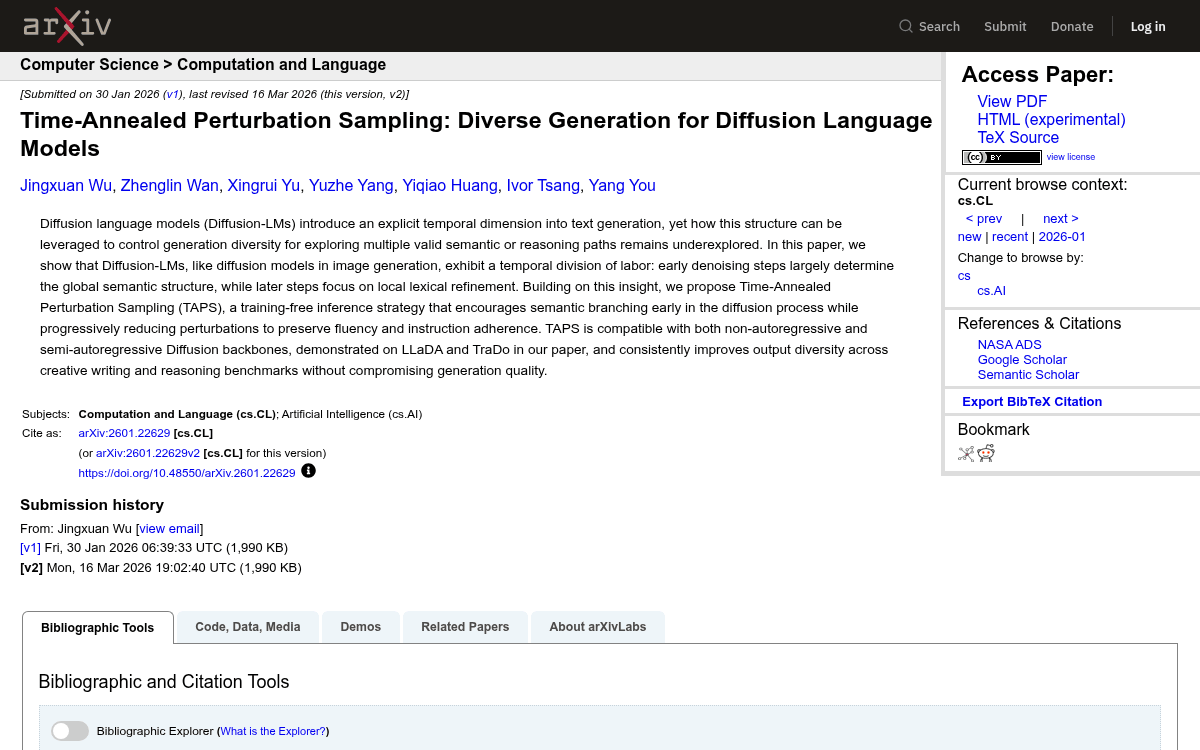
A new paper introduces Time-Annealed Perturbation Sampling (TAPS), a training-free decoding strategy that exploits a temporal structure inside diffusion LMs to force meaningful branching without wrecking output quality. The authors demonstrate it on LLaDA-8B-Instruct and TraDo-8B-Instruct, with a project page at taps-dlm.github.io.
The observation that makes it work
The paper starts from an empirical claim that mirrors what has long been known in image diffusion: early denoising steps largely determine the global semantic structure, while later steps focus on local lexical refinement. If that division of labor is real for text, then the natural place to inject variation is the first few denoising steps, and the natural place to stop injecting is right before the model settles on wording.
That is exactly what TAPS does. Instead of perturbing token logits at the output like temperature sampling, it perturbs the conditioning signal, meaning the embedding of the prompt that the model is denoising against, and it does so with a strength that decays over time.
How the method works
The core recipe is short. At each denoising step t inside a chosen window, the prompt embedding E is replaced with a noisy version, with the noise magnitude following a monotonically decreasing schedule (cosine or linear both work). Formally the perturbed conditioning is E + sigma(t) * epsilon where epsilon is Gaussian.
Naively adding noise to embeddings destroys generation quality, so TAPS bolts on two stabilizers:
- Distribution-aware rescaling. The perturbed embedding is renormalized to match the mean and standard deviation of the original, then linearly interpolated with the clean embedding through a mixing coefficient
psi. - Norm-preserving projection. Each token's perturbed vector is rescaled so its L2 norm matches the original, keeping the perturbation on a hypersphere and preserving the model's learned representation geometry.

The whole thing is training-free and adds negligible overhead. Default settings the authors converge on are noise scale sigma = 0.2, a mixing coefficient of 0.9, and cosine annealing, with the injection window covering the early portion of denoising (roughly t in [0.9, 0.3] for LLaDA and [0.9, 0.5] for TraDo).
What the numbers say
The authors evaluate on four benchmarks that stress different flavors of diversity: NoveltyBench for multi-sample diversity, WritingPrompts for long-form stories, the creative-writing subset of Arena-Hard-Auto, and GSM8K for reasoning. Diversity is measured with IntraDistinct, Div-BLEU (1 minus Self-BLEU), Sentence-BERT distance, and Expectation-Adjusted Distinct N-grams (EAD).
On NoveltyBench with LLaDA, TAPS lifts Sentence-BERT diversity from 25.80 to 36.04 and EAD from 50.22 to 63.35, while baselines like top-p, top-k, and min-p barely move or actively hurt semantic diversity. The bigger point is that gains in semantic and embedding-level diversity are substantially larger than for baselines, indicating more meaningful variation beyond surface-level lexical changes.
The reasoning result is the most interesting side effect. On GSM8K with 10 samples per problem, single-sample accuracy drops slightly, but majority-vote accuracy improves at higher temperatures, the opposite of what happens for temperature and nucleus sampling. The interpretation is that TAPS produces sets of solutions with less correlated errors, so majority voting recovers correct answers more often. In the qualitative GSM8K case study the base LLaDA hits 60 percent accuracy across 10 samples on an easy problem while TAPS hits 100 percent, because the base model keeps rehashing the same arithmetic slip.
What is actually new here
The conceptual contribution is separating where randomness is injected from when it is injected. Standard decoding tricks operate at the output distribution at every step. TAPS operates on the input-side conditioning and only during the semantic-formation phase. That maps cleanly onto findings in image diffusion research (CADS and particle guidance take a similar view for images) but had not been established for text diffusion.
Practical takeaways for anyone working with diffusion LMs:
- Use it when you need multiple valid answers. Creative writing, brainstorming, self-consistency reasoning, best-of-N candidate generation, and RL rollouts that need uncorrelated trajectories all benefit.
- Backbone matters. Non-autoregressive diffusion (LLaDA) tolerates larger perturbations because it has more denoising steps to absorb them. Semi-autoregressive designs like TraDo, which decode in blocks of 4 tokens, have a tighter budget and degrade faster under strong noise.
- Do not skip the stabilizers. Ablations show that turning off the psi-mix (setting it to 1.0) gives slightly higher diversity but the lowest quality; a value around 0.9 gives essentially all the diversity with the quality preserved.
- Late-stage noise is counterproductive. Shifting the injection window toward the end of denoising kills semantic diversity and interferes with lexical refinement.
Limitations are honest. Perturbations are applied uniformly across tokens, ignoring that some tokens carry disproportionate semantic weight. Quality can dip mildly at high temperature settings. And no public code drop is announced in the paper itself beyond the project page, so anyone wanting to try it will likely be reimplementing Algorithm 1 on top of the official LLaDA or TraDo checkpoints. Given that the algorithm is roughly ten lines around an existing sampling loop, that is probably a weekend project rather than a research effort.