
TaoBench Exposes How Top Math Provers Collapse Outside MathLib
A new Lean benchmark built from Terence Tao's Analysis I exposes a 26-point accuracy gap when theorem provers face definitions outside MathLib.
 Pro
Takeaways
- TaoBench introduces 150 Lean exercises from Terence Tao's Analysis I formalization to test ATP generalization.
- State of the art provers score about 26 points lower on Tao formulations than on equivalent MathLib translations.
- Goedel-Prover-V2-32B tops open provers at 49.33% on TaoBench versus 72.67% on the MathLib version.
- Performance collapses to 6.37% when problems require 10 or more local definitions in context.
- Frontier models like GPT-5.1 handle novel definitions better than specialized provers despite weaker MathLib scores.
- Paper, dataset, and agentic extraction pipelines are available via the TaoBench project site.
Automated theorem provers built on large language models have been racking up impressive numbers on formal math benchmarks, but a new evaluation suggests those numbers may say more about MathLib familiarity than about mathematical reasoning. TaoBench, a benchmark derived from Terence Tao's Lean formalization of Analysis I, shows that when you ask state of the art provers to work with definitions that diverge from Lean's standard library, their success rates fall off a cliff.
TaoBench tests a question that matters for anyone hoping to use these tools on real research math: can ATP models generalize across such definitional frameworks? The answer, based on the paper's experiments, is mostly no.
The MathLib monoculture problem
Nearly every popular Lean theorem proving benchmark is built inside MathLib, the de facto standard math library for Lean 4. That means training data, evaluation problems, and reinforcement learning loops all share the same definitional conventions. Exploratory mathematical research often ventures beyond the boundaries of MathLib and requires problem-specific definitions and constructions to prototype concepts and guide proofs. When a working mathematician builds a bespoke inductive type for natural numbers or defines convergence using an explicit epsilon-delta formulation instead of MathLib's filter abstractions, the model is suddenly out of distribution even if the underlying math is undergraduate level.
Tao's Analysis I companion repository is a natural stress test. It builds analysis from first principles: custom inductive naturals with addition defined by primitive recursion, order defined existentially, and convergence stated directly through neighborhoods rather than filters.
Building a fair test
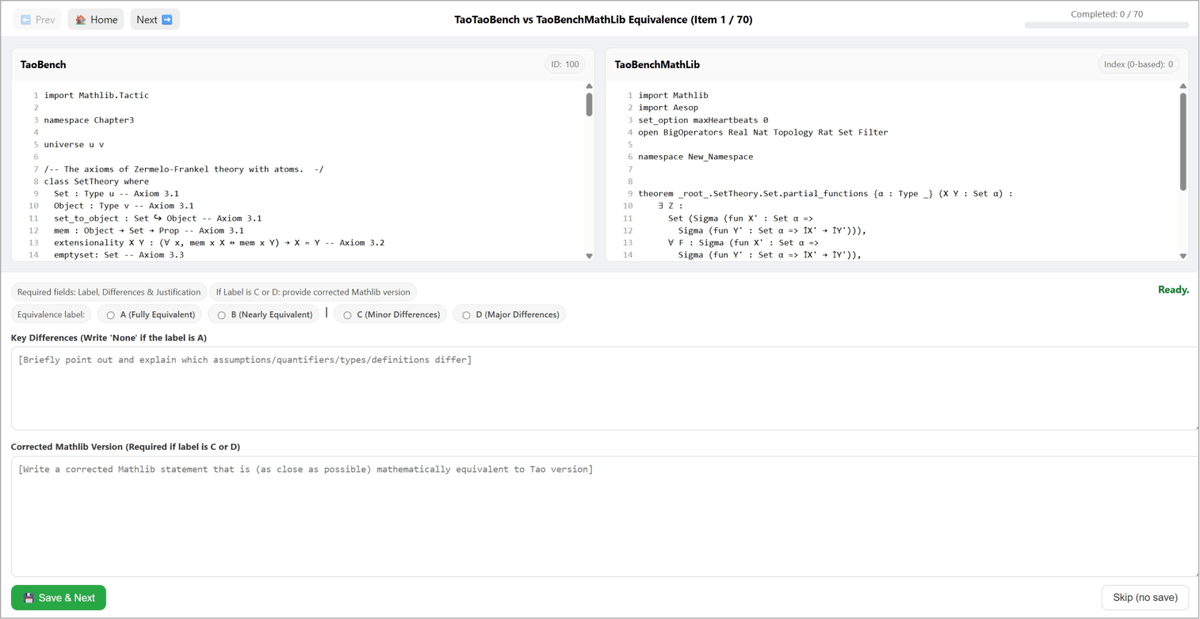
The team constructed 150 exercises spanning ten chapters of Tao's text, then produced a paired MathLib translation of each one. That pairing is the key methodological move. If a model does worse on the Tao version, you can attribute the drop to the definitional framework rather than to problem difficulty.

Extracting a compilable, self-contained Lean environment for each problem required some engineering. The authors built an agentic pipeline that uses the JiXia static analysis tool to recursively find all references a problem depends on, then hands those references to an agent equipped with a file lookup tool and the Lean compiler. The agent iterates until compilation succeeds. A separate pipeline uses GPT-5.1 with web search to rewrite each problem into MathLib syntax, followed by an equivalence check and expert human review.
Where provers stumble
Five open ATP models were evaluated at pass@128: DeepSeek-Prover-V2 (7B), Goedel-Prover-V2 (8B and 32B), and Kimina-Prover (8B). The gap is consistent across every model.
| Model | TaoBench | TaoBenchMathLib |
|---|---|---|
| DeepSeek-Prover-V2-7B | 41.33% | 69.33% |
| Goedel-Prover-V2-8B | 37.33% | 70.67% |
| Goedel-Prover-V2-32B | 49.33% | 72.67% |
| Kimina-Prover-8B | 22.00% | 50.00% |
While state-of-the-art ATP models perform capably within the MathLib framework, performance drops by an average of roughly 26% on the definitionally equivalent Tao formulation. Scaling helps modestly, with Goedel's 32B version gaining 12 points over the 8B on TaoBench versus only 2 points on the MathLib side. But even the largest model tested cannot close the gap.
Context makes it worse, not better
The more interesting finding is what happens as you add local definitions to the prompt. The authors bucketed problems by how many bespoke definitions each one requires. On the MathLib side, average pass@128 decays gently from about 68% at zero local definitions to 53% at ten or more. On the Tao side, it collapses from 67% down to 6.37%.

Even more telling, removing the local context from Tao problems only causes a modest performance drop, and manual review showed that models sometimes solve context-free problems by silently substituting MathLib constructions that bypass the intended exercise. In other words, current provers are not reliably reading the definitions you give them, they are pattern matching to what they saw in training.
Frontier models tell a different story
The authors also ran GPT-5.1, Gemini 3 Pro, and DeepSeek-V3.2 at pass@8. General purpose frontier models underperform the specialized provers on MathLib problems, which is expected. But on the Tao formulations, they hold up better relative to their MathLib scores, suggesting they are more flexible at integrating unfamiliar in-context definitions even if their raw proving ability is weaker. GPT-5.1 hits 52% on TaoBench, edging out Goedel-32B.
Why this matters for practitioners
If you are considering plugging a Lean prover into a research codebase, this benchmark is a warning that headline pass rates on MiniF2F or PutnamBench do not predict robustness inside your own definitional world. A few practical takeaways:
- Specialized provers are fine tuned to a specific formal ecosystem, and fine tuning does not transfer well to unseen frameworks.
- Adding local definitions to the prompt is not a free performance boost, it can actively hurt provers that were not trained to consume them.
- General purpose reasoning models may be a better starting point for exploratory formalization projects that live outside MathLib.
- Set theory problems in Chapter 3 showed the biggest gaps, up to 58 points, while chapters closer to standard analysis showed smaller or occasionally reversed deltas.
The benchmark, the paired MathLib translations, and both extraction pipelines are positioned as tools for future work on provers that can actually keep up with the way mathematicians write proofs when they are building something new.