
Taiwan University's TASTE-Streaming Cuts Voice AI Latency by 40x
A CTC-based ASR module and causal unit decoder cut encoding latency by 50x while matching offline speech tokenization quality.
 Pro
Takeaways
- TASTE-S adds streaming to text-aligned speech tokenization by embedding a CTC-based ASR module into the encoder.
- Encoding RTF drops from 0.117 to 0.002; decoding RTF from 0.414 to 0.076 versus offline TASTE.
- First chunk latency on long-form audio falls from 12.29 seconds to about 0.31 seconds.
- Reconstruction quality matches or beats the original TASTE, with 4.1% WER and 0.88 speaker similarity.
- Uses Whisper and CosyVoice 2 initializations, FSQ quantization, and a two-stage bi-stage training recipe.
- Audio samples available at the TASTE-S demo page; trained in a day on 2 H100 GPUs.
Voice assistants that combine speech and text in a single language model face a stubborn engineering problem: raw speech tokens run at dozens of frames per second, while text tokens arrive at maybe three per second. That mismatch forces awkward workarounds during joint training. A framework called TASTE solved the length problem last year by producing speech tokens that align one-to-one with their text counterparts, but it relied on an offline ASR system and a non-causal decoder that made streaming impossible. A new paper from National Taiwan University, TASTE-Streaming, closes that gap.
The length-mismatch tax on spoken LLMs
Conventional speech units are typically much finer-grained and longer than text tokens, leading to a significant length discrepancy. Prior joint text-speech models papered over this with padding, interleaving, or multi-channel modeling, all of which add complexity. The TASTE framework addressed this by mitigating the length mismatch issue at the tokenization stage, producing tokens aligned with the transcript.
The catch: the original TASTE framework suffers from a critical drawback: latency. Because the alignment process was primarily designed for offline processing, it remains unsuitable for the always-on, instant-response requirements of real-world conversational AI. It also depended on an external ASR pass before tokenization could even begin.
Building the ASR inside the tokenizer
TASTE-S makes three architectural changes. First, it internalizes the ASR by attaching a lightweight Connectionist Temporal Classification (CTC) decoder to the speech encoder, facilitating immediate text token extraction. CTC is a training objective that lets a model emit text symbols from audio frames without needing frame-by-frame labels, and it runs in a single forward pass rather than autoregressively.
Second, the unit decoder is rebuilt to be fully causal. The Unit_decoder adopts a streamable pattern during training by interleaving the text-aligned tokens with the target units by a predefined N:M ratio, and the non-causal vocoder is swapped for a causal version borrowed from CosyVoice 2. The result is chunk-by-chunk generation instead of waiting for the full utterance.
Third, a two-stage training recipe stabilizes things. In Stage I the CTC head trains independently while the aggregator and unit decoder see oracle transcripts. In Stage II everything runs end-to-end using the CTC predictions the encoder actually produces, closing the loop between the built-in ASR and the reconstruction path.
The setup and the numbers
The system is initialized from Whisper (for the ASR encoder, CTC decoder, and aggregator) and CosyVoice 2 (for the unit decoder and vocoder). Training data is roughly a random English subset of Emilia (~400 hours) and the full training set from LibriTTS (~600 hours), and the whole bi-stage training takes around one day to finish on 2 NVIDIA H100 GPUs. Evaluation uses LibriSpeech test-clean.
On reconstruction quality, TASTE-S essentially matches its offline predecessor: TASTE-S achieves superior WER (4.2% vs. 4.5%) and speaker similarity (0.86 vs. 0.80) at a comparable bitrate. The bigger story is speed. Encoding real-time factor drops from 0.117 to 0.002, and decoding RTF drops from 0.414 to 0.076. On long-form audio the difference is stark:
| Method | WER | RTF | First Chunk Latency |
|---|---|---|---|
| TASTE (offline, 30s window) | 4.2% | 0.439 | 12.29s |
| TASTE-S (built-in CTC, 15s) | 4.6% | 0.088 | 0.312s |
| TASTE-S (built-in CTC, 30s) | 4.5% | 0.081 | 0.311s |
That is a roughly 40x reduction in the wall-clock time before the first audio chunk comes out, which is what actually determines whether an interface feels conversational.
What is actually novel here
Beyond the latency headline, a few details are worth flagging:
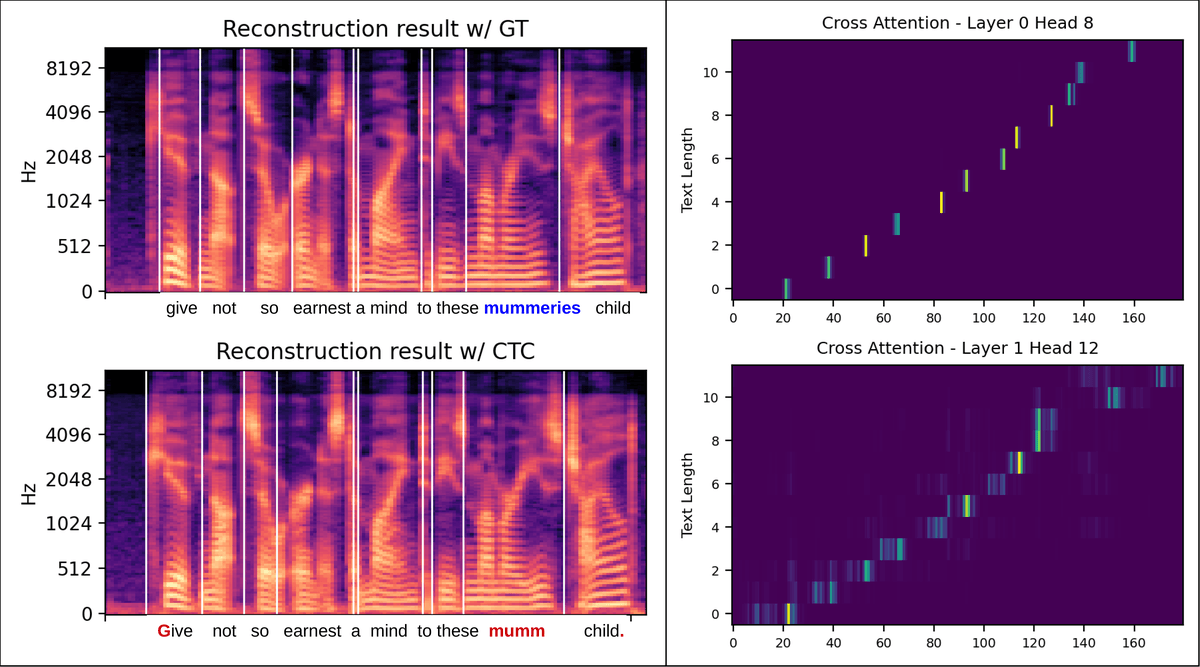
- Robustness to imperfect transcripts. Even when the built-in CTC gets words wrong, the reconstructed spectrograms are almost identical, indicating that the tokenization and reconstruction are robust to imperfect or different transcripts. Swapping in an external ASR at inference time still works.
- FSQ instead of VQ. The team uses Finite Scalar Quantization, which enables high utilization without the need for an explicit codebook, allowing TASTE-S to maintain high reconstruction fidelity with more compact latent. TASTE-S uses embedding dimension 32 or 64 versus TASTE's 256.
- Long-form works. Chunked encoding at 10-30 second windows produces average length deviations under 1% on 3-4 minute concatenated clips.
Availability and caveats
Audio samples are posted at the project demo page. The paper does not link to a public code release for TASTE-S itself, though the original TASTE codebase from MediaTek Research is open source and provides the framework this work extends.
The obvious limitation is scope. Experiments are English-only, and reconstruction quality still lags BigCodec on most metrics, though BigCodec emits tokens at 80 Hz, which makes downstream LLM modeling prohibitively slow. For anyone building a joint text-speech LLM where the tokenizer needs to feed an autoregressive model in real time, this is the tradeoff the paper is targeting, and the numbers suggest it is close to a solved problem at the tokenization layer.