
Taiwan's Multi-Agent RL Framework Cuts City Traffic Waiting by 10%
A multi-agent RL framework for real-world traffic lights uses turning-ratio randomization and exponential adjustments to cut waiting time by over 10 percent.
 Pro
Takeaways
- New MARL framework for traffic signals cuts average waiting time over 10% versus RL baselines in Vissim tests.
- Turning Ratio Randomization prevents agents from memorizing static timing patterns during training.
- Exponential phase adjustment {0, ±1, ±2, ±4, ±8}s balances fine tuning and rapid congestion response.
- Neighbor-level MAPPO with CTDE nearly matches global-observation performance while keeping state size constant.
- Tested on a calibrated digital twin of five intersections on Zhongzheng East Road, Taoyuan City.
- Randomized neighbor agent hits 124.37s off-peak travel time versus 126.57s for MaxPressure heuristic.
Reinforcement learning has been promising a fix for city traffic lights for years, but the models keep falling apart the moment real traffic stops behaving like the training set. A new paper from National Yang Ming Chiao Tung University, Academia Sinica, and ELAN Microelectronics tackles that gap head-on with a multi-agent RL framework tested on a calibrated digital twin of a Taiwanese arterial road, and it manages to shave average waiting time by more than 10 percent while staying compatible with how human drivers actually expect signals to behave.
Why signal-control RL keeps breaking in the wild
Congestion is expensive. According to the INRIX traffic report in 2025, traffic congestion costs the U.S. economy over $85 billion, an 11.3% increase from the previous year. Traditional fixed-time and rule-based controllers cannot keep up with stochastic demand, and deep RL should in principle handle that. The catch is that most published RL controllers are trained and tested on the same static traffic distribution, so they end up memorizing a schedule instead of learning to read the road.
The authors identify three specific failure modes that block deployment:
- Overfitting to static patterns. Agents tend to memorize specific timing patterns rather than learning the underlying traffic dynamics, so they struggle to generalize and often need separate policies for peak versus off-peak periods.
- Driver-hostile action spaces. Acyclic phase selection breaks the fixed green-yellow-red order drivers rely on, while binary switching causes signals to flicker unpredictably.
- Scalability vs. coordination. Global observations do not scale beyond small grids, and purely local observations cannot form green waves.
Three mechanisms, one framework
The proposal, built on the Vissim microscopic simulator via the authors' earlier VissimRL interface, combines three ideas that each target one of those failures.

Turning Ratio Randomization. At the start of each training episode, the turning probabilities at every approach get perturbed with multiplicative noise sampled from a uniform distribution, then re-normalized so they still sum to one. Because the noise is multiplicative rather than additive, dominant flows are not distorted disproportionately. Traffic volume is deliberately left alone, since volume fluctuations cause reward magnitudes to shift independent of policy quality, generating misleading signals that can destabilize learning.
Exponential Phase Duration Adjustment. Instead of the usual linear step set like {0, plus or minus 3, plus or minus 6}, the agent picks from an exponential set {0, ±1, ±2, ±4, ±8} seconds (with base 2). Small steps handle steady-state fine tuning without oscillation, while the larger 8-second jumps can absorb a sudden queue in a single cycle. The phase order stays cyclic, so drivers never see a surprise sequence.
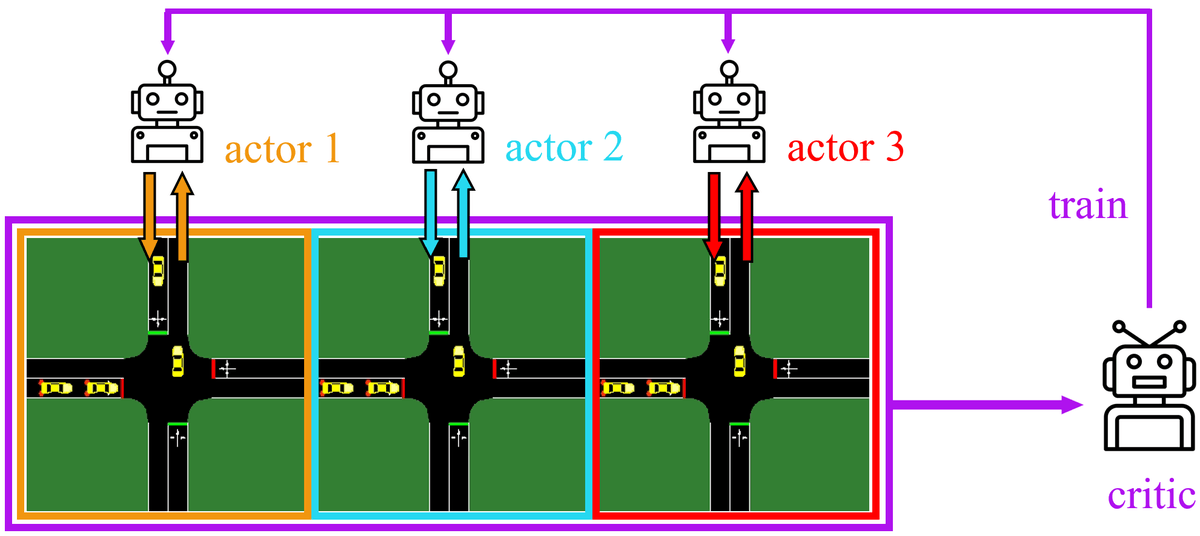
Neighbor-level MAPPO with CTDE. Each intersection is an agent whose observation is its own state plus the local states of its directly connected upstream and downstream neighbors. The critic sees the whole network during training, but at inference each actor only needs neighbor communication. This keeps the observation dimension constant regardless of network size, avoiding the complexity of O(|N| × |O_local|) that a truly global observation would incur.
The numbers
The testbed is a digital twin of five consecutive intersections on Zhongzheng East Road in Taoyuan City, with real 24-hour detector data split into a peak hour (~4800 veh/hr) for training and an off-peak hour (~1800 veh/hr) held out for evaluation.
On the peak scenario, the neighbor-observation model trained with randomization hits 230.58 seconds average travel time versus 265.79 for the MaxPressure heuristic and 383.92 for the fixed-time plan. The generalization test is where the story gets interesting: standard RL agents trained on static ratios actually do worse than the heuristics off-peak, while the randomized neighbor agent drops travel time to 124.37 seconds, essentially matching a full global-view agent (119.32 seconds).
The ablations back up each component. Swapping MAPPO for the decentralized IPPO baseline pushes peak travel time from 230.58 up to 298.43 seconds. Replacing the exponential action set with a matched-size linear set {0, ±5, ±10, ±15, ±20} works in peak conditions but blows up off-peak, hitting 144.96 seconds instead of 124.37.

What it is good for, and what it is not
The framework is aimed squarely at deployable arterial control where safety-critical cyclic sequencing is non-negotiable. That is a real gap: most academic TSC work uses SUMO or CityFlow and acyclic action spaces that traffic engineers will not accept.
Practical caveats worth flagging:
- Only four-wheeled vehicles are modeled. Pedestrians, cyclists, and public transit priority are out of scope.
- Evaluation is on a five-intersection arterial, not a full grid. The authors explicitly list grid networks as future work.
- Turning-ratio randomization improves robustness to turning-mix shifts, not to demand surges beyond training volume.
- No public code release is mentioned in the paper. The underlying VissimRL environment interface is described in a companion paper, and Vissim itself is commercial software.
The broader signal here is architectural. Domain randomization plus a properly shaped, driver-legal action space plus CTDE turns out to be enough to close most of the gap between local and global observation, without any exotic graph-attention machinery. For anyone working on cooperative multi-agent control in physical infrastructure, that recipe is worth borrowing.